Beginner Foundations of Trading: Structure, Risk, and Process / Module 0: Final Assessment Lesson 22 of 22
Course Outline — Lesson 22 of 22
M1 How Markets Work
1 L1.1 — What Is a Financial Market? 2 L1.2 — Who Is Really in the Market? 3 L1.3 — How to Read a Candlestick Chart
M2 Reading Market Structure
1 L2.1 — Swing Highs, Swing Lows, and How to Identify Them 2 L2.2 — Trend Structure: Uptrends, Downtrends, and How to Confirm Them 3 L2.3 — Break of Structure and Change of Character
M3 Key Levels and Price Zones
1 L3.1 — Support and Resistance Zones (Not Lines) 2 L3.2 — Psychological Levels and Round Numbers 3 L3.3 — Previous Session Highs and Lows as Reference Points
M4 Sessions, Timeframes and Analysis
1 L4.1 — Session Times and Why They Matter 2 L4.2 — Timeframe Selection: What Each Timeframe Is For 3 L4.3 — Top-Down Analysis: Building a Bias Before You Touch the Chart
M5 XAUUSD and Gold Trading
1 L5.1 — XAUUSD Fundamentals: What Drives Gold Price 2 L5.2 — Reading Structure and Sessions on Gold Charts
M6 Risk Management Fundamentals
1 L6.1 — The Maths of Risk: Why Percentages Matter More Than Pips 2 L6.2 — Stop-Loss Placement: Structure-Based Stops vs Arbitrary Stops 3 L6.3 — Position Sizing: How to Calculate Lot Size 4 L6.4 — Building Your Personal Risk Framework
M7 Process, Psychology and Journals
1 L7.1 — The Most Common Psychological Traps 2 L7.2 — Building a Rules-Based Process: Your Trading Plan 3 L7.3 — The Trading Journal: Your Most Powerful Tool
✓ Final Assessment
1 Course Completion — Final Assessment
Lesson 22 of 22 Quiz

Course Completion — Final Assessment

Congratulations on reaching the end of Foundations of Trading: Structure, Risk, and Process.

This final assessment tests your understanding across all seven modules. Ten questions — one or two per module — covering the core concepts you have studied.
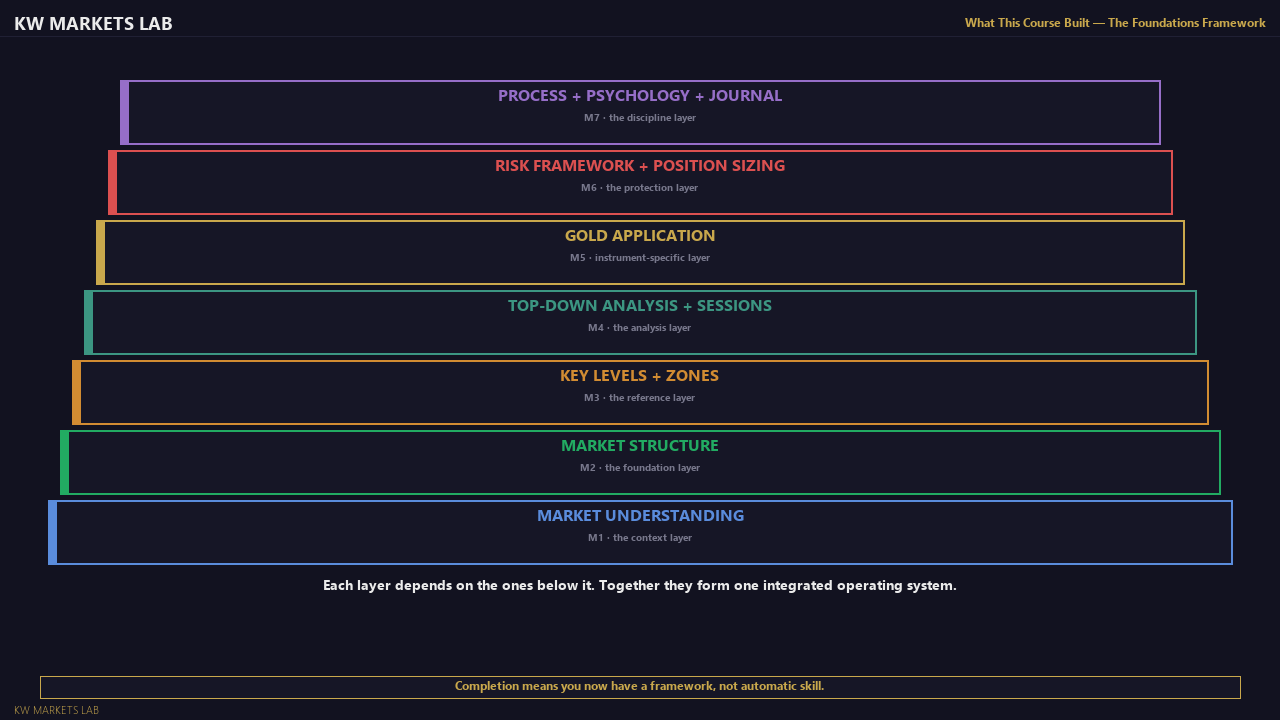
What This Course Built: The Foundations Framework
What This Course Built: The Foundations FrameworkCompletion means you now have a framework, not automatic skill.

Before You Begin

Work through the questions without referring to your notes first. Then review your answers against the explanations. Incorrect answers are not failures — they are the most useful diagnostic tool you have. Note which modules produced the most errors and return to those lessons.


Course Completion Checklist

After the assessment, use this self-evaluation to confirm you have the working tools in place:

  • I can explain what price represents and name the main categories of market participant (M1)
  • I can identify swing highs and lows, classify a trend, and recognise BOS and CHOCH on any chart (M2)
  • I can draw support and resistance zones correctly, identify role reversal, and explain psychological levels and session reference points (M3)
  • I can complete a full top-down analysis (Daily → H4 → H1 → M15) and produce a written pre-session plan (M4)
  • I can apply the full framework to XAUUSD and run a pre-trade fundamental check before each gold trade (M5)
  • I can calculate dollar risk, place a structure-based stop, and calculate lot size for forex and gold. I have a completed personal risk framework document. (M6)
  • I have a completed trading plan and a trading journal set up and ready to use (M7)
  • I can name the six psychological traps and identify my dominant patterns from observation (M7)
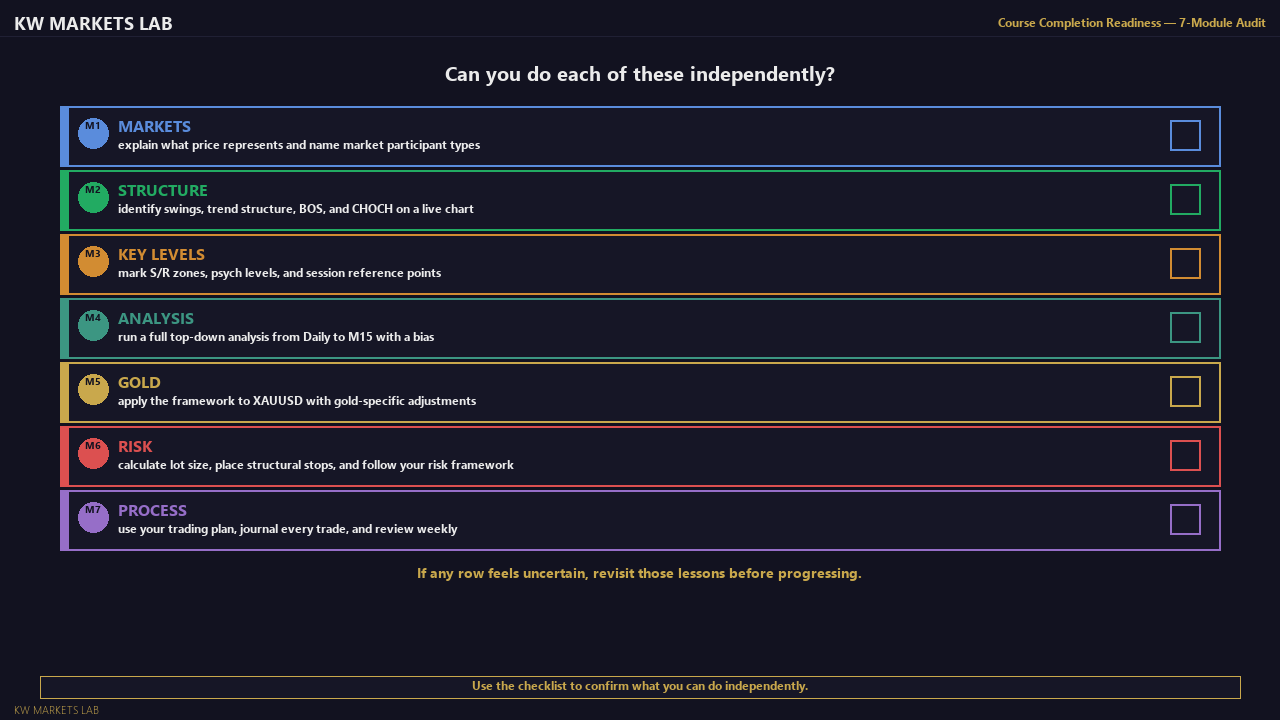
Course Completion Readiness: 7-Module Audit
Course Completion Readiness: 7-Module AuditUse the checklist to confirm what you can do independently.

What Comes Next

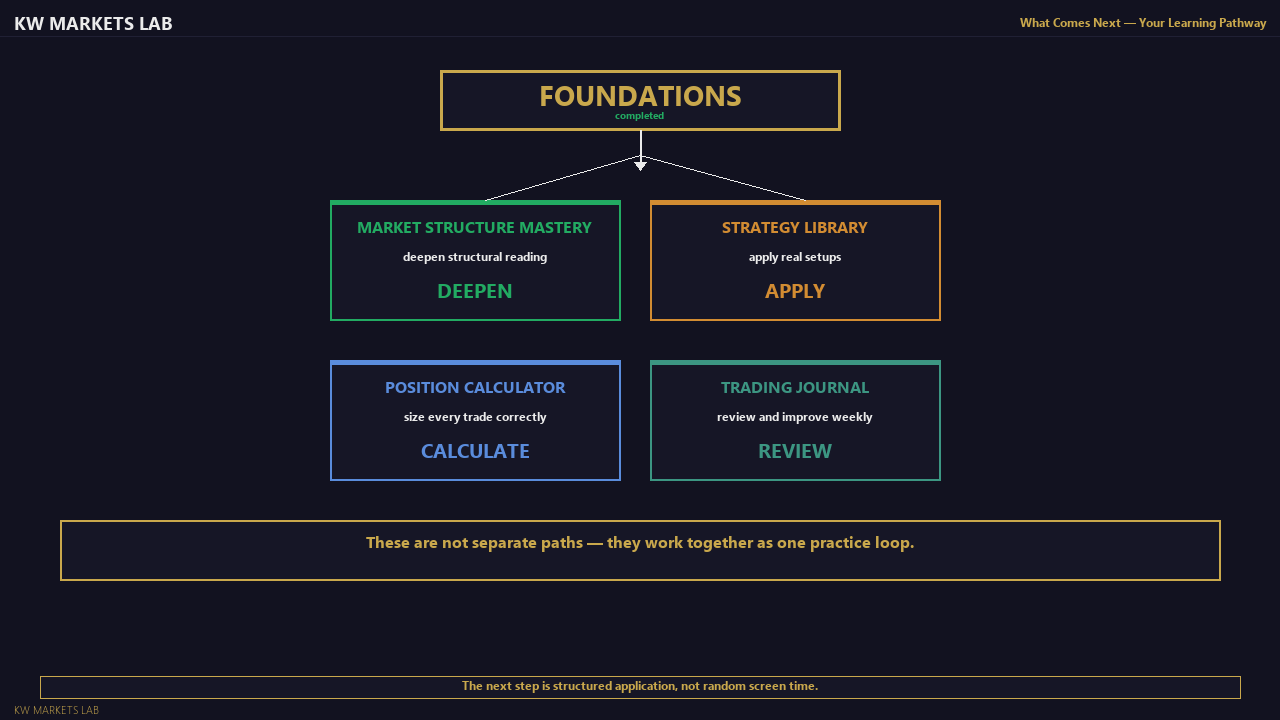
What Comes Next: Your Learning Pathway
What Comes Next: Your Learning PathwayThe next step is structured application, not random screen time.

Completing this course gives you a documented framework. The journal, the weekly review, and consistent documented practice are what turn that framework into skill. No course replaces screen time — but screen time without a framework produces very slow progress.
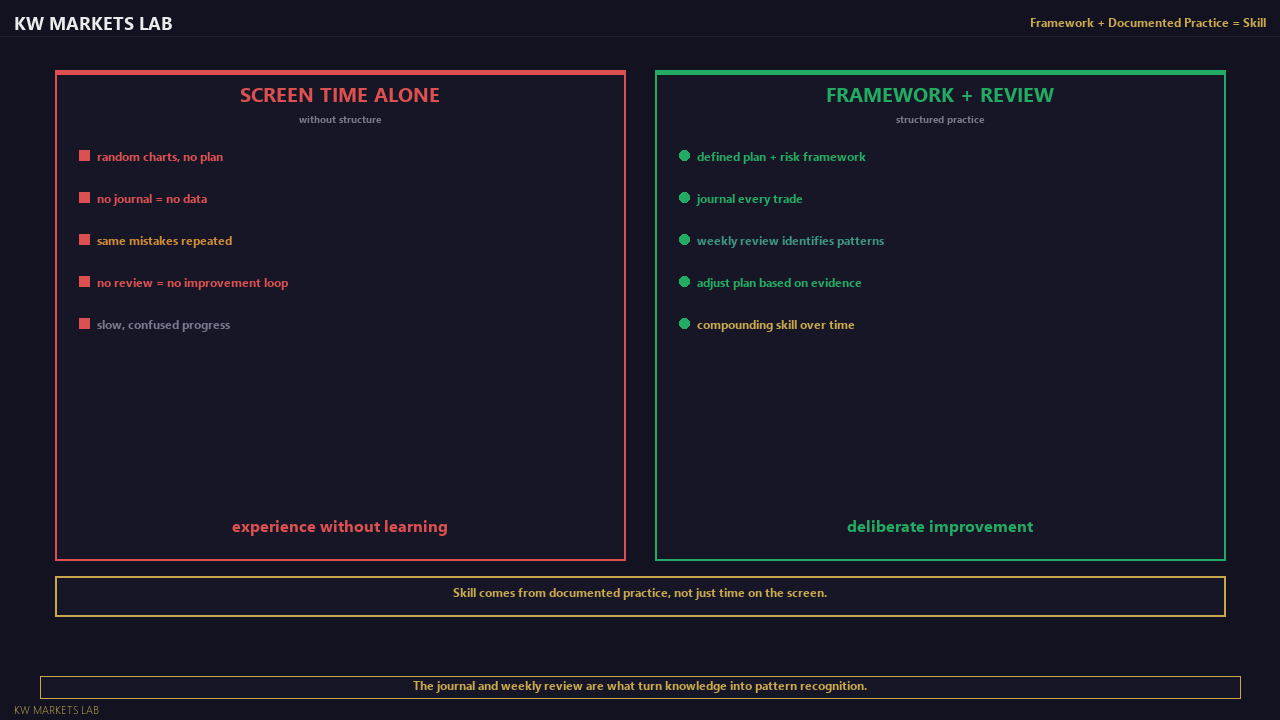
Framework + Documented Practice = Skill
Framework + Documented Practice = SkillThe journal and weekly review are what turn knowledge into pattern recognition.

Apply the framework. Log every trade. Review weekly. Adjust only what the data tells you to adjust.
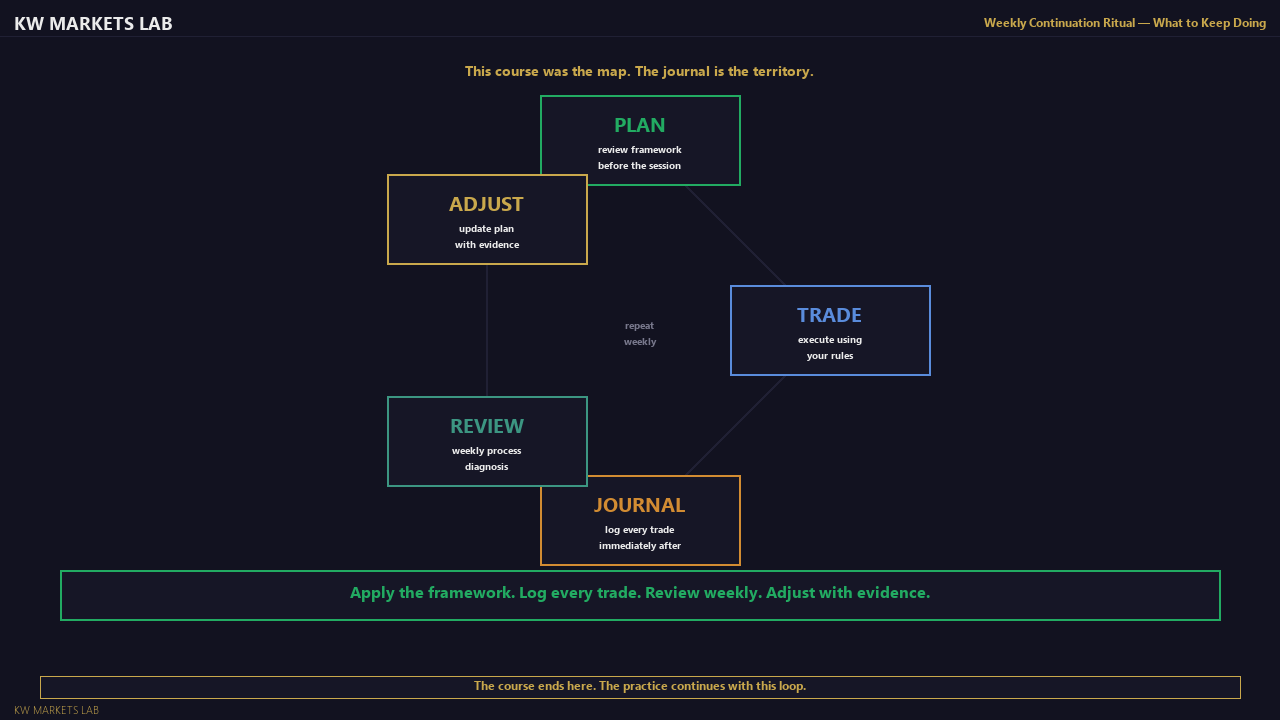
Weekly Continuation Ritual
Weekly Continuation RitualThe course ends here. The practice continues with this loop.
Course Complete — Next in Path
Master multi-timeframe structure, internal vs external swing →
Stay Updated

Get notified when new lessons and content are published.

Foundations of Trading: Structure, Risk, and Process
🔒 Progress locked
Login to save your lesson progress.
Login to Track
Stay Updated

Get notified when new lessons and content are published.