Course Outline — Lesson 20 of 22 ▼
L7.2 — Building a Rules-Based Process: Your Trading Plan
Building a Rules-Based Process: Your Trading Plan
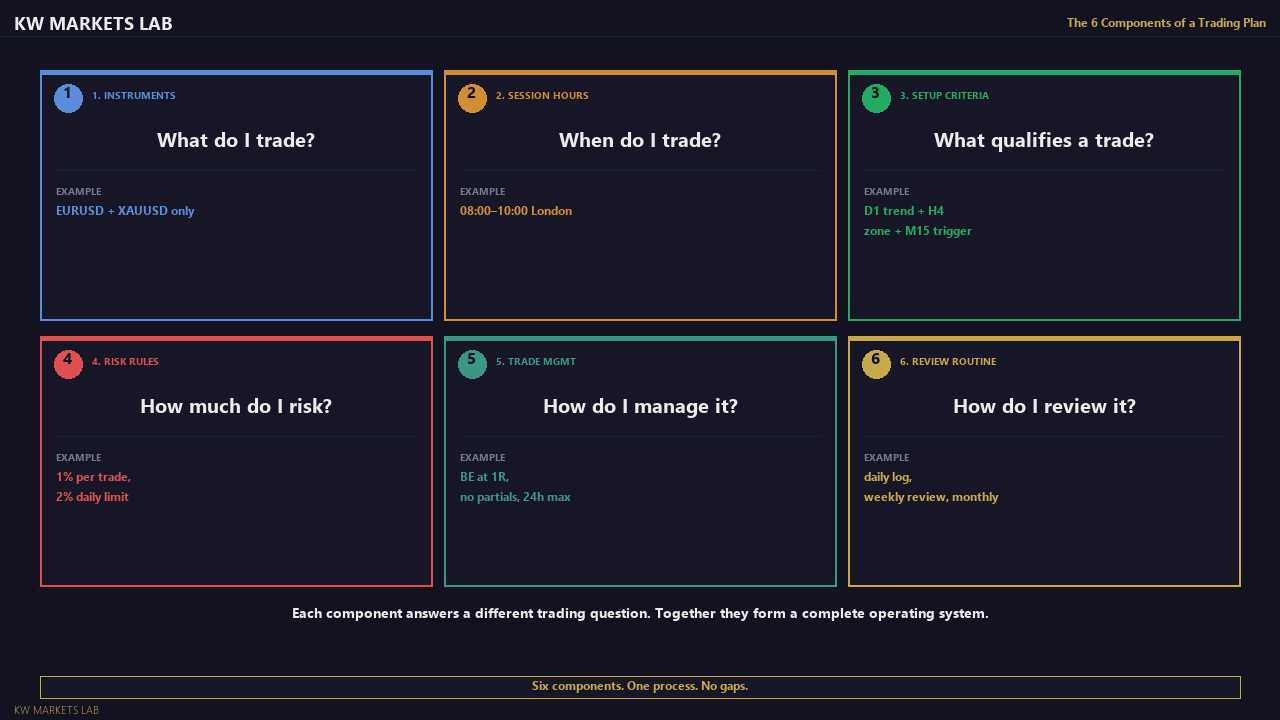
A trading plan is the written specification of how you trade. It contains your market selection, your session focus, your setup criteria, your risk rules, and your review process. It is the document that answers the question "what am I doing and why?" before you sit down at the charts on any given day.
Without one, every trading session begins with a blank slate — no defined parameters, no documented criteria, no consistent reference point. Consistency cannot exist without a specification to be consistent against.
This lesson explains what a trading plan contains, how each section should be written, and — critically — what makes a trading plan a living document rather than a one-time exercise that gets filed and forgotten.
What a Trading Plan Is Not
Before defining what a trading plan contains, it is worth clearing up two common misconceptions.
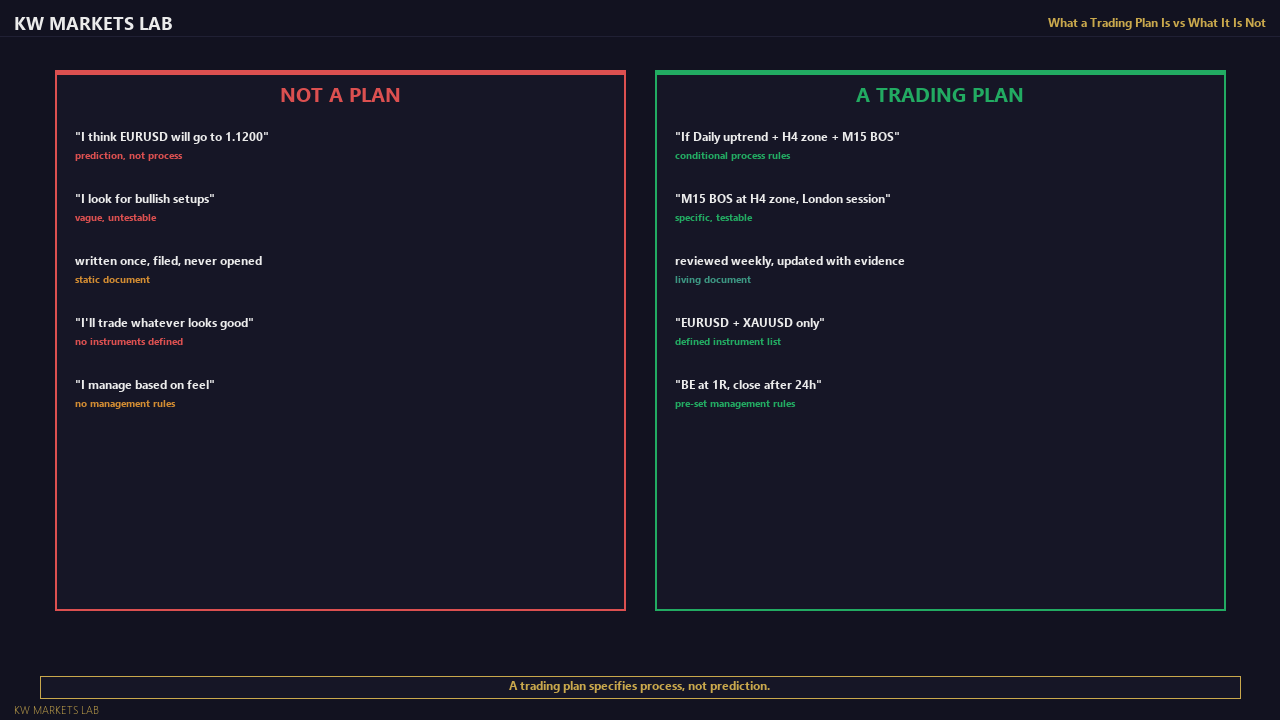
A trading plan is not a prediction document. It does not say "I think EURUSD will go to 1.1200 this month." It says "If X structural conditions are present on the Daily chart and Y trigger forms on the M15 chart, I will take a long trade with a stop below Z and a target at W." The plan specifies process, not outcome.
A trading plan is not a one-time exercise. A plan written in January and never reviewed is not a trading plan — it is a document. A trading plan is reviewed regularly, updated when the strategy is refined, and referenced before every session. It is a working tool.
The Six Components of a Trading Plan
1. Instruments and Markets
Specify exactly which instruments you will trade. Not "forex" — which pairs. Not "commodities" — specifically XAUUSD. Not "indices" — specifically US500 or UK100.
Why specificity matters: each instrument has different session characteristics, spread profiles, volatility ranges, and fundamental drivers. Attempting to trade all instruments with a single set of rules produces inconsistency. A plan built around EURUSD and XAUUSD, studied and practised, is worth far more than vague coverage of twenty instruments you watch casually.
Recommended starting point for beginners: one to two instruments. Typically one major forex pair (EURUSD or GBPUSD) and optionally XAUUSD if gold is your primary interest. Expand as you build competence in reading each instrument's specific behaviour.
Document it as: "I trade: [list specific instruments]. I do not trade instruments outside this list without updating this plan first."
2. Session Hours
Specify when you will place new trades. Connect this directly to the session analysis from Module 4.
This section should be brutally specific:
- The sessions you will trade (London, New York, overlap)
- The local times those sessions correspond to, adjusted for your timezone
- Any exceptions (e.g., "I will not trade within 30 minutes of a major data release")
- Hard cut-off: a time after which no new positions are opened
Why a hard cut-off? Trading decisions made late in the day — when the trader is tired, when session liquidity is thin, when the impulsive moves of the day have already resolved — are statistically lower quality. The cut-off removes the temptation.
Document it as: "I place new trades only between [time] and [time] local / [time] and [time] London. No new positions after [cut-off time]."
3. Setup Criteria — The Entry Specification
This is the core of the trading plan. It defines, in specific and testable terms, what must be present for a trade to be valid.
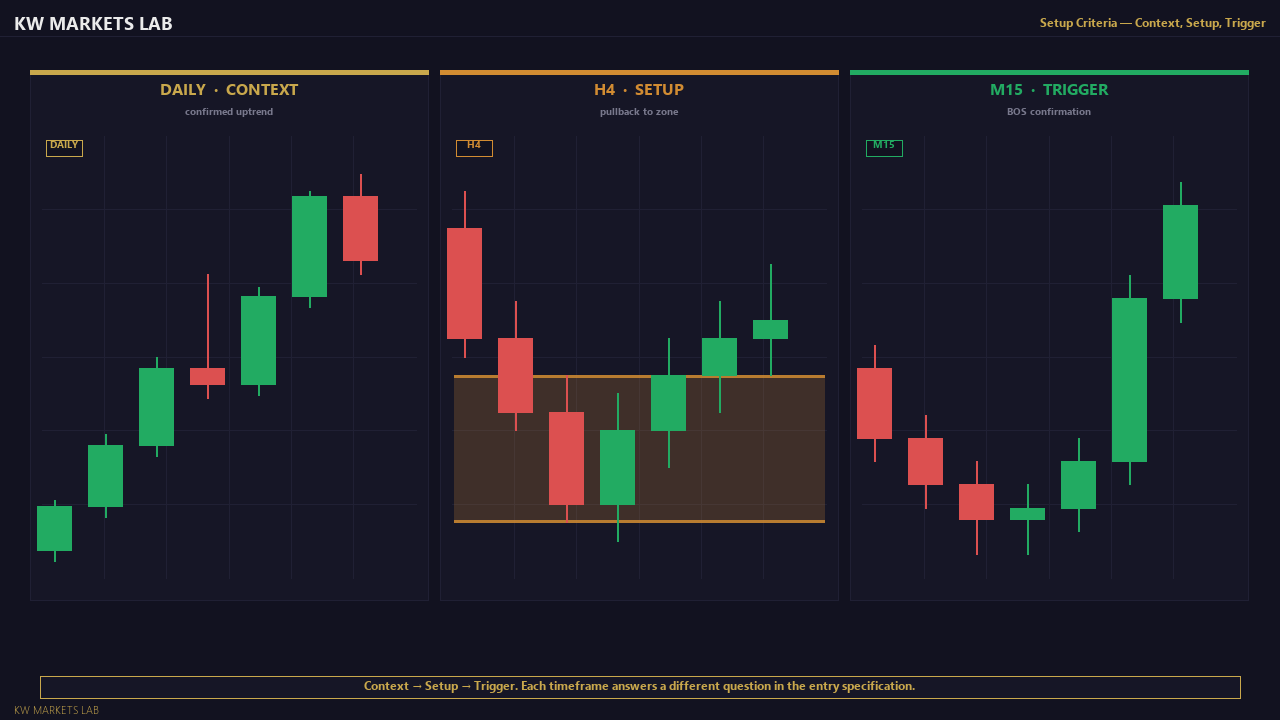
A complete entry specification has three parts, derived from the top-down analysis framework in Module 4:
Context (higher timeframe conditions required):
What must the Daily chart show? "Daily chart is in a confirmed uptrend (HH/HL sequence visible). Price has pulled back to a Daily support zone or PDH/PDL reference level."
Setup (H4–H1 conditions that confirm the entry zone):
"H4 swing structure is aligned with Daily trend or showing a CHOCH that signals the pullback is ending. Entry zone is defined as the area between the last H4 HL and the prior H4 HH."
Trigger (M15 confirmation required before entry):
"A confirmed M15 BOS in the direction of the Daily trend, occurring within the entry zone defined at H4. Or: a rejection candle on M15 with a clear wick and body reversal at the entry zone."
Write this for your specific approach. If you currently only have one setup type, document that one. Do not document ten setups you plan to learn eventually — document the one you are actually executing. A plan built around one well-understood setup is more useful than a plan that catalogues every pattern you have ever seen.
4. Risk Rules
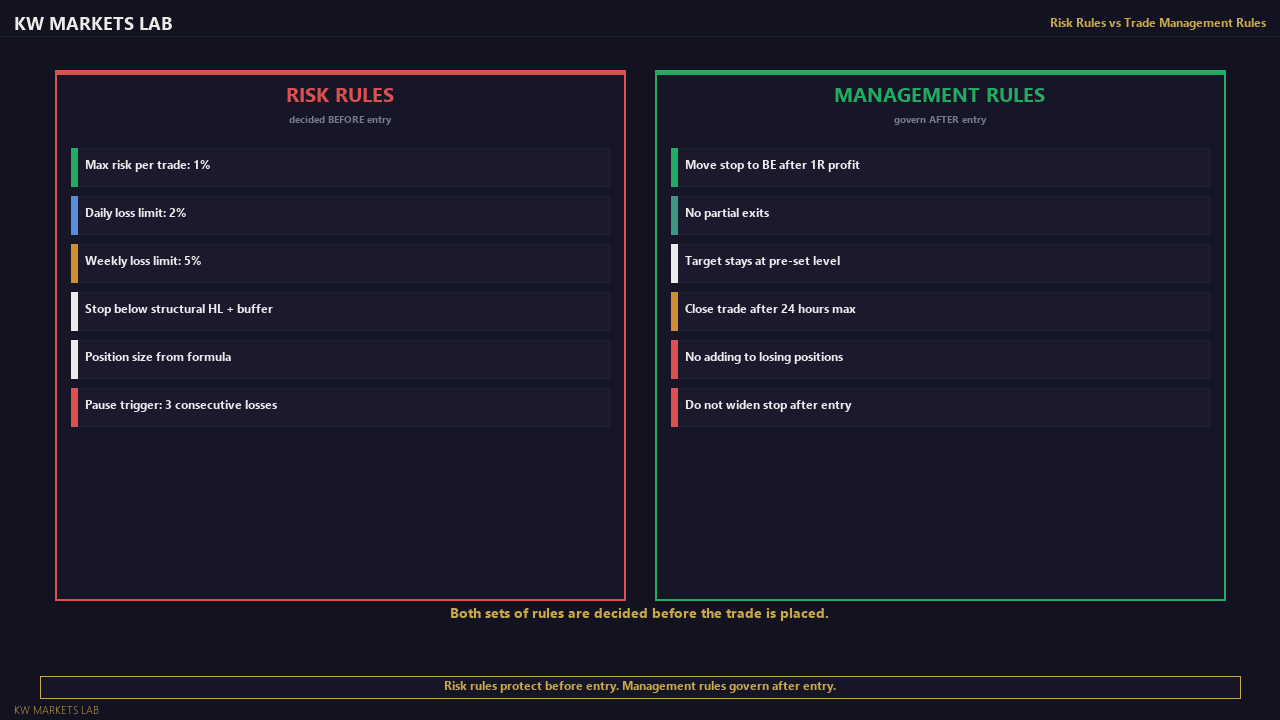
Reference your personal risk framework from L6.4 directly. Do not duplicate all the detail — link to it and confirm:
- Maximum risk per trade: [X]%
- Daily drawdown limit: [Y]%
- Weekly drawdown limit: [Z]%
- Stop placement rule: structure-based, behind the relevant swing point, with buffer
- Position sizing method: calculated formula (not estimated)
This section ensures that risk management is a built-in component of the plan, not an afterthought.
5. Trade Management Rules
Define what you do after entry. Pre-set rules for the period between entry and exit.
Questions to answer:
- Do you move the stop to breakeven? If yes, at what point? (e.g., "After price moves 1R in my favour, I move stop to breakeven.")
- Do you take partial profit? If yes, at what target? (e.g., "Take 50% off at 1R, let remaining run to 2R.")
- Do you trail the stop? If yes, by what method?
- Is your default to hold to target? (e.g., "No in-trade adjustments unless price reaches 1R profit or my defined rules for partial exit.")
There is no universally correct answer to these questions. The requirement is that your answers are written down and applied consistently. Changing trade management rules mid-trade based on how the trade looks in the moment is not management — it is improvisation. Improvisation produces inconsistent results that are impossible to evaluate.
6. Review Routine
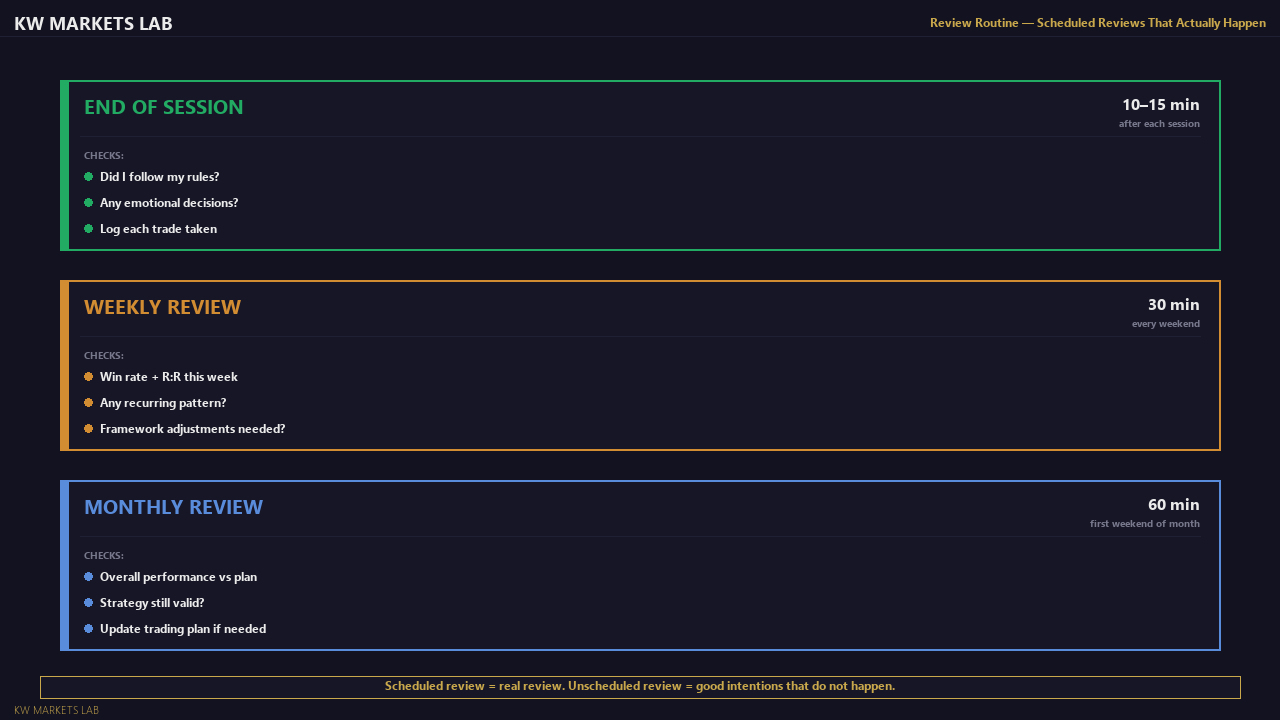
Specify your scheduled review cadence. At minimum:
- End of session review (10–15 minutes): What trades were taken? Did they follow the plan? Any rule breaks?
- Weekly review (30–45 minutes): What was the week's performance in R-terms? Were losses rule-following or rule-breaking? What patterns are emerging in the journal?
- Monthly review (60–90 minutes): Longer-term performance trends, setup win rate, average R:R achieved vs planned, any plan adjustments needed.
Document the scheduled day and time for each review. Reviews that are not scheduled do not happen.
Why a Trading Plan Is a Living Document
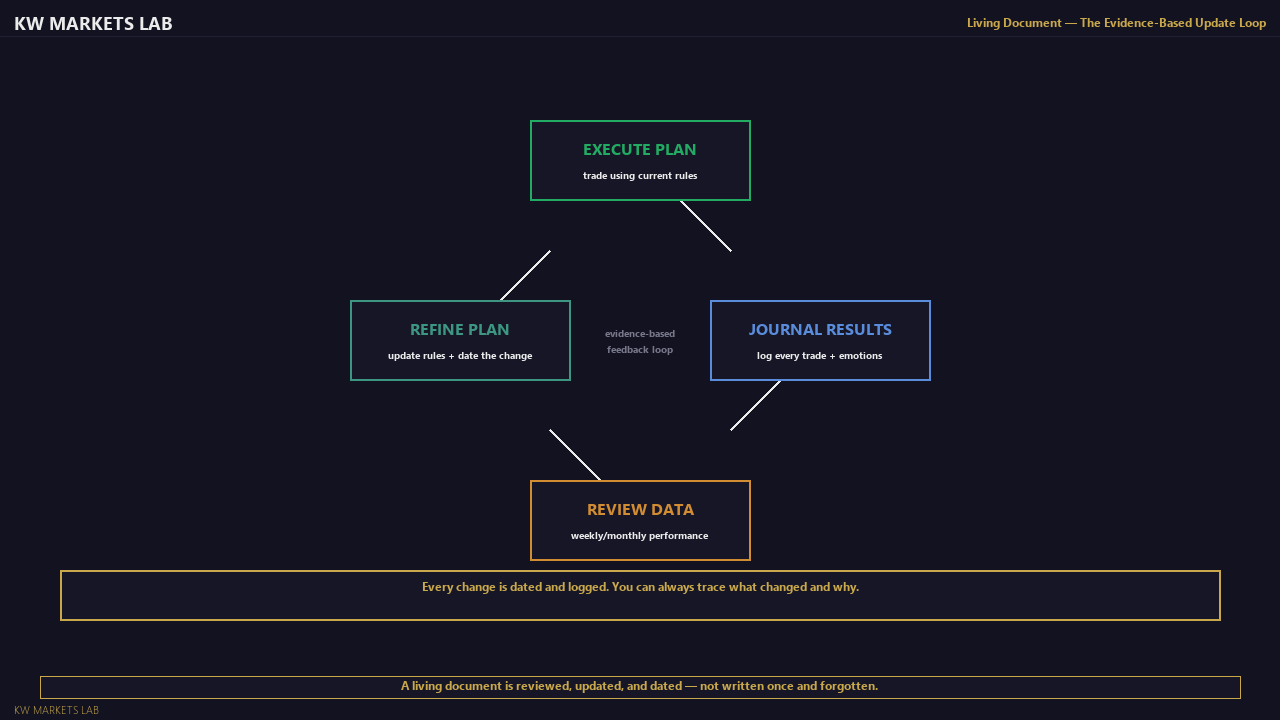
A plan written when you have two months of chart experience will not be the same plan you need with two years of chart experience. As your pattern recognition improves, as you build a statistical dataset from your journal, and as market conditions evolve, your plan must be updated to reflect what you have learned.
The difference between a living document and a static one is a review date. Every time you review the plan — weekly, monthly, or after a significant shift in performance — you should ask:
- Are the setup criteria still accurate? Have I refined my understanding of what constitutes a valid entry?
- Are the session hours still appropriate? Has my available time changed?
- Has my risk tolerance changed based on documented account performance?
- Is there anything in this plan I consistently fail to execute? Why?
Changes to the plan should be dated and logged. Knowing what you changed and when allows you to evaluate whether the change improved results.
Your Trading Plan Template
Worksheet M7a (included with this lesson) is the fillable trading plan template. Complete every section with your specific rules before you trade live. An imperfect plan you actually use is worth more than a perfect plan that stays in a folder.
What a Completed Section Looks Like: A Partial Filled Example
Abstract template sections are only useful once you can see what they look like filled in. Below is an example of Components 3 and 5 completed for a hypothetical trader who trades EURUSD and XAUUSD during the London session.
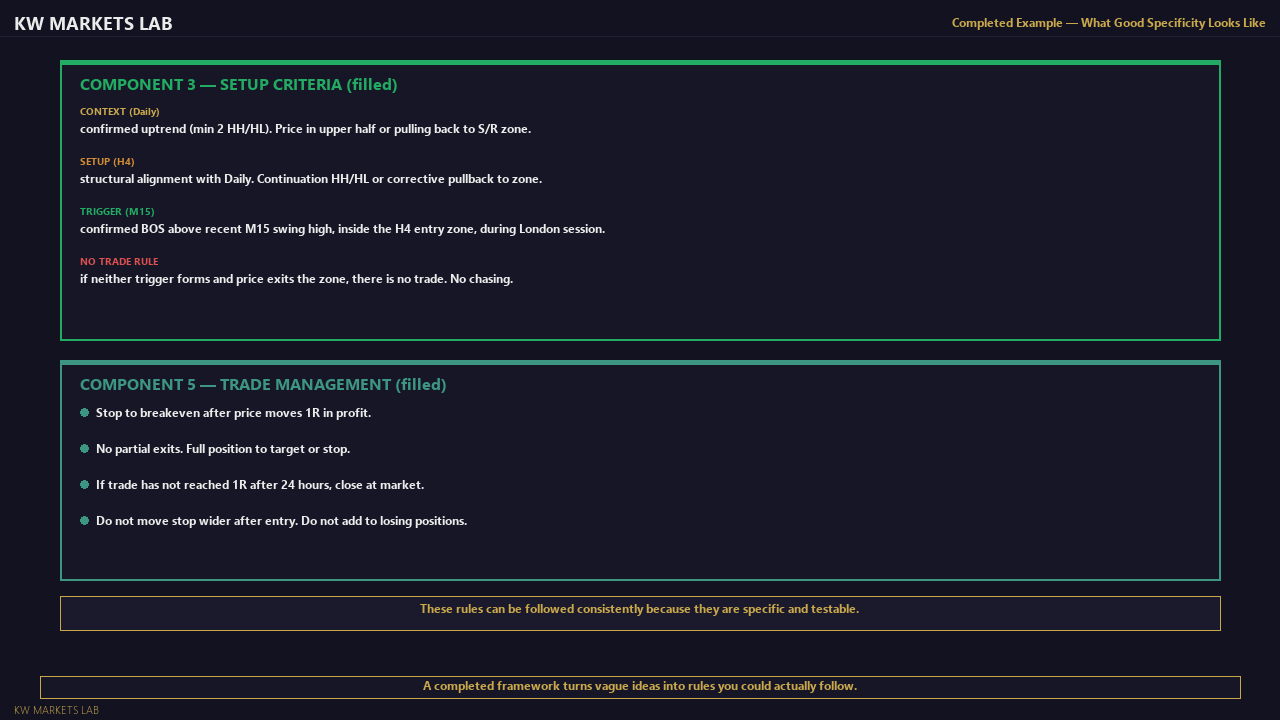
Component 3 — Setup Criteria (filled example)
Context (Daily chart conditions required):
The Daily chart must show a confirmed uptrend (minimum two HH/HL pairs clearly visible). Price must have pulled back from the most recent HH and be sitting within 20 pips of a identified Daily support zone or at the previous day's low (PDL). I do not take long setups if the Daily chart is ranging or if price is more than 50 pips above the nearest Daily structural support.
Setup (H4 conditions required):
The H4 chart must show structural alignment with the Daily bias: either a continued HH/HL sequence or a CHOCH from a corrective phase back toward the Daily trend. The H4 must be pulling back to the identified H4 HL zone. I define the entry zone as the area between the last H4 HL and the prior H4 HH.
Trigger (M15 entry required):
A confirmed M15 BOS above the most recent M15 swing high, occurring within the H4 entry zone. "Confirmed" means the M15 candle closes above the swing high — not wicks. OR: a rejection candle at the H4 HL with a clear wick into the zone and a body closing above the zone midpoint.
If neither trigger forms and price exits the entry zone, there is no trade. I do not chase price.
Component 5 — Trade Management Rules (filled example)
- I do not adjust my stop loss after entry except to move it to breakeven.
- I move stop to breakeven after price moves 1R in my favour. Not before.
- I do not take partial profit. My target is pre-set and I hold to target or stop. (Note: I reviewed this after 30 trades and found I was consistently cutting winners early. The "no partials" rule was added to fix this specific problem.)
- If price has not hit my target or stop within 24 hours of entry, I close the trade at market. Reason: I do not hold through the next London session without re-evaluating.
- I set my take profit order at the target level at the time of entry. It is entered into the platform before I close the trade window. This removes the temptation to manually close early.
Why specificity matters here
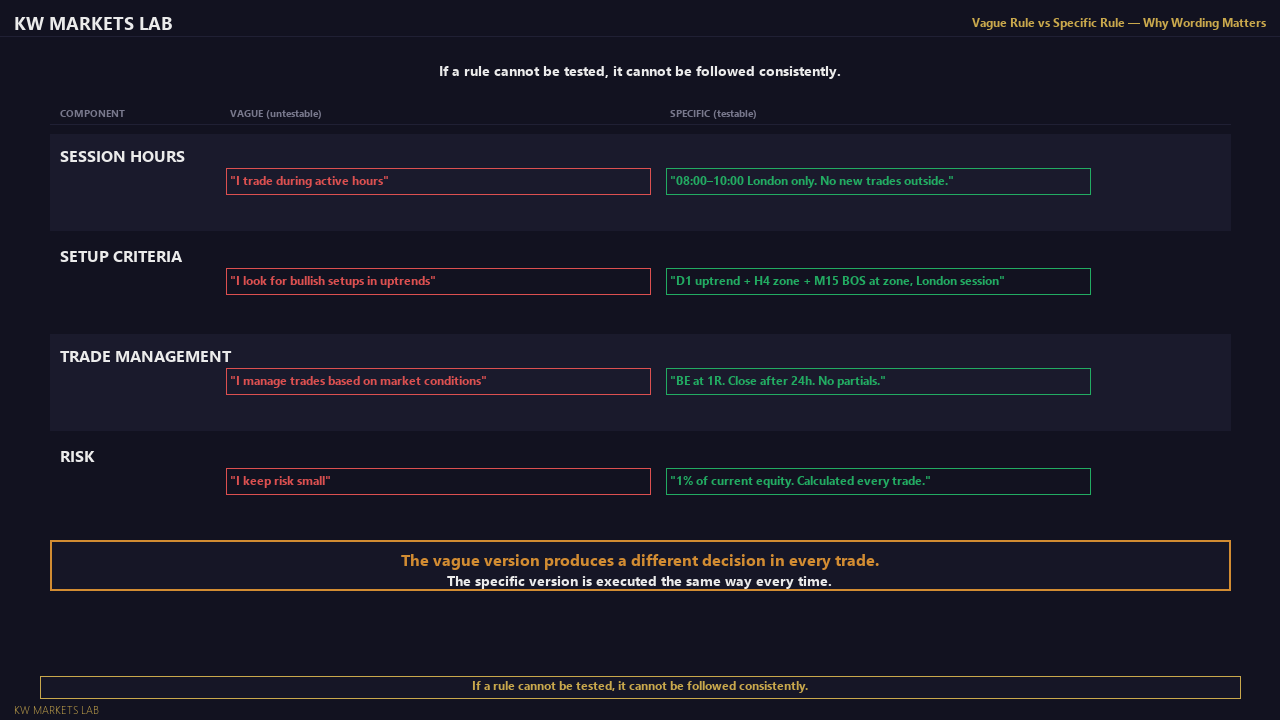
Compare these two versions of the same rule:
Vague: "I manage trades based on market conditions."
Specific: "I move stop to breakeven after 1R profit. I close if held more than 24 hours. No other adjustments."
The vague version produces a different decision in every trade. The specific version is executed the same way every time. Only the specific version gives you data you can evaluate.
Common Mistakes
Writing a plan once and never looking at it again.
A trading plan that is not referenced before each session is not being used. The review routine section of the plan exists to prevent this. If you never read your own rules, you are not trading with a plan — you are trading on habit and intuition.
Making the setup criteria too vague to be testable.
"I look for bullish setups in uptrends" is not criteria — it cannot be tested, back-checked, or evaluated. "A confirmed M15 BOS above the prior M15 swing high, within 20 pips of the H4 HL zone, with the Daily chart showing at least two HH/HL pairs" is testable criteria. Vague criteria produce variable execution and make performance evaluation impossible.
Writing the plan to describe ideal conditions, not actual conditions.
If you trade impulsively at 02:00 AM when you cannot sleep, and your plan says you only trade London session, your plan does not describe your actual trading. Write what you will actually do — then hold yourself to it.
Updating the plan based on recent performance rather than evidence.
After a losing week, it is tempting to change the setup criteria. Before doing so, ask: were the losses caused by the setup failing, or by execution errors (rule breaks, poor trade management, FOMO entries)? Changing the setup criteria when the problem was execution does not fix the problem.
Key Takeaways
- A trading plan specifies process, not predictions. It defines what you will trade, when, how you will enter and exit, and how you will manage risk.
- The six components: instruments, session hours, setup criteria, risk rules, trade management rules, review routine.
- Setup criteria must be testable and specific — vague criteria produce variable execution.
- The plan is a living document. Date every change and review it on a set schedule.
- Writing a plan that describes your ideal behaviour is less useful than writing one that describes what you will actually do, then committing to it.
Lesson Deliverable
By the end of this lesson, complete the trading plan template above with your own specific rules. This is a working document, not an assessment. An imperfect plan that you actually use is worth more than a perfect plan that stays in a folder.
Keep it alongside your risk framework from L6.4 — these two documents together form the operational foundation of your trading process.
Lesson Objective
By the end of this lesson, you should be able to articulate the six components of a trading plan, explain why setup criteria must be specific and testable, and produce a completed trading plan template with your own rules for instruments, sessions, entry criteria, risk, and trade management.
Get notified when new lessons and content are published.