Course Outline — Lesson 19 of 22 ▼
L7.1 — The Most Common Psychological Traps
The Most Common Psychological Traps
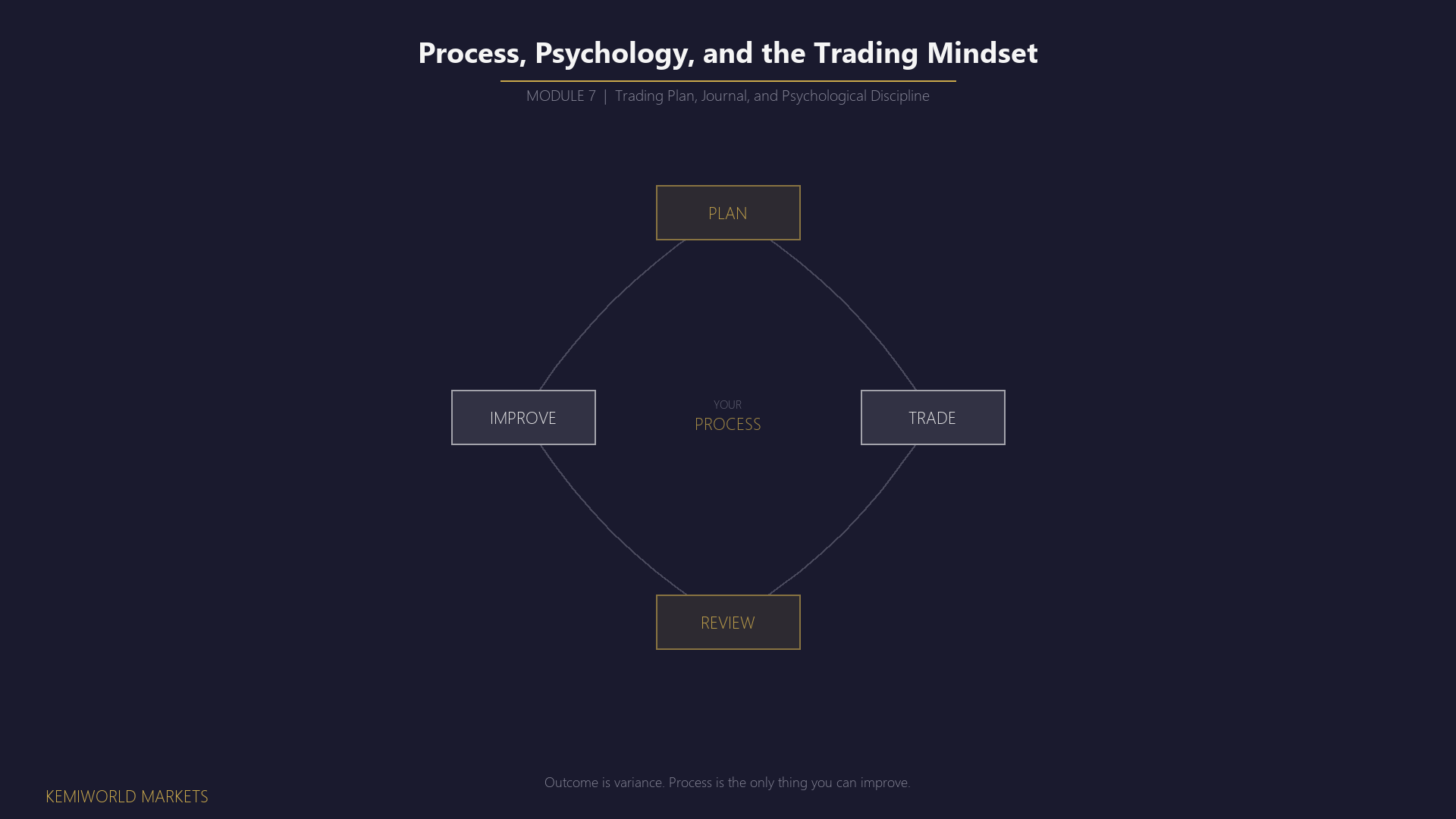
You can complete every lesson in this course, apply the structural framework correctly, size your positions properly, and place your stops at the right levels — and still lose money. Not because the framework is wrong, but because execution happens in real time, under real financial pressure, in a market that feels personal even when it is not.
Trading psychology is not a soft topic added to courses for completeness. It is the gap between what traders know and what traders do. This lesson identifies the most common psychological traps by name, explains the mechanism behind each, and gives you the tools to recognise them in yourself before they cost you.
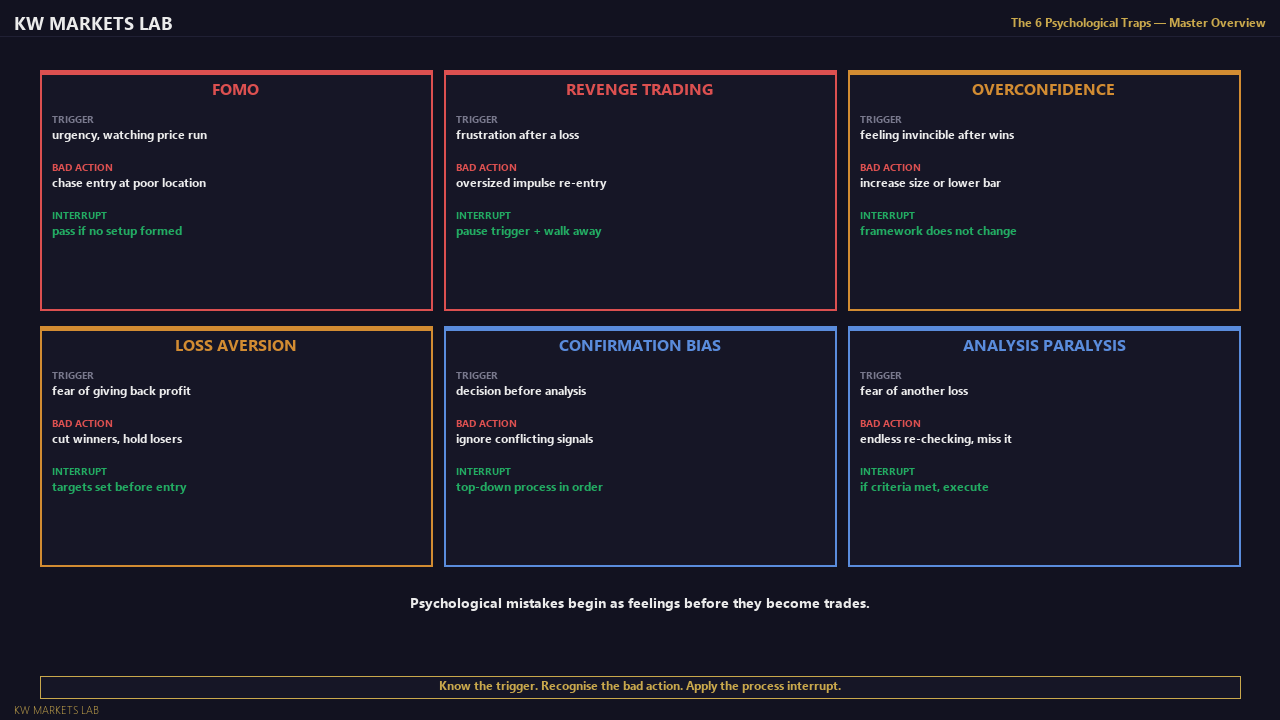
Trap 1: FOMO — Fear of Missing Out
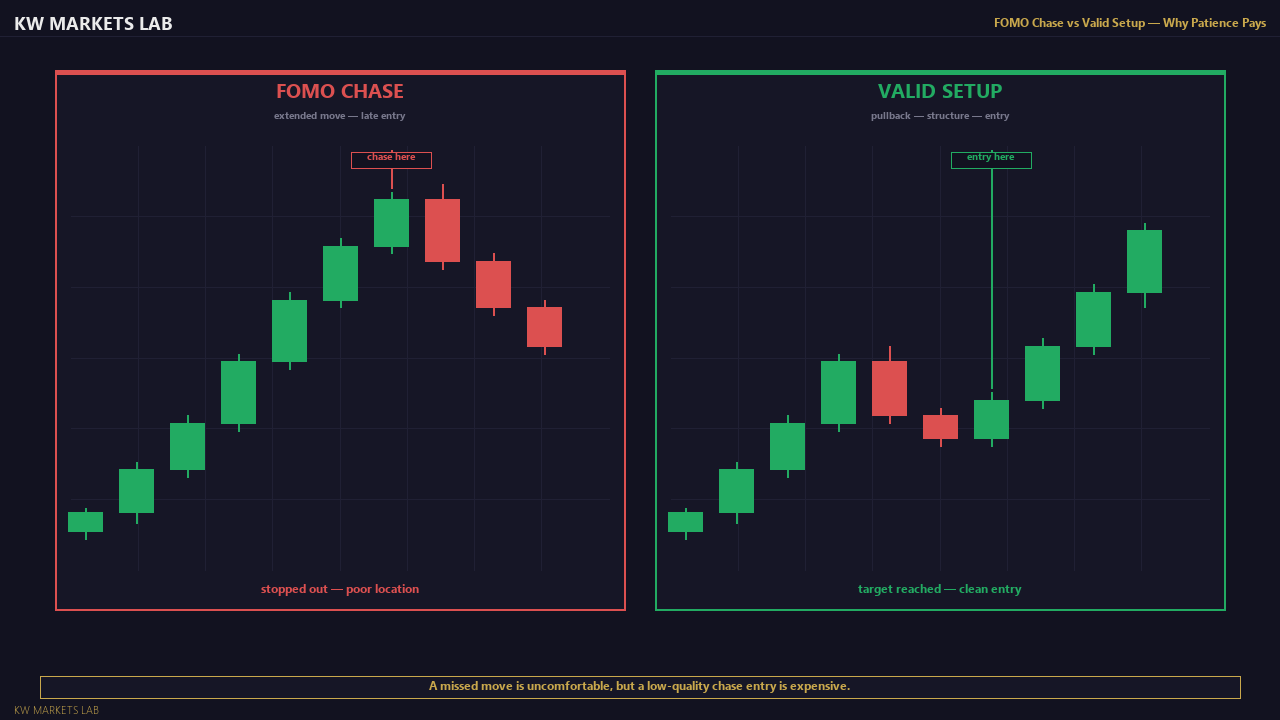
What it looks like: Price has been moving strongly in one direction and you were not in the trade. You watch it move 50, 80, 100 pips in your direction without you. The discomfort of having missed it grows. Eventually, you enter — usually late, usually without a clear structural setup, usually chasing price as it is already extended.
What usually happens: You enter at or near the end of the move. Price stalls, consolidates, or retraces. Your stop is hit. The move you were chasing is now largely over.
The mechanism: FOMO is not a rational response to market information. It is a response to the emotional discomfort of not participating. The trade that you did not take cannot hurt you. Only the trades you do take carry financial risk. FOMO causes you to expose yourself to risk in order to relieve emotional discomfort — which is the opposite of systematic trading.
How to recognise it: You are entering because "it is still going" rather than because a structural setup has formed. You are in a hurry. You are not following your pre-session checklist. You feel anxious that you are being left behind.
The response: Your trading plan specifies the conditions required for an entry. If those conditions are not met, there is no trade. The move you missed was not yours to take. The next valid setup in your framework will come. Pass the trade.
Trap 2: Revenge Trading
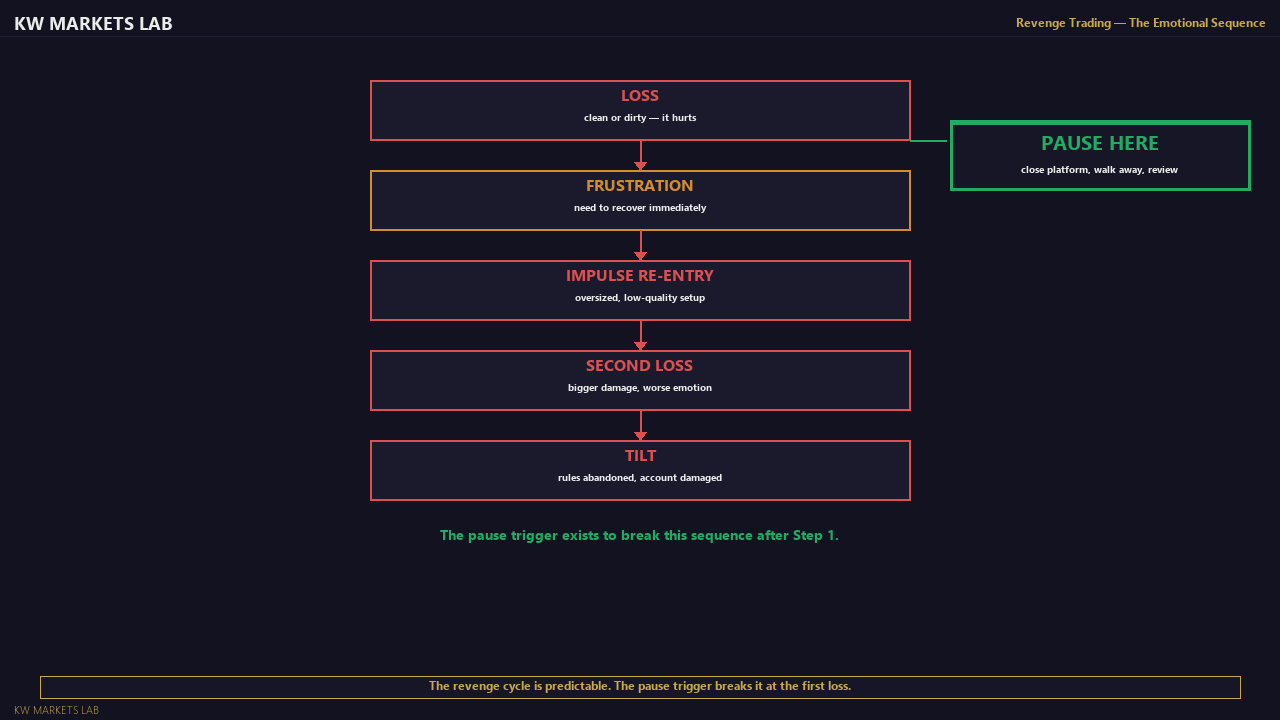
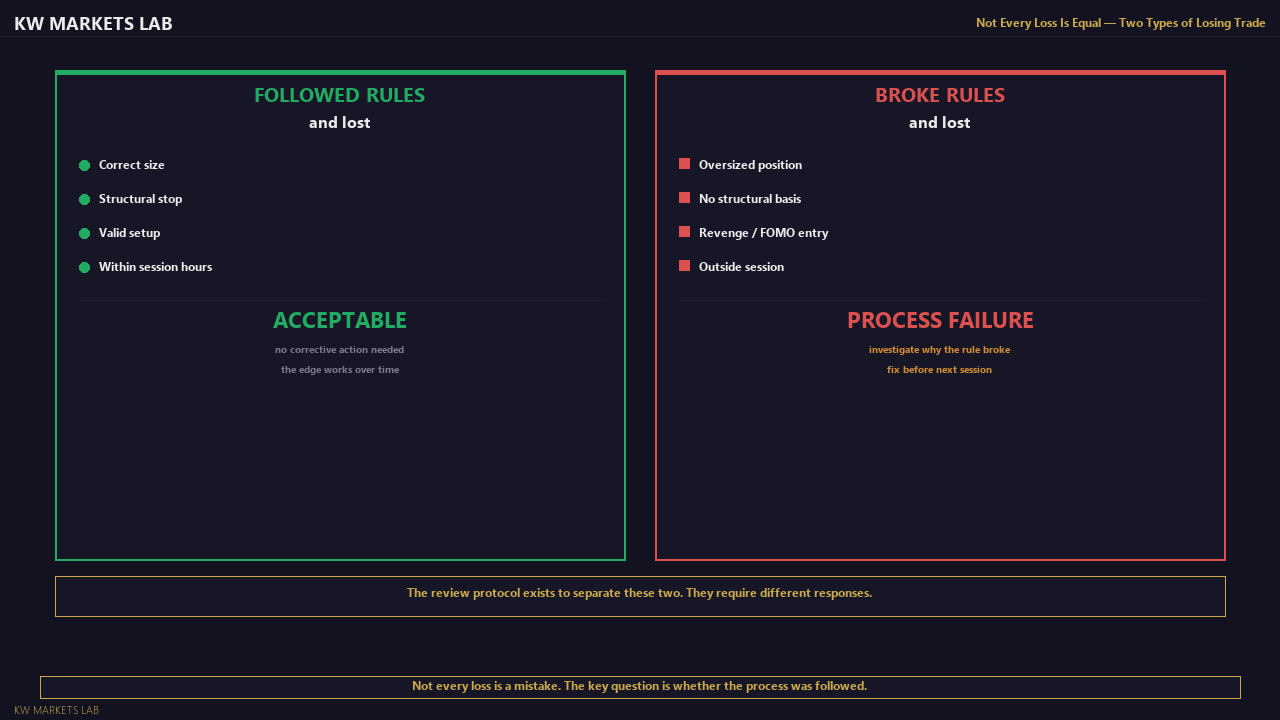
What it looks like: You have taken a loss — possibly a clean, rule-following loss, or possibly a loss caused by a rule break. You feel the need to recover it quickly. You immediately open another trade, often in a larger size, with less analysis, in the same market that just stopped you out.
What usually happens: The revenge trade also loses. Now you have two losses, the second of which was larger and less considered than the first. The compounding of losses accelerates.
The mechanism: A loss triggers a strong emotional response — frustration, embarrassment, or a perceived threat to self-worth. Revenge trading is an attempt to undo the loss as quickly as possible. It is not a trading decision — it is an emotional reaction dressed as one. The market has no memory of your previous trade. It owes you nothing.
How to recognise it: You opened a new trade within minutes of closing a losing one. You sized the new trade larger than normal. You did not run through your checklist before entering. You are thinking about the previous loss while analysing the new setup.
The response: The risk framework from L6.4 includes a pause trigger for consecutive losses. If you have hit your pause trigger, you stop, close the platform, and do not return for a defined cooling period. The pause trigger exists specifically because the moment after a loss is the worst possible time to make a new trading decision.
Trap 3: Overconfidence After a Winning Streak
What it looks like: You have had four or five consecutive winning trades. You begin to feel that you have "figured it out." You start taking setups that do not fully meet your criteria. You size up without adjusting your framework. You take more trades than planned because "the edge is working."
What usually happens: The winning streak was partly skill and partly variance. As variance corrects, you encounter losses — now with a larger position size and less rigorous entry criteria than your framework specifies. The drawdown is amplified compared to what it would have been under normal conditions.
The mechanism: A run of wins is a psychologically powerful experience. It creates the feeling of competence and control. The trap is treating variance as skill. Even a very good trading framework will produce winning streaks that would have occurred by random chance at that win rate. The streak does not prove the framework is now better — it proves it is working normally.
How to recognise it: You are considering taking a trade that, on a normal day, you would have passed. You are sizing up "because I'm running hot." You have not updated or reviewed your risk framework recently. You feel that the rules that protected you before are now unnecessary.
The response: The risk framework does not change after a winning streak. Position size is calculated from your defined percentage — not from confidence level. If you feel the urge to increase size after wins, write down the reason. If the reason is "I'm winning a lot lately," that is not a reason to change your framework.
Trap 4: Loss Aversion — Cutting Winners and Holding Losers
What it looks like: You exit a winning trade early because you are afraid it will reverse and you will give back the profit. Meanwhile, you hold a losing trade past your defined stop because you are certain it will "come back." The result: small wins and large losses — the opposite of what a positive risk:reward system requires.
The mechanism: Loss aversion is one of the most well-documented findings in behavioural economics. The pain of losing $100 is psychologically larger than the pleasure of gaining $100, even though the financial impact is symmetric. This asymmetry causes traders to:
- Exit winners prematurely to "lock in" the gain and avoid losing it
- Refuse to close losers because closing makes the loss "real"
Both behaviours sabotage positive expectancy. A 1:2 risk:reward system only delivers positive expectancy if the winners actually reach the 2R target. If they are consistently cut at 0.8R or 1R due to fear, the expectancy collapses.
How to recognise it: You are moving your take-profit closer to the current price "just to be safe." You are telling yourself the losing trade will recover "if I just give it more time." You have moved a stop loss wider on a losing trade.
The response: Target placement is part of the pre-trade plan, set before entry. "I will exit this trade when price reaches [level]" is a rule, not a preference. Let the trade reach the target or the stop. The pre-trade analysis is done under calm conditions — in-trade decisions are made under emotional pressure. Trust the pre-trade plan.
Trap 5: Confirmation Bias
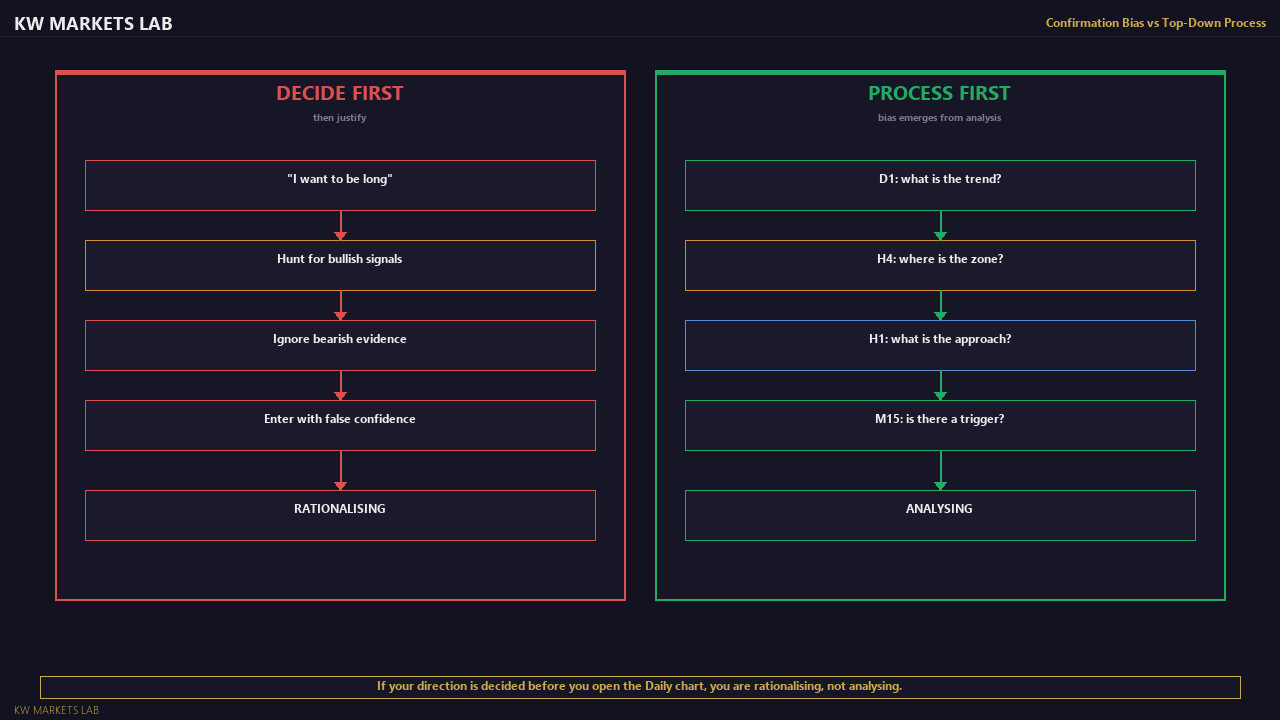
What it looks like: You have decided you want to be long EURUSD. You look at the chart and find reasons to be long. You dismiss the daily downtrend because "the H1 is bullish." You ignore the resistance zone at your entry because "it will break." You find a pattern that justifies the trade you have already decided to take.
How to recognise it: You completed your analysis before you looked at the chart, not after. You dismissed one or more higher-timeframe signals that contradicted your bias. You found your entry trigger before you completed the top-down process. You are "waiting for confirmation" but you have already decided.
The response: Complete the top-down analysis in order — Daily first, then H4, then H1, then M15. Your bias should emerge from the analysis, not precede it. If the first thing you do is decide which direction you want to trade and then look for justification, you are not analysing — you are rationalising.
Trap 6: Analysis Paralysis
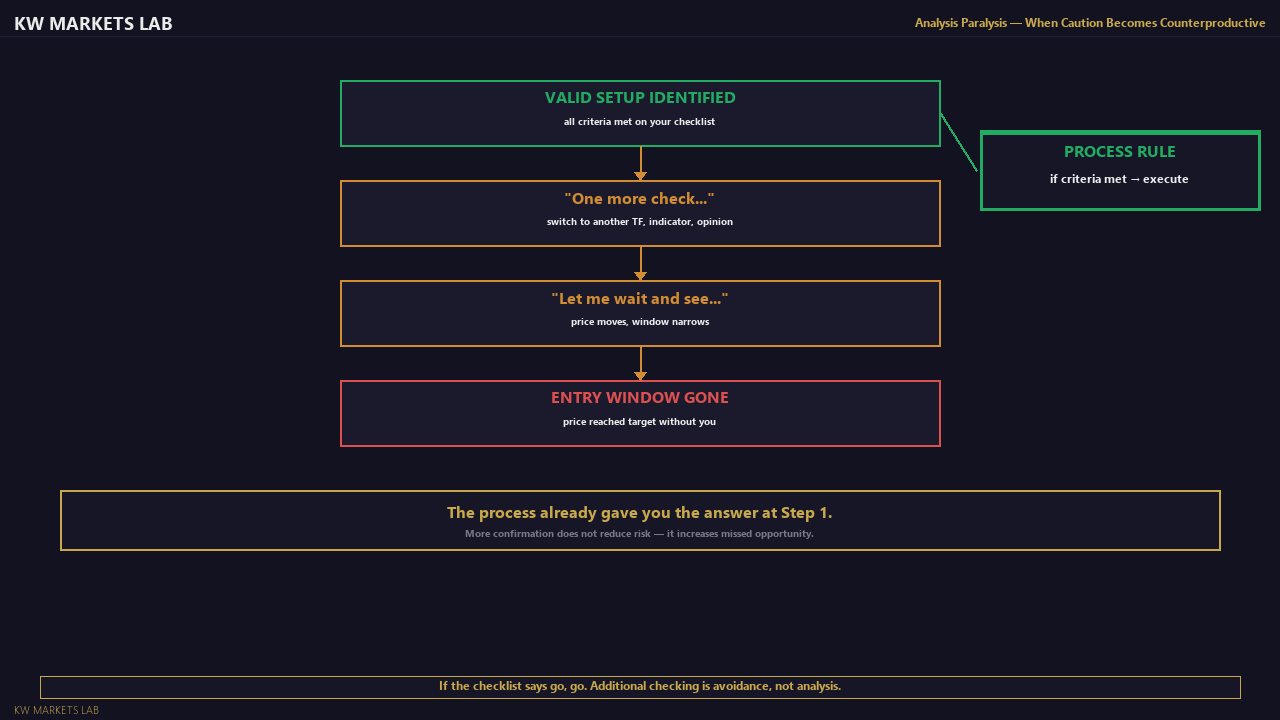
What it looks like: You have a valid setup but you cannot bring yourself to enter. You keep looking at one more timeframe, waiting for one more confirmation, checking one more indicator. The entry window passes. You do not enter. You then watch the trade work without you — and this makes the next paralysis episode worse.
The mechanism: Analysis paralysis typically follows a painful loss. The subconscious response is to seek certainty before the next entry — and to keep seeking it until certainty feels guaranteed. Certainty in trading is not available. Every trade has a probability, not a guarantee. Attempting to find certainty produces indefinite postponement.
How to recognise it: You have been watching the same setup for an extended period beyond what your analysis process requires. You have added conditions to your entry criteria that were not in your original framework. You are looking for reasons not to enter rather than a clear reason to enter.
The response: Your entry criteria are defined in your trading plan (covered in L7.2). If those criteria are met, the trade is valid. Execution is required. The outcome will be what it is — consistent execution of a sound process over many trades is the only path to evaluating and improving the edge. Skipping valid setups breaks the process just as surely as taking invalid ones.
Early Warning Signs: Catching the Trap Before It Becomes a Trade
Each trap has precursor feelings — states you enter before the bad decision is made. Learning to recognise the precursor is more valuable than recognising the mistake after the fact.
| Trap | The feeling that precedes it | The question to ask yourself |
|---|---|---|
| FOMO | Urgency. Watching price move and feeling left behind. A tightening in the chest. | "Am I entering because conditions are met, or because I feel left out?" |
| Revenge trading | Frustration after a loss. A strong pull toward the charts. "One more" thinking. | "How long ago did my last trade close? Am I in the post-loss window?" |
| Overconfidence | A feeling of being "in sync." Trades seem obvious. Rules feel optional. | "Would I take this trade if I had just come off a losing streak?" |
| Loss aversion | Discomfort watching a winner sit at +1R. Certainty that "it will come back" on a loser. | "Am I moving targets or stops based on feelings, or based on the pre-trade plan?" |
| Confirmation bias | The trade feels obvious before analysis is complete. | "Did I decide direction before I looked at the Daily chart?" |
| Analysis paralysis | Excessive checking, repeated timeframe switching, postponement of an obvious entry. | "Have I been watching this setup longer than my analysis process requires?" |
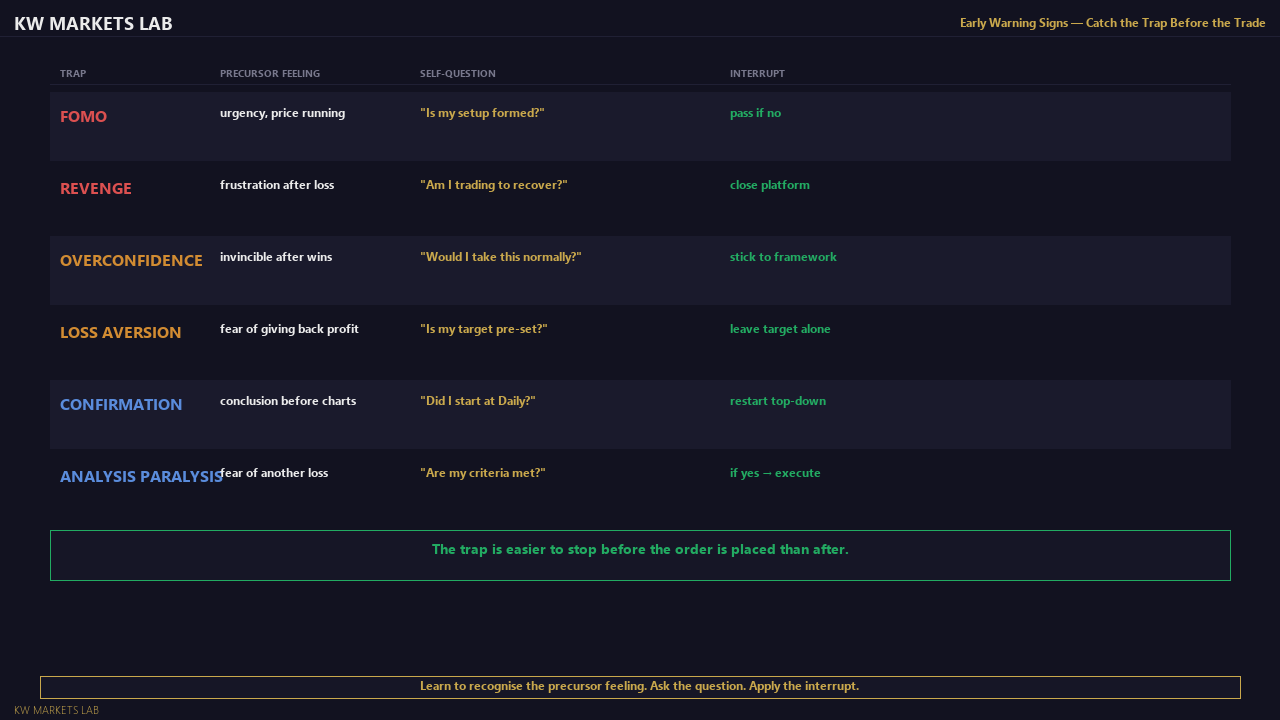
None of these feelings are wrong or abnormal. Every trader experiences them. The difference between a trader who improves and one who does not is whether the feeling produces a trade — or whether the process intercepts it.
Building Your Personal Pattern Map
After your next ten sessions, score yourself on each trap:
0 = Did not experience this feeling at all
1 = Experienced the feeling but did not act on it
2 = Experienced the feeling and partially acted on it (hesitated, moved a stop, took an early exit)
3 = Acted on it fully (entered a FOMO trade, revenge traded, cut a winner at 0.5R, etc.)
| Session | FOMO | Revenge | Overconfidence | Loss aversion | Confirmation bias | Analysis paralysis |
|---|---|---|---|---|---|---|
| 1 | ||||||
| 2 | ||||||
| 3 | ||||||
| ... |
After ten sessions, add each column. Your highest total is your dominant trap. Your second highest is your secondary. These two patterns will account for the majority of your rule breaks.
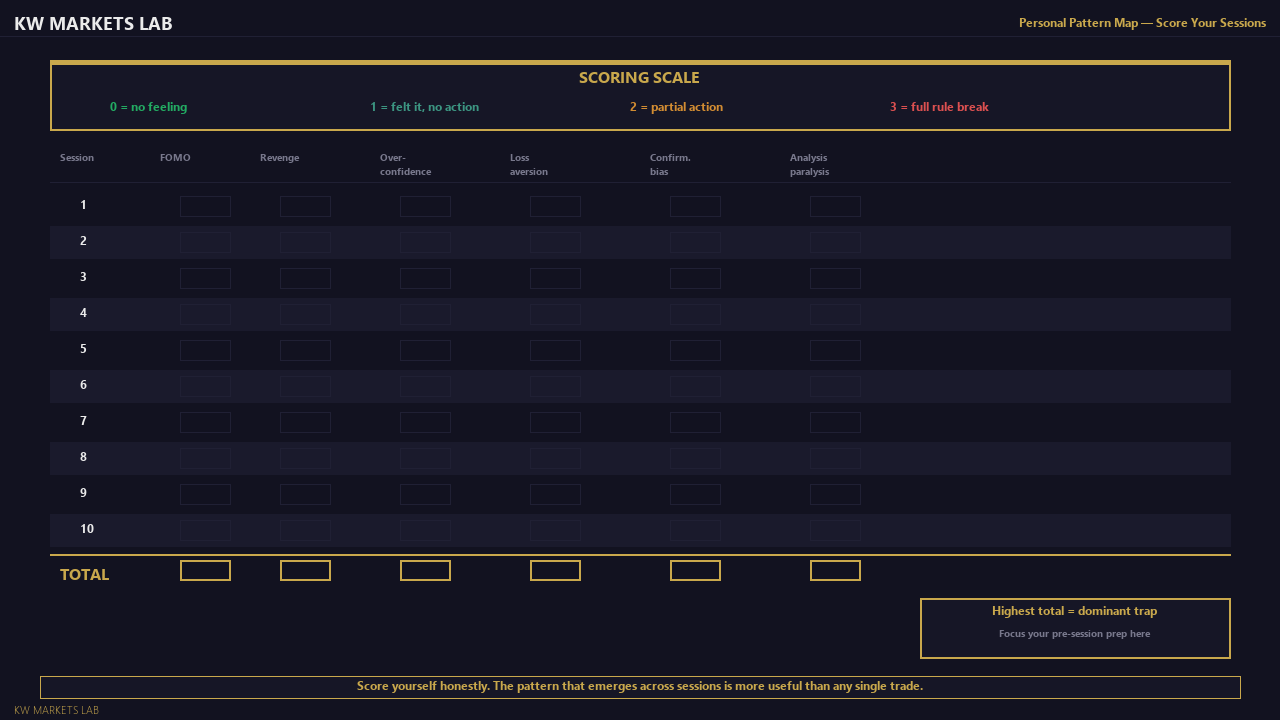
Knowing your dominant pattern changes how you prepare for sessions. If FOMO is your highest score, you add a specific FOMO check to your pre-entry checklist. If loss aversion is highest, you review your stop and target before every session and commit to not touching them once the trade is live.
Recognising Your Personal Patterns
The six traps above are the most common. You will likely have a dominant pattern — one or two that occur more frequently than the others. Identifying your pattern is the first step to managing it.
The trading journal (covered in L7.3) is the primary tool for this. After each session, noting whether any of these traps were present — even if you did not act on them — builds a dataset of your own psychological tendencies over time. Once you can name the trap and recognise the feeling that precedes it, you have a chance to interrupt the pattern before it becomes a trade.
You will not eliminate these responses. They are human. The goal is not to trade without emotion — it is to build a process robust enough that emotional responses do not get to make the final decision.
Key Takeaways
- FOMO causes you to chase moves that have already happened. Pass the trade if the setup has not formed.
- Revenge trading is an emotional reaction to a loss, dressed as a trading decision. The pause trigger exists for this exact moment.
- Overconfidence after a winning streak is variance misidentified as skill. The framework does not change.
- Loss aversion causes you to cut winners early and hold losers too long — the exact opposite of positive expectancy.
- Confirmation bias produces circular analysis. Build bias from the top down, in order, every time.
- Analysis paralysis is the search for certainty that does not exist. Execute valid setups; evaluate the process over time.
Checkpoint Exercise
After your next five trading sessions, complete this self-assessment for each session:
- Did I experience FOMO? Did I act on it?
- Did I revenge trade? Did I trade within 10 minutes of a losing trade?
- Did I cut a winner before its target? Why?
- Did I hold a loser past its stop? Why?
- Did I complete the top-down analysis before deciding on a direction, or after?
- Did I hesitate on a valid setup? What was the reason?
Write honest answers. The pattern that emerges across five sessions is more useful than any single entry.
Lesson Objective
By the end of this lesson, you should be able to identify and name the six most common psychological traps in trading, describe the mechanism behind each, and recognise at least two of your own dominant patterns based on your recent trading behaviour.
Get notified when new lessons and content are published.