Course Outline — Lesson 8 of 22 ▼
L3.2 — Psychological Levels and Round Numbers
Psychological Levels and Round Numbers
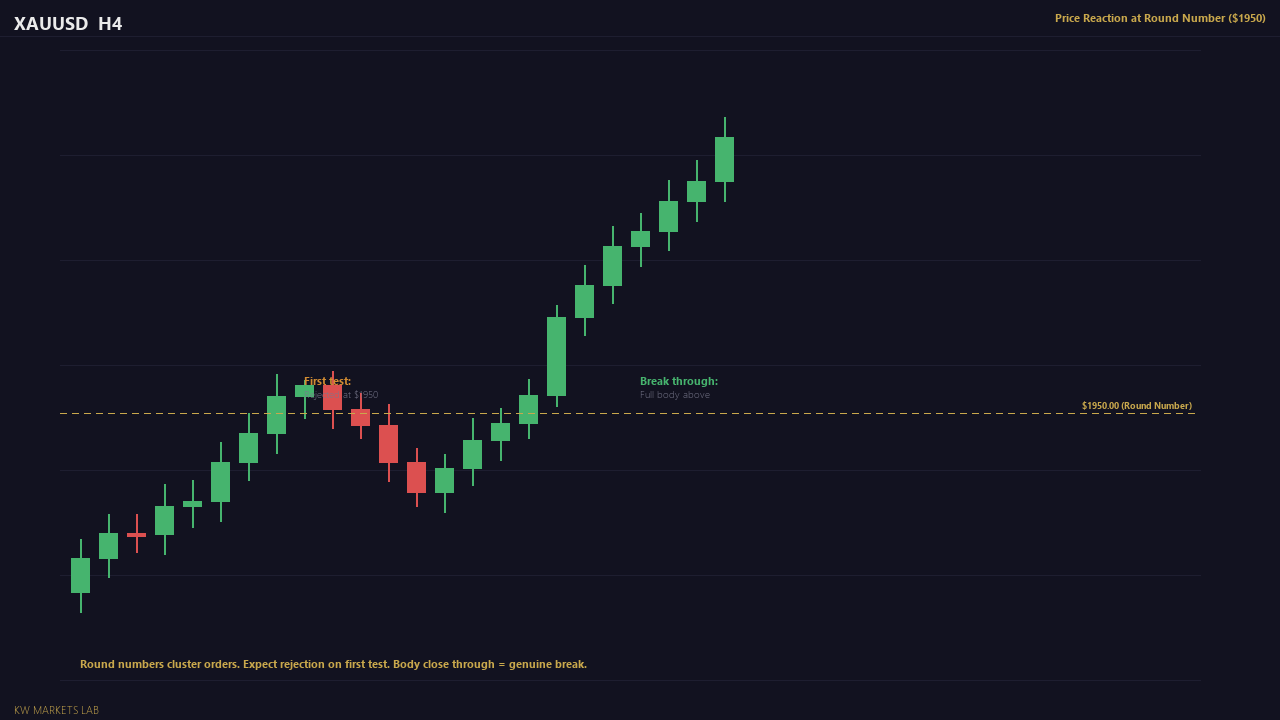
Not all key levels are created by previous swing highs and lows. Some of the most consistently respected levels in forex, gold, and indices are round numbers — prices that have no structural significance on their own, but attract disproportionate attention and order flow because of human and algorithmic psychology.
Understanding why these levels work, where to find them, and how to factor them into analysis is a practical skill that improves the quality of your level selection.
Why Round Numbers Matter
Human beings naturally cluster attention, memory, and decision-making around round numbers. A forex trader managing a position does not set their stop at 1.08347 — they set it at 1.0850 or 1.0900. A fund manager does not announce "we expect gold to reach $2,147" — they frame targets and thresholds around $2,000, $2,100, $2,200.
This clustering behaviour is not random. It reflects how:
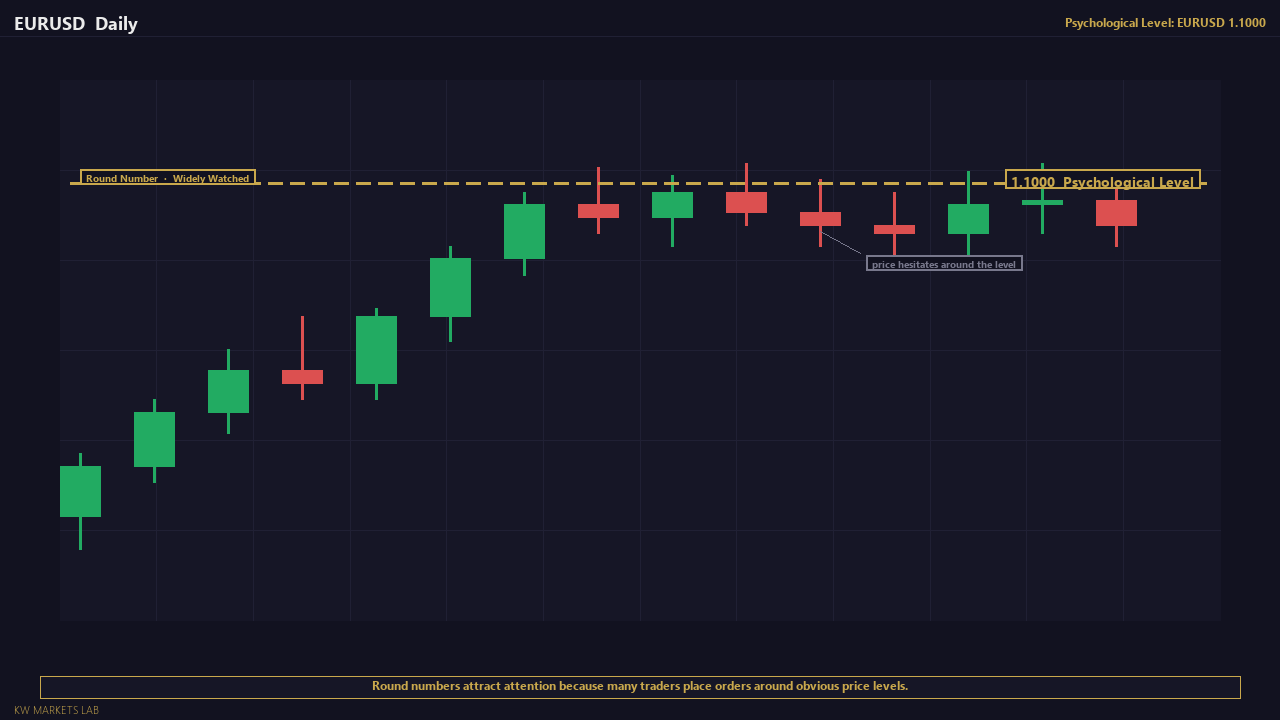
- Retail traders place orders. Stop losses, take profit targets, and pending orders cluster at round numbers across all account sizes and platforms.
- Algorithms are programmed. Many trading algorithms reference round numbers explicitly as trigger levels or as zone filters.
- Institutional targets are communicated. Investment bank research, analyst price targets, and media commentary all anchor around major round numbers.
- Market maker awareness. Participants who can see order flow know exactly where the large clusters of stops and pending orders sit — and those clusters are disproportionately at round numbers.
The practical result: price reacts at these levels even when there is no structural chart reason for it to do so.
Three Tiers of Psychological Levels
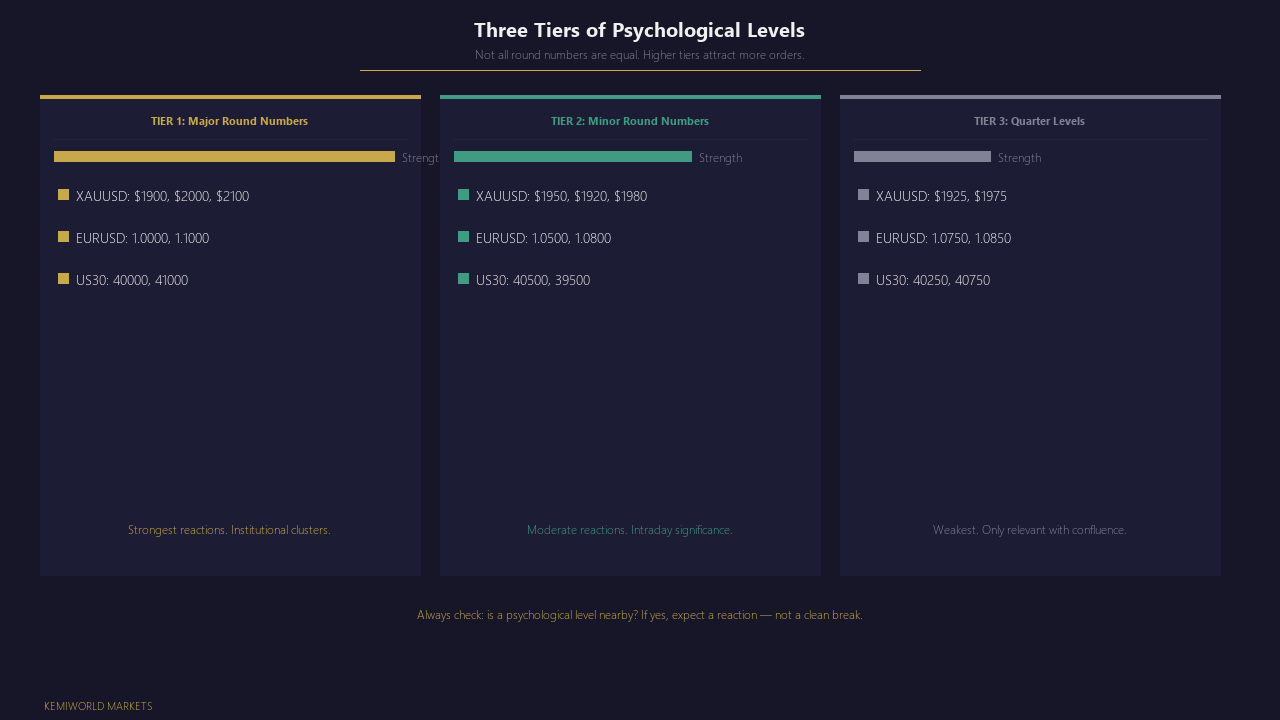
Psychological levels vary in significance. It is useful to think in three tiers:
Major levels (most significant):
These are large round numbers that end in 000 or 0000. They represent major psychological thresholds with the highest order concentration.
- Forex: 1.0000 (EURUSD parity), 1.1000, 1.2000, 1.3000
- Gold: 2000.00, 2100.00, 2200.00, 2500.00
- Indices: 4000, 5000, 20000 (Nikkei), 40000 (Dow Jones)
Major levels often attract very wide reaction zones — price may consolidate around them for extended periods.
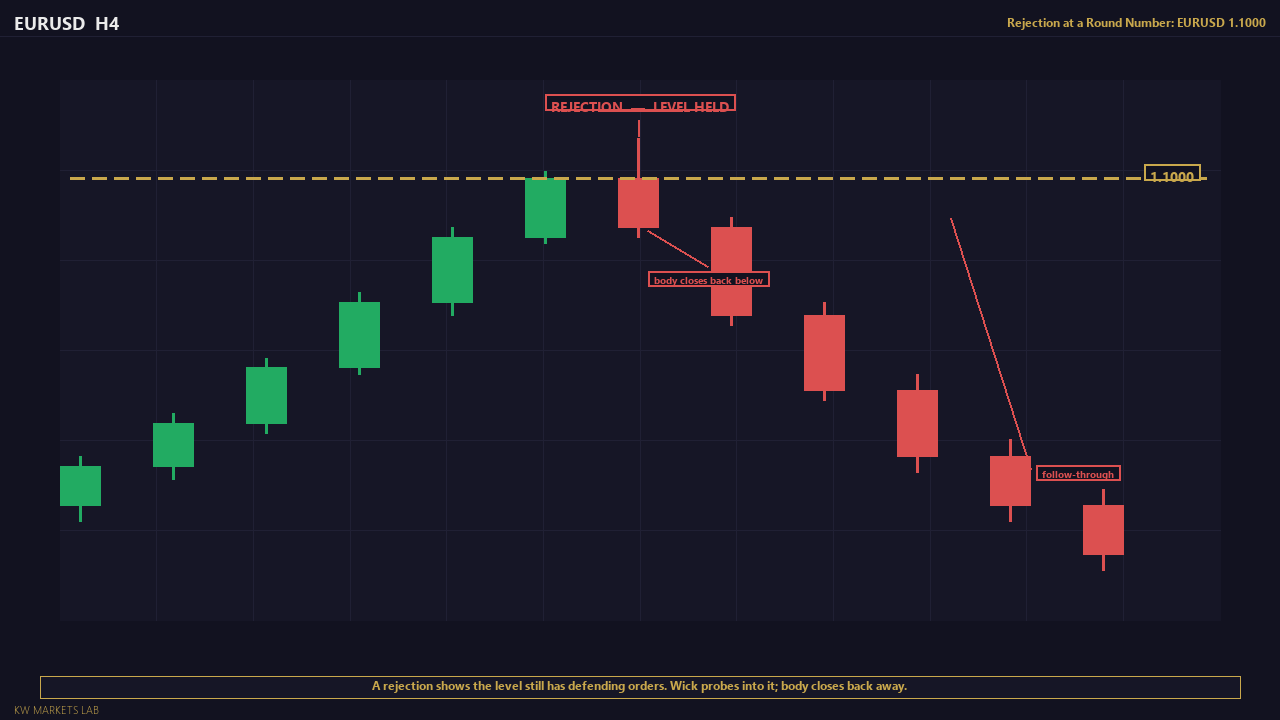
Intermediate levels (moderate significance):
Numbers ending in 500 or 50. Half-round levels attract meaningful participation but less than major levels.
- Forex: 1.0500, 1.1500, 1.2500
- Gold: 1950.00, 2050.00, 2150.00
- Indices: 4500, 5500
Minor levels (contextual significance):
Numbers ending in 00 or smaller round increments. Relevant for intraday analysis but less reliable on higher timeframes.
- Forex: 1.0800, 1.0850, 1.0900
- Gold: 2020, 2030, 2040
- Indices: 4100, 4150, 4200
In general: the more zeros at the end of the number, the more significant the level. Focus your analysis on major and intermediate levels unless you are trading on very short timeframes.
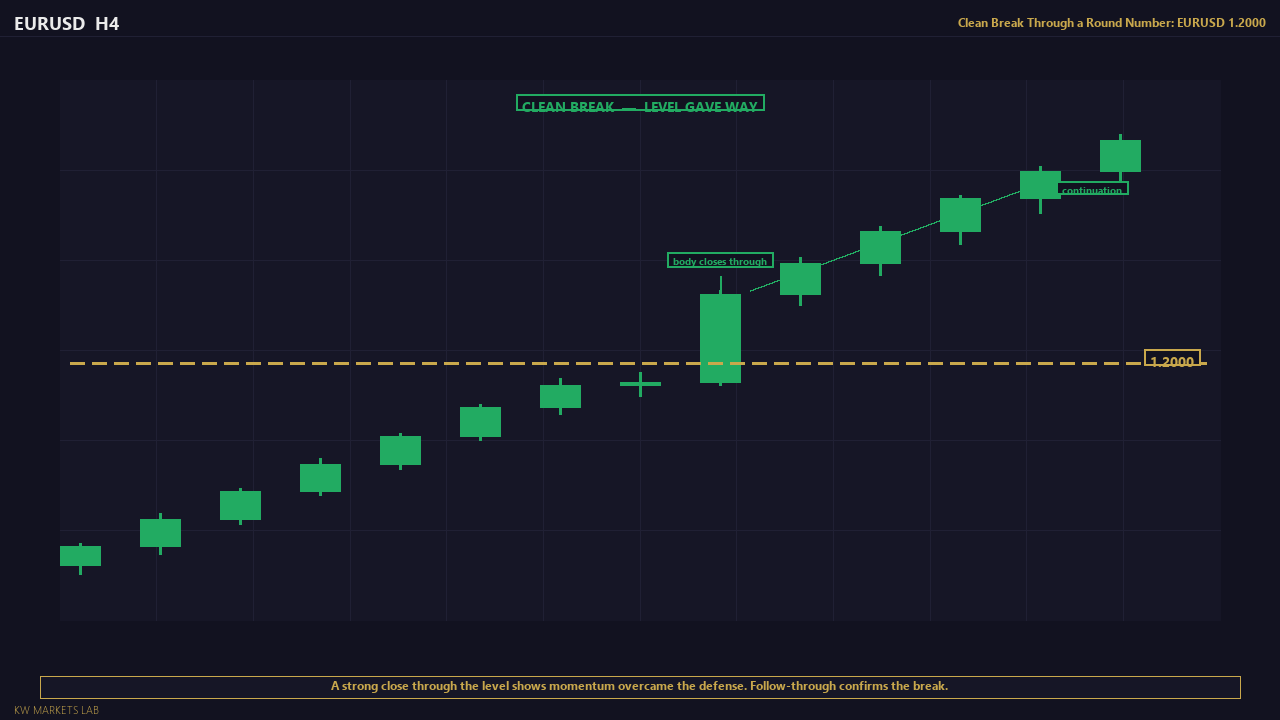
How to Factor Psychological Levels into Analysis
Psychological levels do not replace structural zones — they complement them.
Confluence: When a structural support or resistance zone aligns with a major psychological level, the zone is significantly stronger. Two independent reasons for price to react at the same area mean a higher probability of a reaction. A support zone at the H4 level that also sits at a major round number (e.g., EURUSD at 1.0800) is a much higher-quality reference point than either the structural zone or the round number alone.
Targets and bias: When forecasting where a move might run to or where it might stall, check whether the next major psychological level lies in that path. A breakout above H4 resistance at 1.0875 with the next major level at 1.0900 suggests price may react or pause at 1.0900 before continuing.
Stop placement awareness: Because large clusters of stop losses sit just beyond round numbers, price often sweeps through them briefly before reversing. This is the same liquidity-sweep concept from L1.2, applied specifically to round numbers. Placing your own stop at exactly 1.1000 (a major level) means it is in the exact cluster that price may sweep. A stop slightly beyond the cluster — at 1.0985 or 1.0990 — gives it more structural protection.
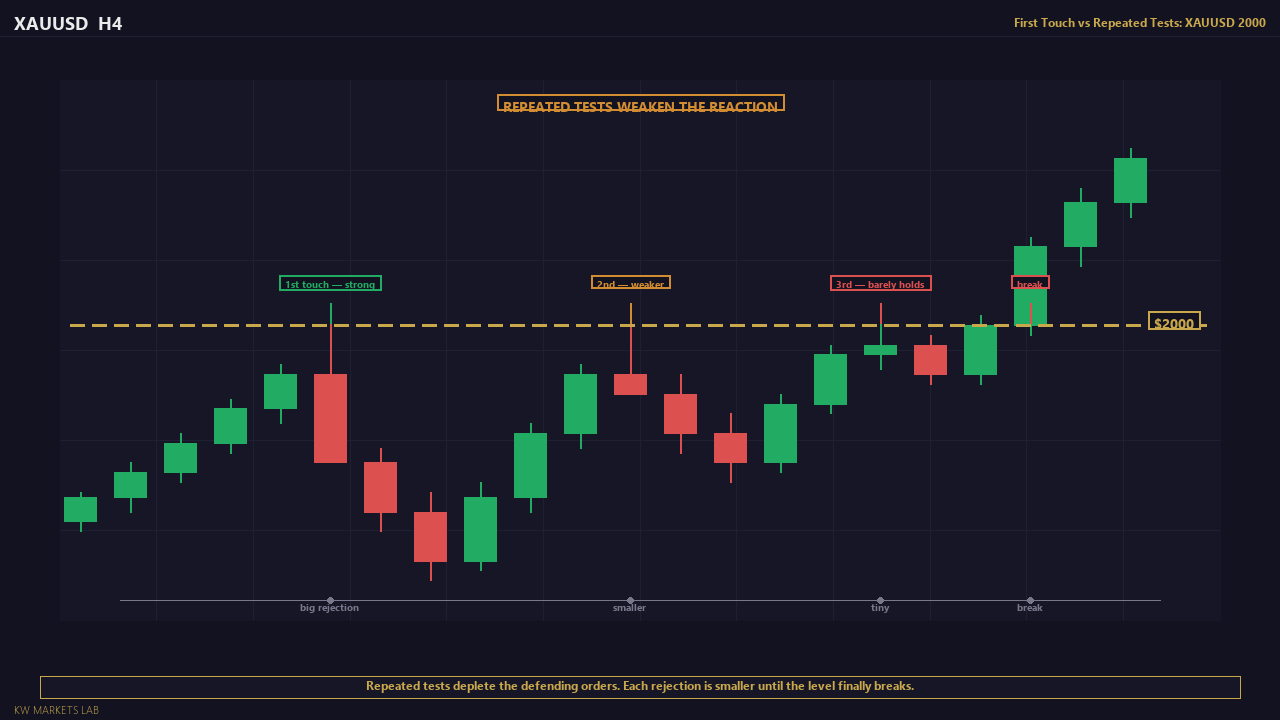
Gold-Specific Psychological Levels
Gold (XAUUSD) has particularly strong psychological level behaviour, for two reasons:
- Gold's price is widely reported in round number terms by financial media, so awareness of levels like $2,000 and $2,500 is extremely broad.
- The USD-denominated price of gold fluctuates significantly across macro cycles, making major milestones (first time gold reaches $2,000, $2,500, etc.) historically memorable anchor points.
In practice: when trading gold, always check the nearest major and intermediate round numbers before placing a trade. A long entry at $2,190 with a target at $2,230 needs to account for the psychological friction at $2,200. If the risk:reward only works if price clears $2,200 cleanly, the quality of the trade depends on whether $2,200 is likely to hold or yield.
Common Mistakes
Treating all round numbers as equally important. A minor round number (e.g., 1.0840 on EURUSD) is not the same as a major one (1.1000). Calibrate your attention to the level's tier.
Using round numbers as exact entry triggers. A round number level is a zone of potential reaction, not an exact entry signal. Wait for price action confirmation at the level before acting.
Ignoring them entirely. Some technically-oriented traders dismiss psychological levels as "not real analysis." The reality is that the order clustering at these levels is real and creates measurable market behaviour. Ignoring them means ignoring part of the picture.
Placing stops directly at round numbers. As noted above, the clustering of orders at round numbers makes them targets for brief sweeps. Give your stop some distance beyond the level.
Key Takeaways
- Round numbers attract disproportionate order flow because of human and algorithmic psychology.
- Three tiers: major (ends in 000/0000), intermediate (ends in 500/50), minor (ends in 00).
- Psychological levels are strongest when they align with structural zones — this is confluence.
- On gold, always check the nearest major round numbers before entering or targeting.
- Do not place stops exactly at round numbers — place them with buffer beyond the likely sweep zone.
Checkpoint Exercise
For each of the three instruments (EURUSD, XAUUSD, one index of your choice):
1. Identify the current major psychological levels above and below the current price.
2. Identify whether any structural zones from L3.1 align with a psychological level — this is confluent.
3. Note where the nearest round number sits relative to your last marked structural resistance.
Lesson Objective
By the end of this lesson, you should be able to identify major, intermediate, and minor psychological levels for EURUSD, XAUUSD, and one index; explain why they attract disproportionate reaction; and describe how to use them in conjunction with structural zones rather than as standalone signals.
Get notified when new lessons and content are published.