Course Outline — Lesson 18 of 22 ▼
L6.4 — Building Your Personal Risk Framework
Building Your Personal Risk Framework
The previous three lessons gave you the mathematics of risk. This lesson turns those numbers into a written document — your personal risk framework — that governs your trading behaviour before, during, and after every trade.
A risk framework is not an aspiration. It is a set of rules that operate regardless of how you feel on a given day. It exists precisely because the days when you most want to break the rules are the days when breaking them is most dangerous.
This lesson covers what a risk framework contains, how to set each parameter, and how to turn it into a document you actually use.
Why a Written Risk Framework Exists
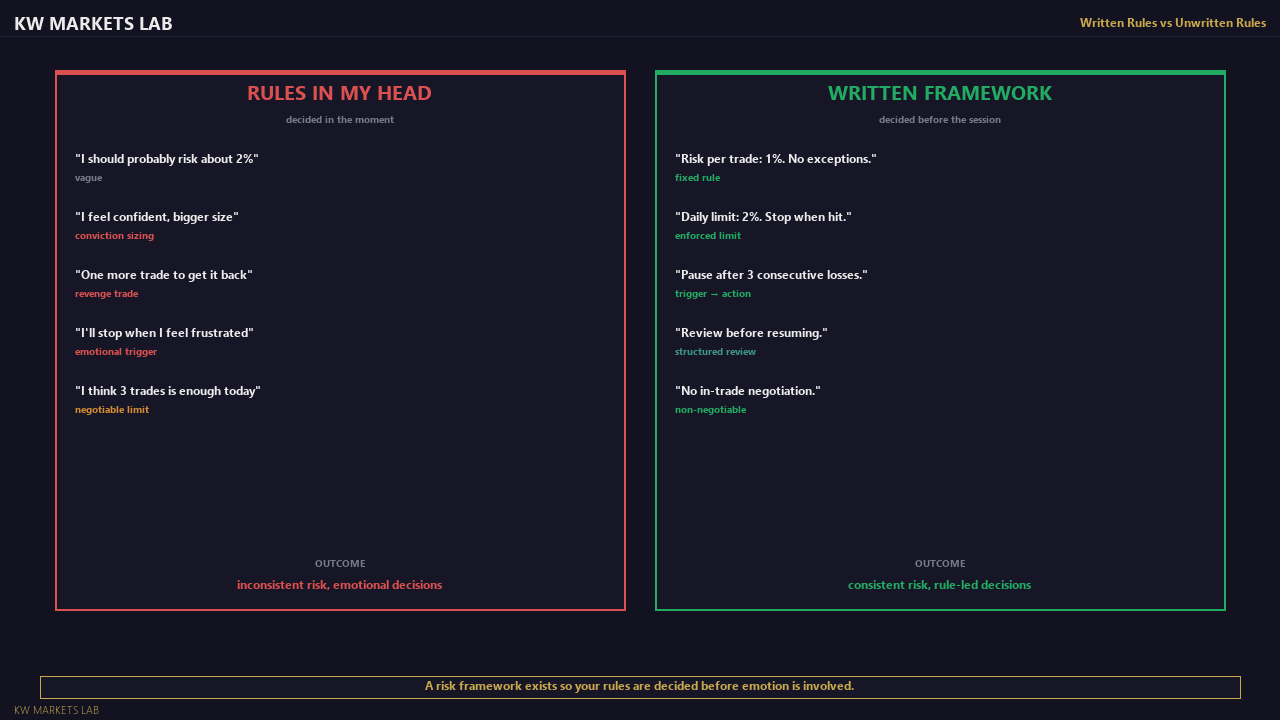
Most traders know the rules conceptually. They know they should not risk more than 2% per trade. They know they should not trade after three consecutive losses. They know they should not revenge trade. And yet they do these things regularly, because:
- In the moment of a trade decision, emotions — excitement, frustration, FOMO, loss aversion — are actively competing with rational judgment.
- "This time is different" is the most expensive thought in trading.
- Without a written rule, there is always an available rationalisation for an exception.
A written risk framework removes the in-the-moment decision. The rule is already made. The question is not "should I risk more on this trade?" — the answer is already no, it is in the document. The question is only "am I going to follow my rules or not?" That is a much cleaner binary choice.
The Five Components of a Personal Risk Framework
1. Maximum Risk Per Trade
The maximum percentage of account equity risked on any single trade. This is the most fundamental parameter.
Recommended starting range: 0.5%–2%.
Most commonly used: 1%–1.5%.
Set this conservatively at first. As you build a track record with consistent execution, you can review it. Do not start at 2% because "1% feels too small." Start where the maths of losing is survivable.
Document it as: "Maximum risk per trade: [X]% of current account equity. No exceptions."
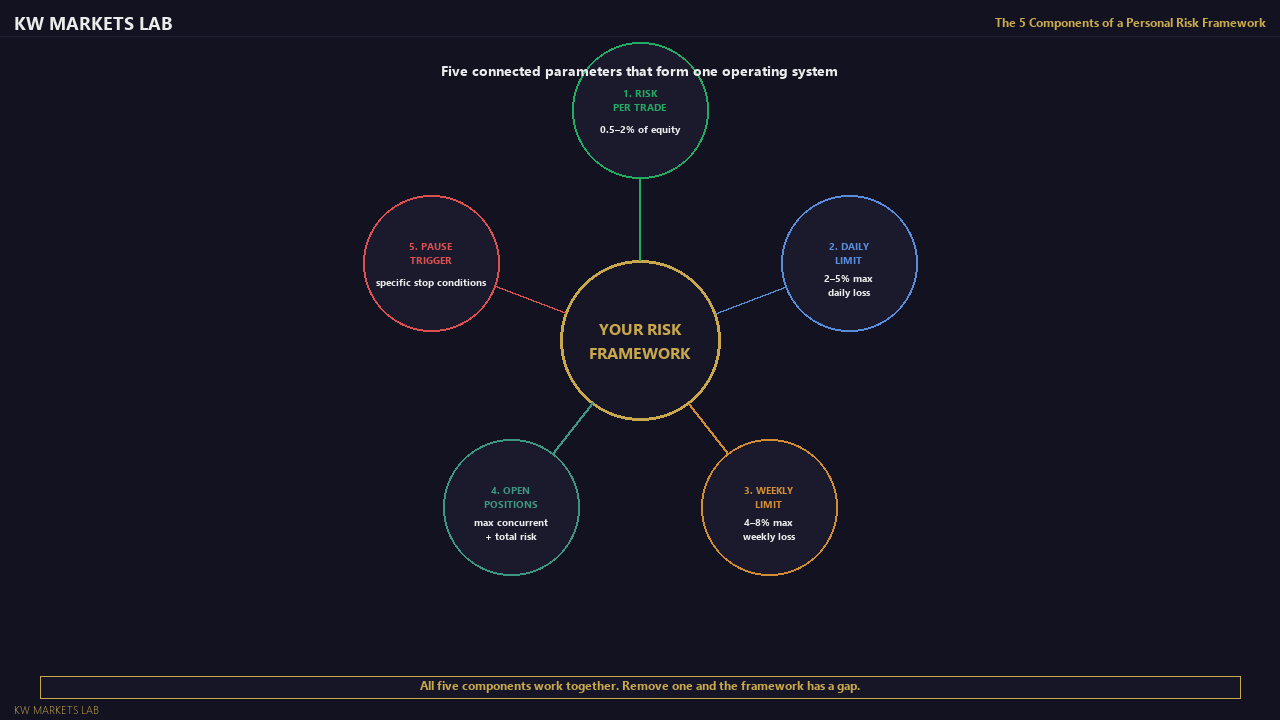
2. Maximum Daily Drawdown Limit
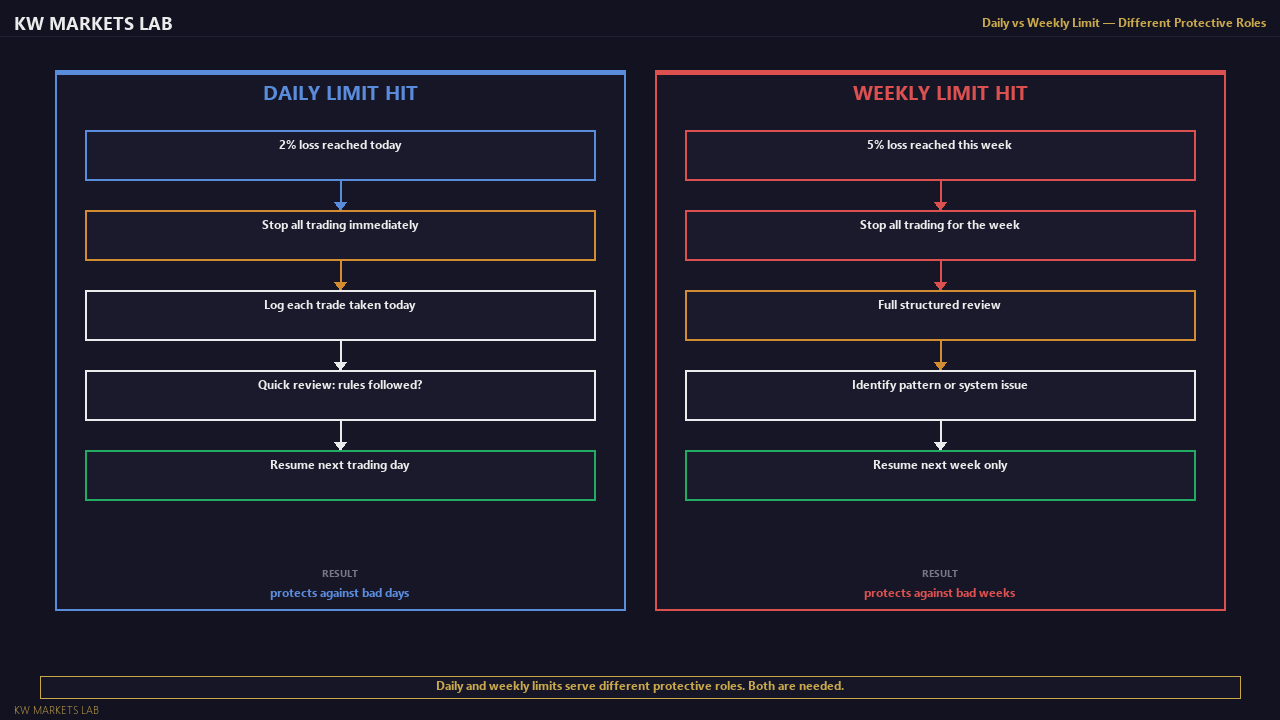
The maximum total loss you will accept in a single trading day before stopping all trading for that day.
Why this matters: a trader who has three losing trades in a row is statistically more likely to break rules on the fourth trade. Emotions compound with losses. The daily drawdown limit enforces a pause before the compounding effect of bad decision-making adds to normal trading losses.
Recommended range: 2%–5% of account equity.
Relationship to trade risk: if your per-trade risk is 1%, a daily limit of 3% means you stop after 3 consecutive losses. This is a natural boundary.
Document it as: "Maximum daily loss: [X]% of account equity. If this is reached, I stop trading for the remainder of the day and review."
3. Maximum Weekly Drawdown Limit
The maximum total loss acceptable in a single trading week before stopping for that week and conducting a review.
A weekly limit adds a second layer of protection against a bad week becoming a catastrophic month. It is also a forcing function for structured review: a week that hits the limit is a week that requires a post-mortem, not a week that quietly continues with smaller positions.
Recommended range: 4%–8% of account equity.
Document it as: "Maximum weekly loss: [X]% of account equity. If this is reached, I stop trading for the remainder of the week and complete the weekly review protocol."
4. Maximum Concurrent Positions
The maximum number of open positions you will hold simultaneously.
This matters because holding multiple open trades on correlated instruments amplifies effective risk. If you are long EURUSD and long GBPUSD simultaneously, both positions are exposed to the same USD strength move. A strong USD rally hits both stops. Your effective risk is doubled.
Recommended for beginners: 1–2 positions maximum.
As a rule of thumb: sum the effective risk across all open positions. Total open risk should not exceed 3%–4% regardless of how many trades contribute to it.
Document it as: "Maximum concurrent positions: [X]. Maximum total open risk at any time: [Y]% of account equity."
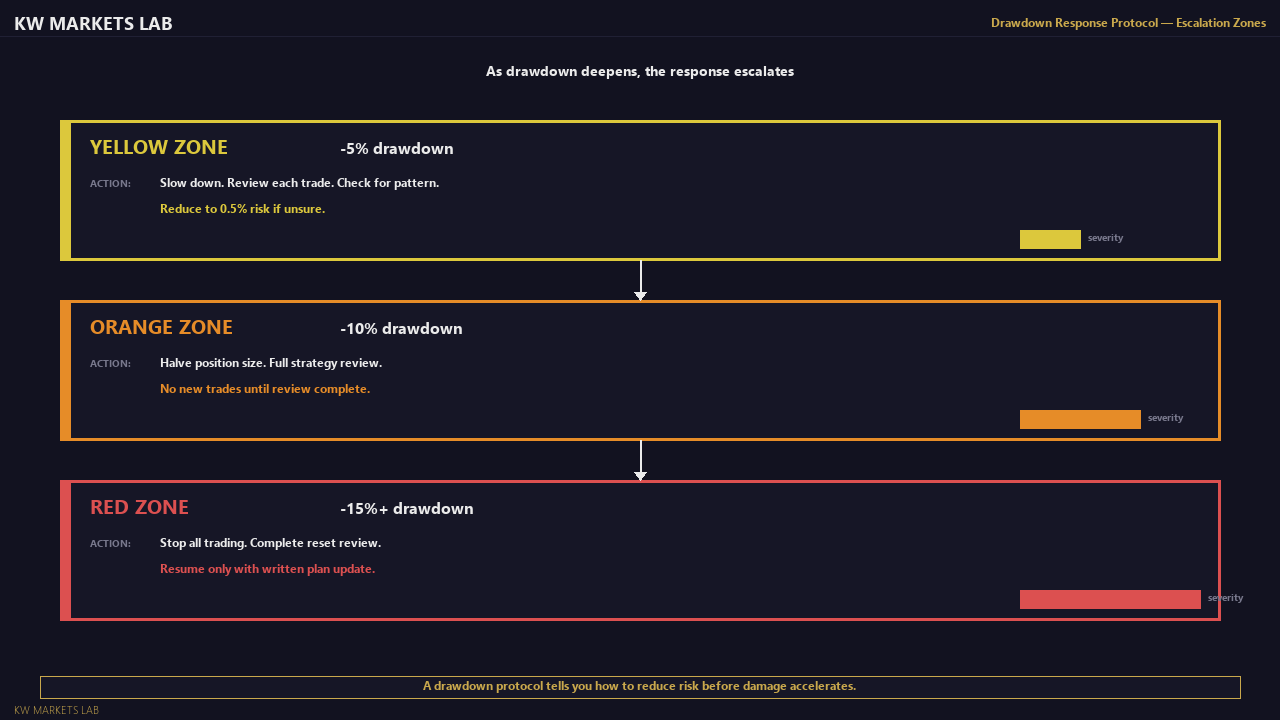
5. The Pause Trigger — When to Stop Trading
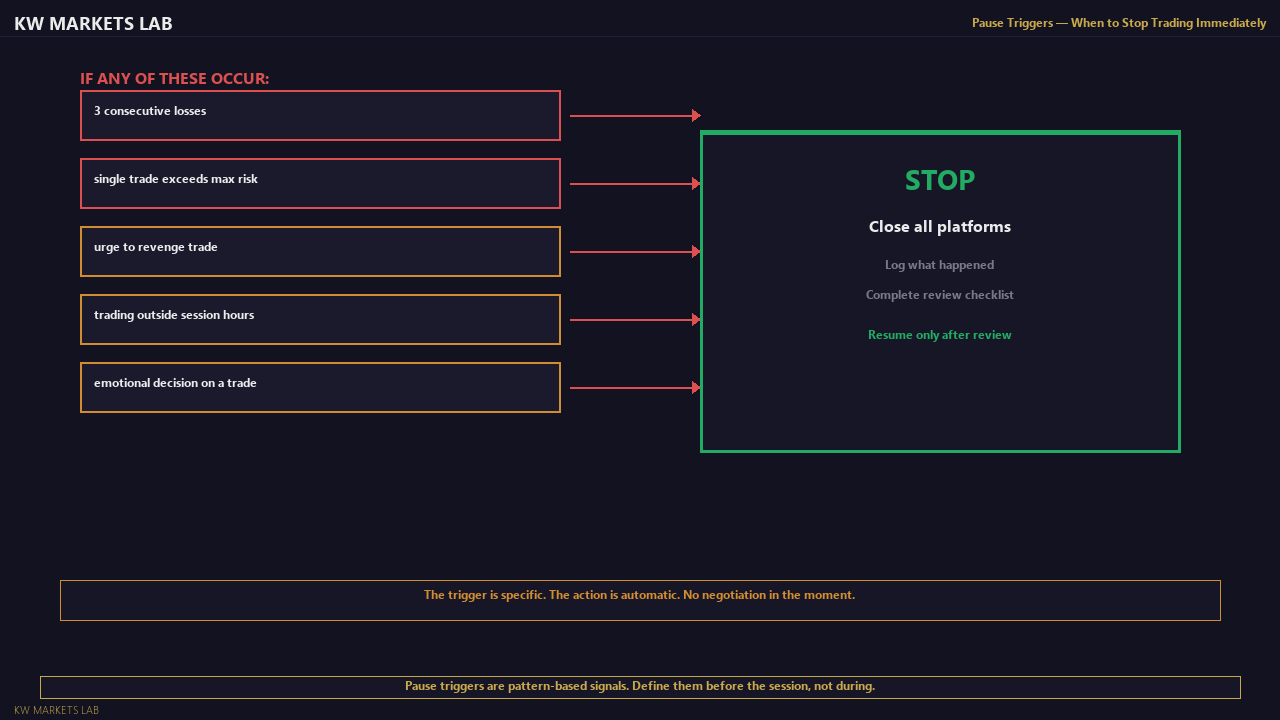
A specific, pre-defined condition that causes you to pause all trading activity and complete a structured review before placing any new trades.
The pause trigger is not the same as the daily or weekly limit. It is a pattern-based signal that your trading has entered a problematic state that requires conscious intervention.
Common pause triggers:
- Three consecutive losses (regardless of whether the daily limit has been hit)
- A single trade loss exceeding the per-trade maximum (indicates a rule was broken)
- Closing a trade and immediately looking for another trade to "make it back"
- Awareness of strong emotional states — anger, frustration, or excessive excitement — while looking at charts
Document it as: "Pause trigger: [specific condition]. When triggered, I stop trading, close all platforms, and do not re-open for a minimum of [X hours]. I complete the review checklist before resuming."
The Review Protocol
Every pause — whether triggered by a daily limit, weekly limit, or pause trigger — should be followed by a structured review. The review is not a feelings exercise. It is a brief analysis of what happened.
Review checklist (5–10 minutes):
- Did I follow my rules on every trade today/this week? (Yes/No on each trade)
- If not, which rule was broken and why?
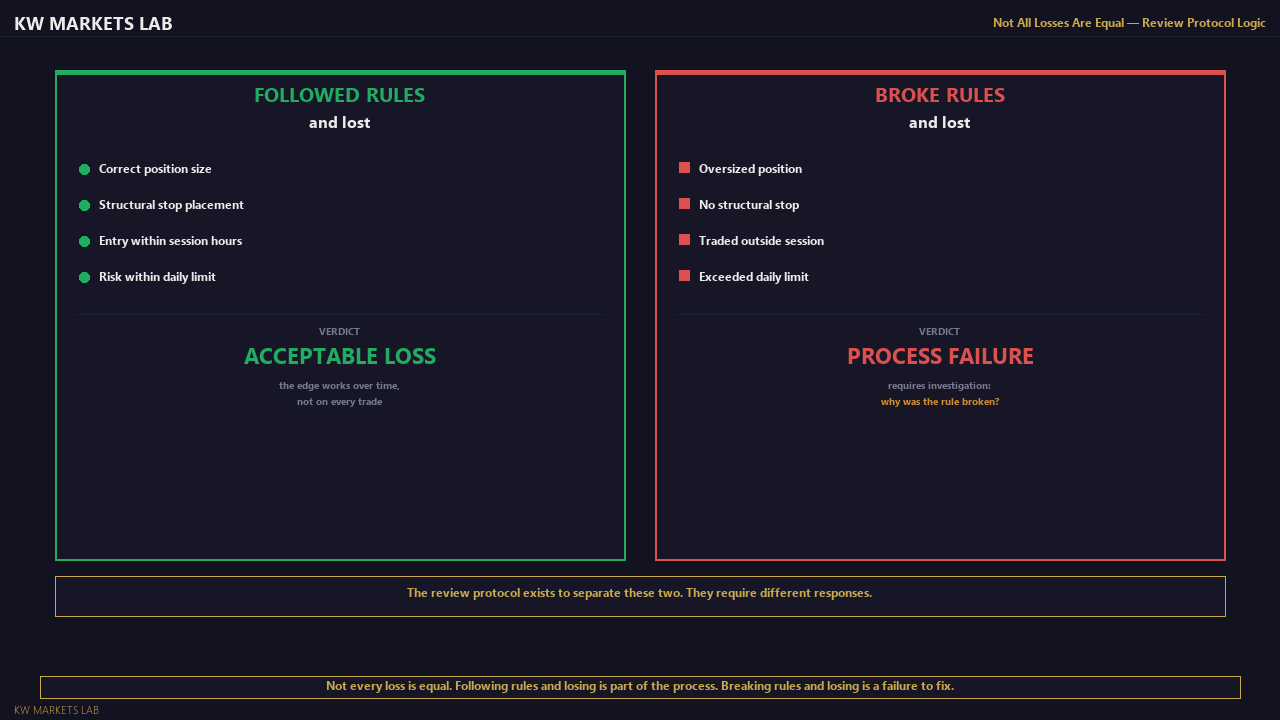
- Were the losses the result of rule-following trades (acceptable losses) or rule-breaking trades (process failures)?
- What specific condition will I look for tomorrow/next week before resuming?
The purpose: distinguish between "I followed my rules and lost" (acceptable — the edge works over time, not on every trade) and "I broke my rules and lost" (a process failure to be corrected). Only the second category requires a change in behaviour.
The Risk Framework Template
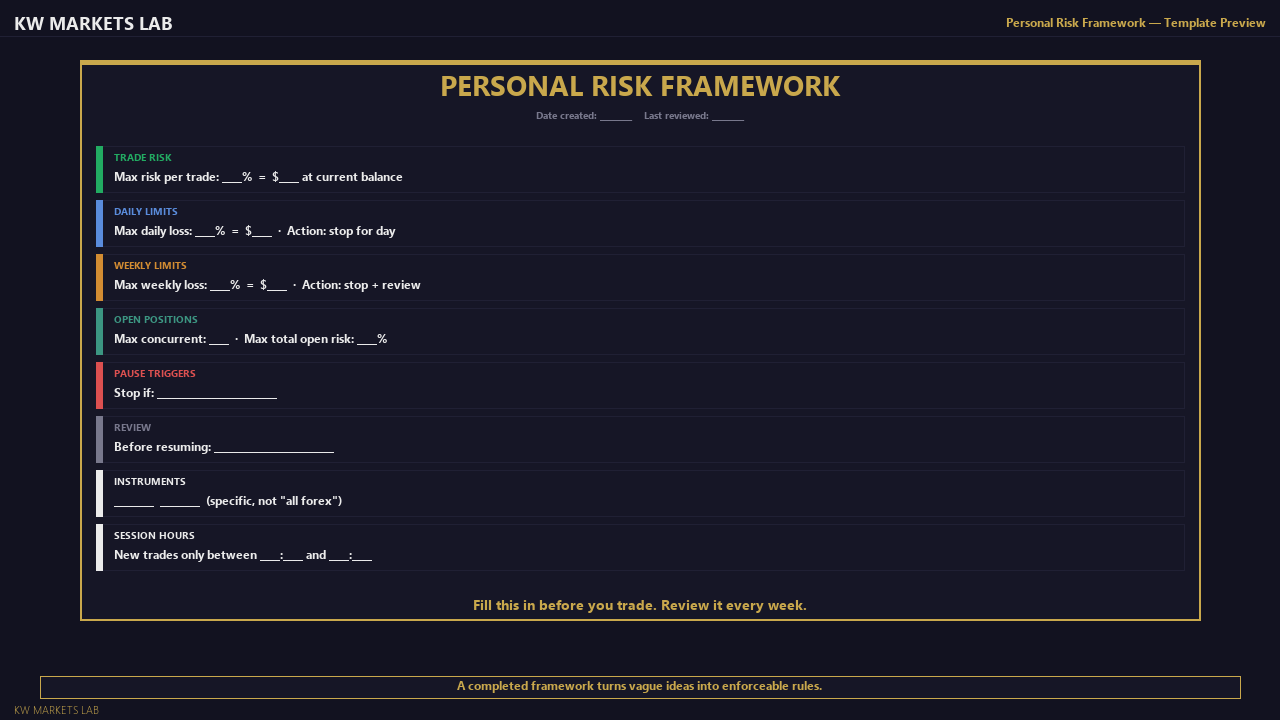
Below is a template to complete and save as your personal document. Review it at the start of every trading week.
```
PERSONAL RISK FRAMEWORK
Date created: [date]
Last reviewed: [date]
TRADE RISK
Maximum risk per trade: [X]% of account equity
This equals $[calculated amount] at my current account balance of $[amount]
No exceptions. No "high conviction" adjustments.
DAILY LIMITS
Maximum daily loss: [X]% of account equity
Action if triggered: Stop all trading for the day. Log the reason. Review rule adherence.
WEEKLY LIMITS
Maximum weekly loss: [X]% of account equity
Action if triggered: Stop all trading for the week. Complete full weekly review.
OPEN POSITIONS
Maximum concurrent open positions: [X]
Maximum total open risk at any time: [Y]% of account equity
PAUSE TRIGGERS
I will immediately stop trading and close all platforms if:
- [e.g., Three consecutive stop-outs in one session]
- [e.g., I feel the urge to enter a trade immediately after a loss]
- [e.g., Any single trade exceeds my maximum risk percentage]
REVIEW REQUIREMENT
Before resuming trading after any limit or trigger is hit:
- [list your 3–5 review questions]
INSTRUMENTS I TRADE
[List your instruments — be specific. "All forex pairs" is not a list.]
SESSION HOURS
I will only place new trades between: [start time] and [end time] local
This corresponds to: [session name] and [session name]
I do not trade outside these hours.
```
Worked Example: A Complete Risk Framework
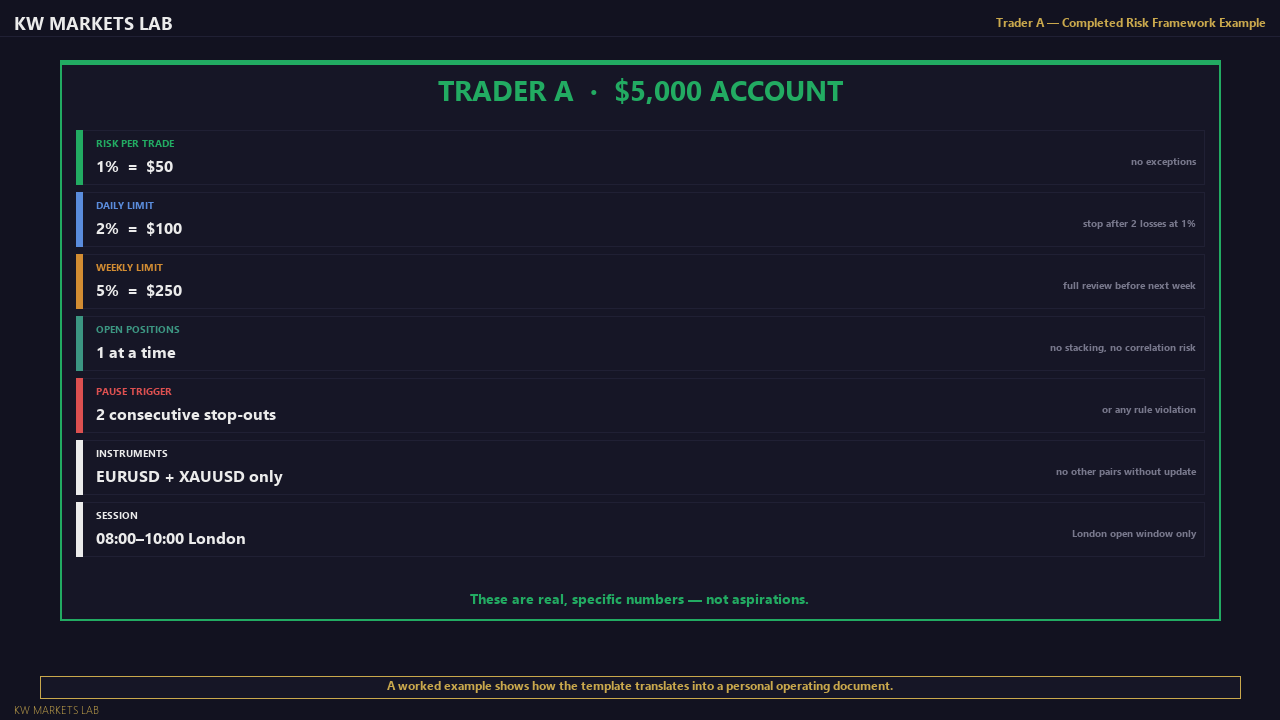
The template above is abstract until you fill it in. Here is a complete worked example for a hypothetical trader — call them Trader A — who is starting with a $5,000 account, trading EURUSD and XAUUSD during the London session, one to two hours per day.
This is not a prescription. Use it as a reference for how to translate the template into real, specific numbers.
Trader A — Personal Risk Framework
Date created: 2026-03-24
Last reviewed: 2026-03-24
TRADE RISK
Maximum risk per trade: 1% of current account equity.
This equals $50.00 at my current account balance of $5,000.
No exceptions. No "high conviction" adjustments.
DAILY LIMITS
Maximum daily loss: 2% of account equity = $100.
Action if triggered: Stop all trading for the day. Close the platform. Log the session in the journal. Do not reopen until the next scheduled session.
WEEKLY LIMITS
Maximum weekly loss: 5% of account equity = $250.
Action if triggered: Stop trading for the week. Complete the full weekly review before resuming the following Monday.
OPEN POSITIONS
Maximum concurrent open positions: 1.
I trade one instrument at a time. No stacking. This removes correlated risk entirely at this stage.
PAUSE TRIGGERS
I will immediately stop trading and close all platforms if:
- I experience two consecutive stop-outs in the same session
- I feel the urge to open a new trade within 5 minutes of a losing trade closing
- Any single trade loses more than $50 (which would indicate a position sizing error or a rule break)
REVIEW REQUIREMENT
Before resuming trading after any limit or pause trigger is hit:
1. Did every trade taken today follow the entry rules in my trading plan? (Yes/No per trade)
2. If not: what was the rule break, and what triggered it emotionally?
3. Were the losses from rule-following trades or rule-breaking trades?
4. Am I re-reading my trading plan before the next session? (Yes — this is a required step, not optional)
INSTRUMENTS I TRADE
EURUSD and XAUUSD only.
I do not trade other instruments without updating this document first.
SESSION HOURS
I place new trades only between 08:00 and 10:00 London time.
This corresponds to the first two hours of the London session.
I do not enter new positions after 10:00, even if I am watching the charts.
Why these specific numbers for Trader A:
- 1% per trade — at $5,000, this is $50 per trade. Losing 10 trades in a row would cost $500 — a 10% drawdown. Survivable and reviewable. Trader A chose 1% over 0.5% because $25 per trade felt psychologically too small to take seriously.
- 2% daily limit — two losing trades at 1% each exhausts the daily limit. This is an intentional tight constraint. At this stage of development, Trader A wants to force a review after two consecutive losses, not four.
- 5% weekly limit — across a five-day week, this allows five losing days at the daily limit before a mandatory weekly review. In practice, a 5% weekly loss with 1% per trade means approximately five losing trades in a week, which is normal at a 40–50% win rate.
- 1 position at a time — keeps total risk at a constant 1% per session, eliminates correlation risk, and prevents overcomplication while learning.
- Session hours 08:00–10:00 London — Trader A works during the day and has a two-hour window. This window covers the London open and early session, which research and observation showed produces the best setups for EURUSD and XAUUSD.
How to Use This Document
- Print it or save it as your desktop background. It must be visible, not buried in a folder.
- Review it at the start of every week. Update the dollar amounts if your account balance has changed significantly.
- Record every time you break a rule. Not to punish yourself — to build an honest picture of your actual behaviour vs your stated framework. The journal (L7.3) is where this record lives.
Common Mistakes
Setting limits too loose to provide any meaningful constraint.
A 20% daily drawdown limit on a 1%-risk account means 20 consecutive losses before you stop. No trader needs 20 losses in a day before pausing. Set limits that create meaningful checkpoints.
Treating the framework as optional when things are "going well."
Risk rules are most at risk of being broken after a winning streak — when confidence is high and the framework feels unnecessary. This is exactly when it is most important.
Not defining the pause trigger precisely.
"I'll stop if I feel emotional" is not a rule — it is a preference that can be overridden in the moment. "Three consecutive losses" is a rule. It is objective and not subject to interpretation.
Creating a framework but not reviewing it weekly.
A framework that is written once and then forgotten is decoration. The weekly review keeps it active and ensures the dollar amounts remain accurate as account balance changes.
Key Takeaways
- A personal risk framework is a written document containing five parameters: max risk per trade, daily drawdown limit, weekly drawdown limit, max concurrent positions, and pause trigger.
- The purpose is to remove in-the-moment decision-making about risk. The rules are pre-made.
- Every pause triggered by a limit or trigger must be followed by a structured review.
- Review the framework weekly and update dollar amounts as account balance changes.
- The framework only works if it is followed consistently — including on days when it feels unnecessary.
Module 6 Deliverable
By the end of this lesson, you should have completed the risk framework template above with your own specific numbers. This is not a theoretical exercise — the completed document is a working tool you will use before every trading session.
If you trade a demo account, complete it for your demo account balance. The habit of working from a written framework is the same regardless of account type.
Save your completed framework and bring it to the Module 7 work on trading plans — the risk framework is one component of the full trading plan you will build there.
Lesson Objective
By the end of this lesson, you should have produced a completed personal risk framework template with specific numbers for all five parameters, and be able to explain what each parameter protects against and why a written document is more reliable than relying on in-the-moment judgment.
Get notified when new lessons and content are published.