Course Outline — Lesson 10 of 22 ▼
L4.1 — Session Times and Why They Matter
Session Times and Why They Matter
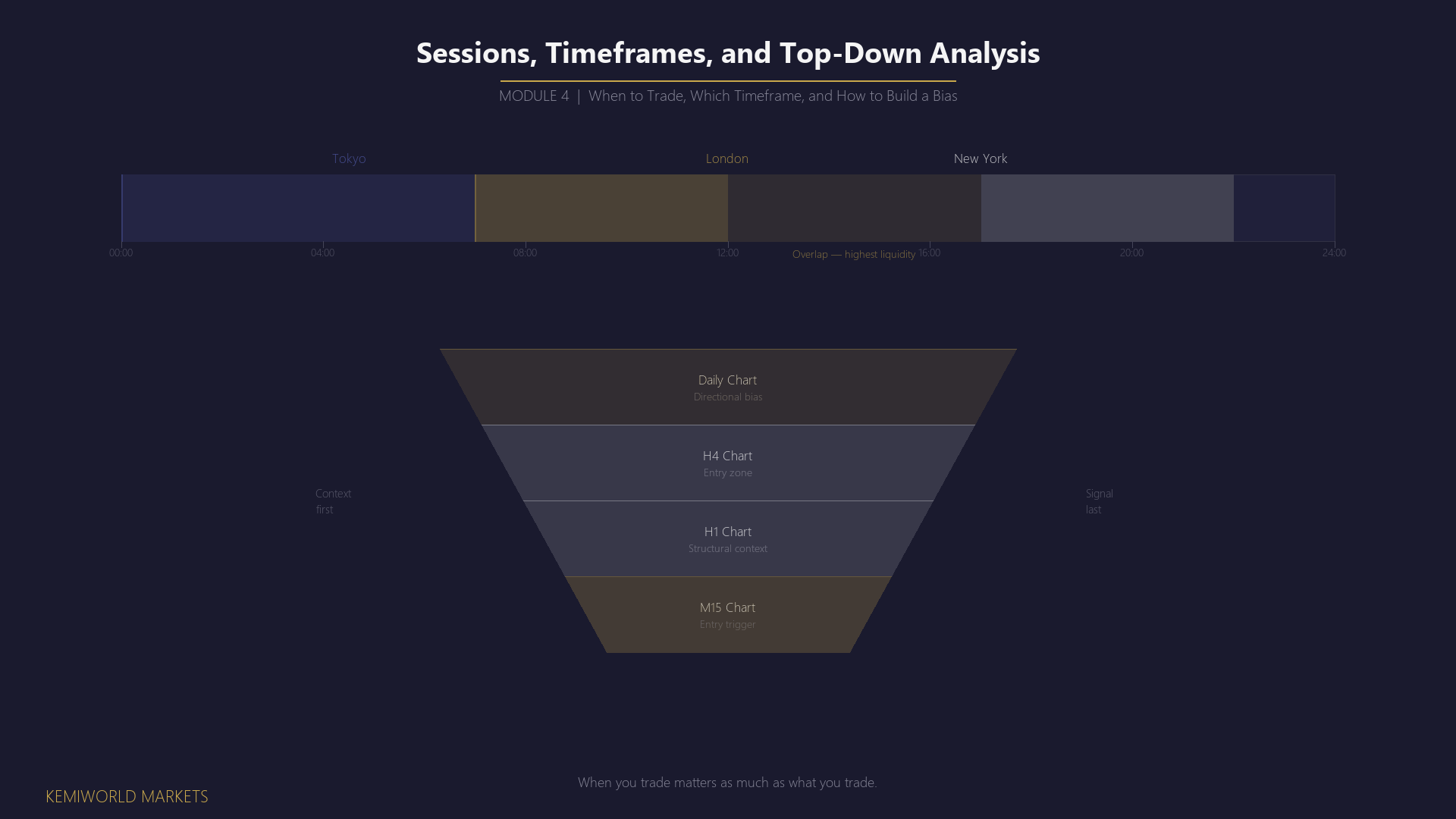
Forex and gold do not trade with uniform activity across the 24-hour trading day. The market is divided into three major sessions — Asia, London, and New York — each with distinct volume levels, volatility characteristics, and directional tendencies. Trading during the right session for your instrument and strategy is one of the simplest, most underrated improvements a developing trader can make.
This lesson explains the three sessions, what happens in each, and how to identify the highest-probability windows for your trading approach.
The Three Sessions
Asian Session (Tokyo)
- Approximate times: 00:00–09:00 London / 19:00–02:00 New York (BST/EST varies by season)
- Key participants: Japanese, Chinese, Australian, and Southeast Asian banks and institutions
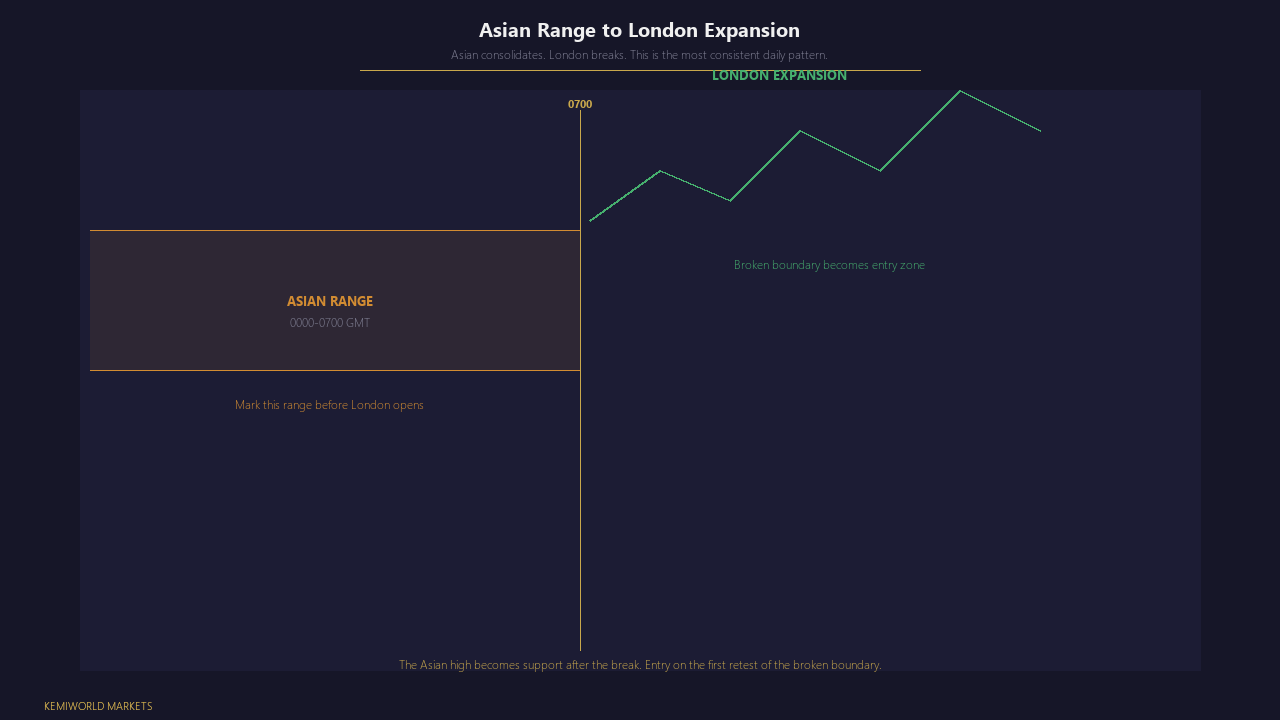
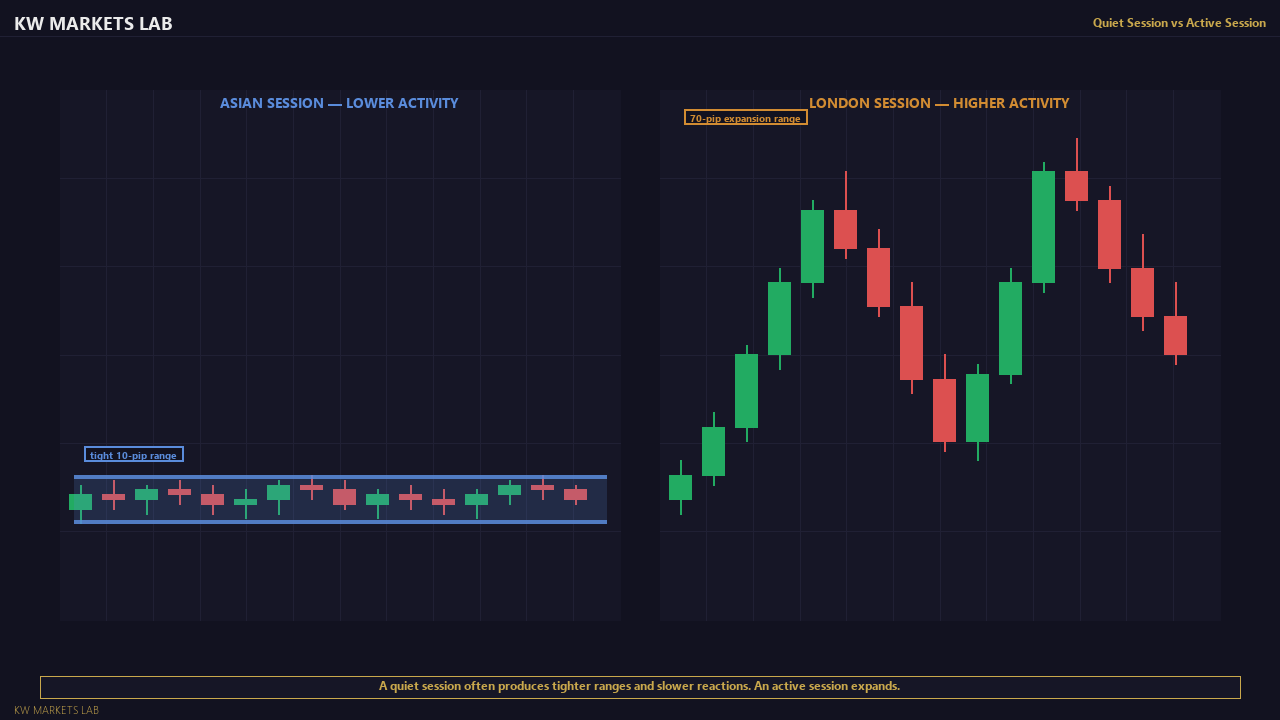
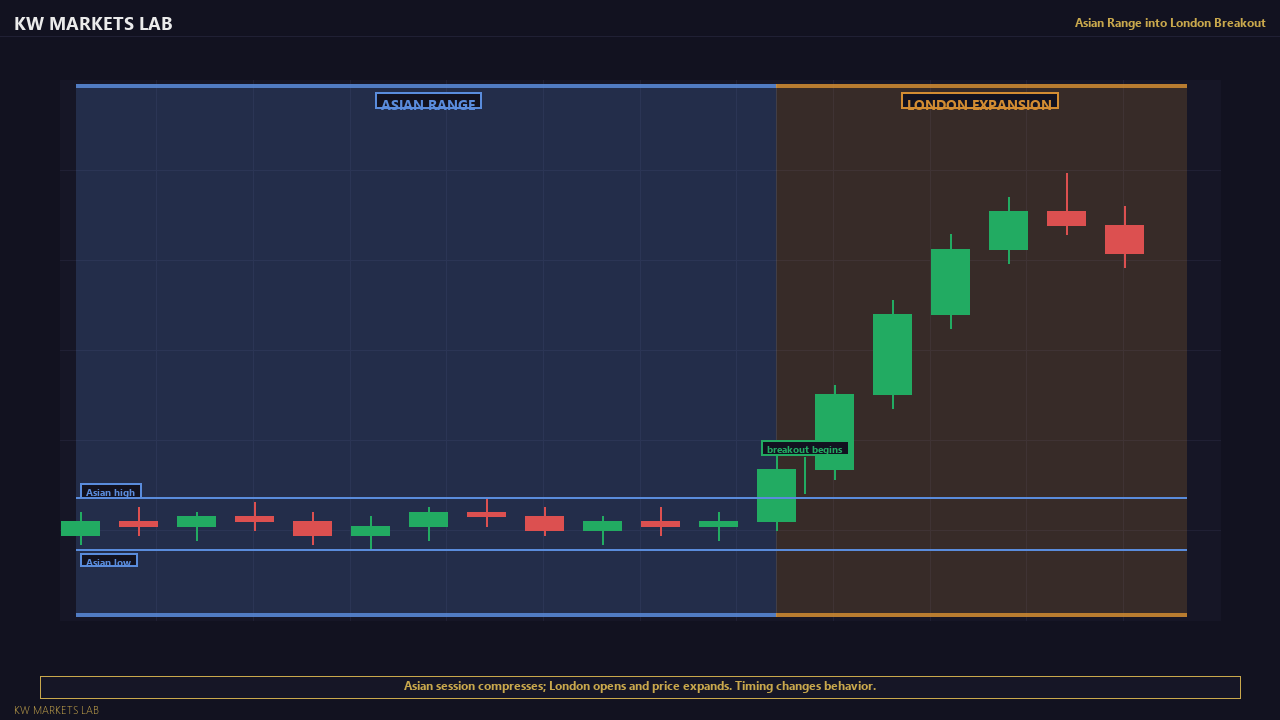
- Characteristics: Lower volume relative to London and New York. Forex pairs involving JPY, AUD, and NZD are most active. Other major pairs (EURUSD, GBPUSD) and gold often range or consolidate. Price sets a coil — a tight range that tends to be resolved in the subsequent sessions.
The Asian session is not low activity in an absolute sense — it is lower relative to the other sessions. For XAUUSD specifically, Asia sets a range that London then expands upon. The Asian high and low become significant reference points (covered in L3.3).
London Session (European)
- Approximate times: 08:00–17:00 London / 03:00–12:00 New York
- Key participants: UK, German, French, Swiss, and broader European banks and institutions
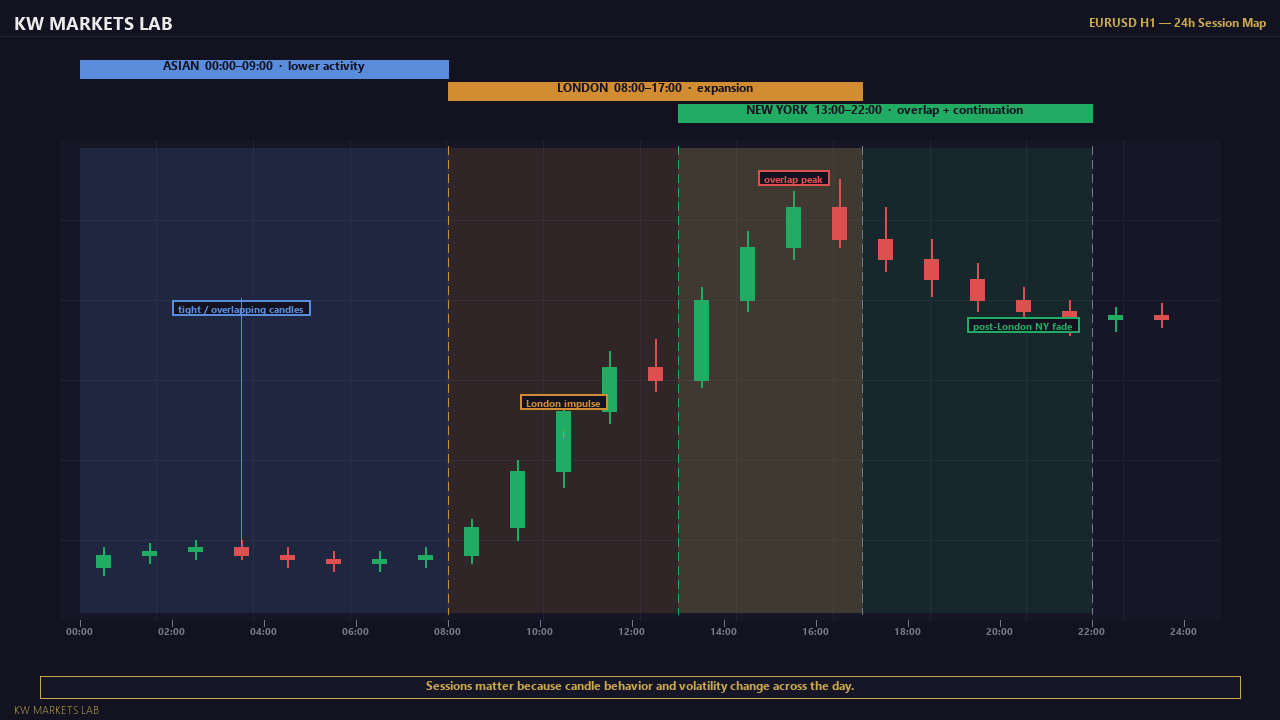
- Characteristics: This is the highest-volume session for major forex pairs. The London open (08:00 London time) is the single most important moment in the trading day for EURUSD, GBPUSD, and XAUUSD. Institutional order flow is at its peak. Large directional moves — the kind that create clean structural breaks and strong trend candles — most often begin at or shortly after the London open.
For most traders whose instruments include EUR/GBP pairs or gold, the London session is where their primary trading activity should be concentrated. The quality of setups, the follow-through on moves, and the cleanness of price action are all highest here.
New York Session
- Approximate times: 13:00–22:00 London / 08:00–17:00 New York
- Key participants: US and Canadian banks, major US equity market participants
- Characteristics: High volume, especially during the overlap with London (13:00–17:00 London time). The New York open (13:00 London) is the second most important moment in the trading day. Major US economic data (NFP, CPI, FOMC) is released at 13:30 London time (08:30 ET), creating the largest volatility spikes of the week.
The New York–London overlap (13:00–17:00 London) is the peak-volatility window globally. The highest pip ranges, the most liquid executions, and the most impulsive moves occur in this 4-hour window.
The London–New York Overlap: The Peak Volatility Window
The overlap between London and New York (roughly 13:00–17:00 London time) deserves specific attention because:
- Both the largest European and largest North American institutions are simultaneously active.
- The combined liquidity is at its maximum.
- US economic data releases fall within this window on most high-impact days.
- The moves that form during this overlap tend to define the daily candle's body and direction.
If your trading strategy depends on clear, impulsive directional moves (which most do), this is the window where those moves are most likely to develop cleanly. Setups that start in Asia and drift in London often resolve forcefully during the overlap.
How Sessions Affect Your Instrument
EURUSD and GBPUSD: Most active during London and the overlap. Ranging or low-volatility during Asia. Trading these pairs during Asian hours is generally lower probability unless you are specifically trading the Asian range breakout.
XAUUSD (Gold): Highly active in both London and New York due to gold's dual nature as a commodity (mined globally) and a financial instrument (priced in USD). The Asian session often sets the range that London breaks. News-driven spikes are most violent during the NY overlap. Gold is one of the most active instruments in terms of daily pip range.
Indices (US500, US30, UK100): US indices are relevant during New York only — they require the US equity market to be open (13:30–20:00 London time). UK100 is active during London hours. Trading US indices outside of US market hours means trading relatively thin, low-liquidity conditions.
USDJPY and JPY pairs: More active during the Asian and early London session. Japanese economic data is released during Asian hours.
Practical: Converting Session Times
A common practical problem: knowing what time the London open is in your local timezone, accounting for daylight saving changes between the UK, US, and your location.
The reference framework:
- London open: 08:00 GMT (07:00 in winter, 08:00 in summer — UK changes clocks in late March and late October)
- NY open: 13:00 London time (08:00 ET)
- NY close: 22:00 London time (17:00 ET)
Most charting platforms (MT5, TradingView) allow you to display session boxes as a visual overlay. Use these tools. Do not rely on manually calculating session times every day — set them up once and leave them visible on your chart.
If your broker quotes time in server time (often GMT+2 or GMT+3), adjust accordingly. Your broker's session times should be findable in their documentation or support pages.
Why Trading Outside High-Probability Sessions Costs You
Trading during low-volume sessions is not just lower opportunity — it is actively disadvantageous:
- Spreads widen during low-volume periods, increasing your entry cost on every trade.
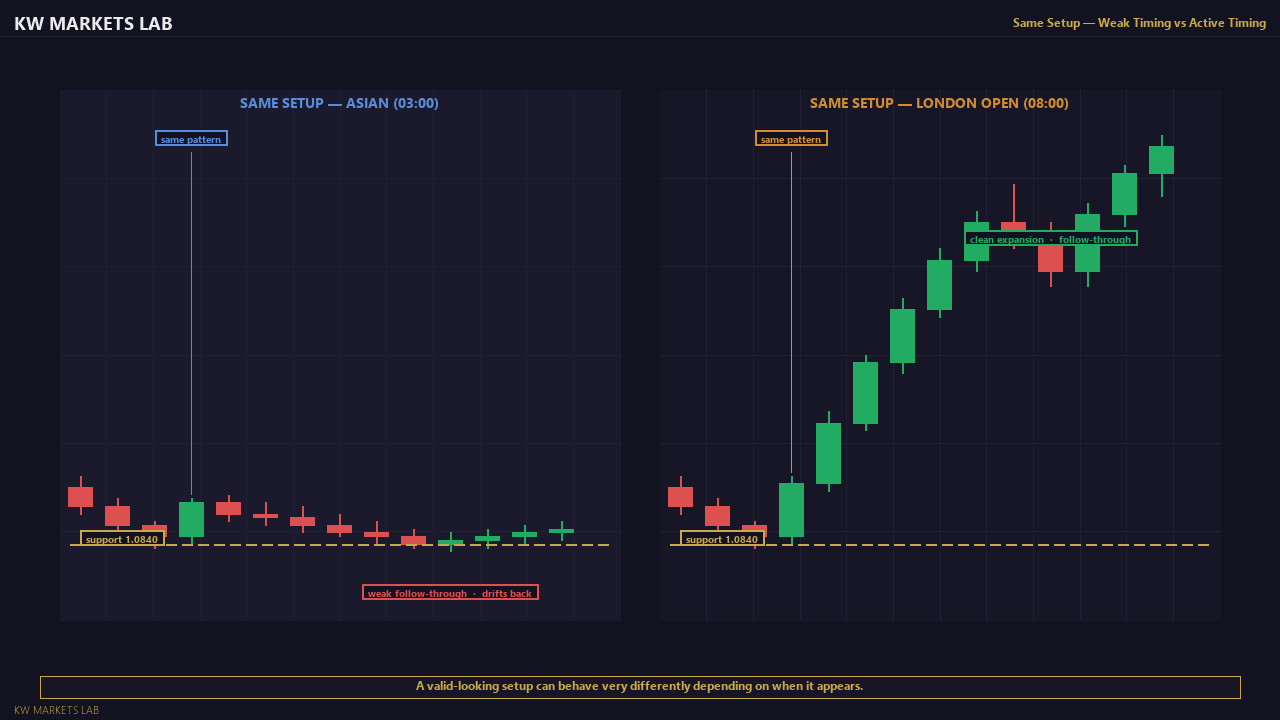
- Price action is choppier and less directional, producing more false signals and whipsaws.
- Institutional participants are absent, meaning the order flow that creates clean structural moves is not present.
A common pattern for beginners: taking a trade at 03:00 London time in the Asian session, getting stopped out by a choppy range, then watching the position they wanted to be in move sharply in their direction at the London open — after they were already out.
The discipline is simple: do your analysis at any time, but execute during the right session for your instrument.
Common Mistakes
Trading major forex pairs during the Asian session. Low volume, wide spreads, choppy range conditions. Higher probability exists later in the day.
Not accounting for daylight saving time changes. The US and UK change clocks on different dates each year. A trader who sets their alarm for "08:00 London open" may be one hour out for weeks after one region changes but the other has not.
Chasing late New York moves. Moves that start well into the NY session (after 19:00 London) are often running out of momentum. Entering late in a session means the institutional participants who drove the move are starting to wind down their activity.
Ignoring the overlap. Treating 13:00–17:00 London time as "just another hour" misses the highest-quality, highest-volume window of the trading day.
Key Takeaways
- Three sessions: Asia (consolidation), London (highest volume for EUR/GBP/gold), New York (US data, equity correlation).
- The London open (08:00 London) is the single most important moment of the day for most forex traders and gold traders.
- The London–NY overlap (13:00–17:00 London) is the peak-volatility window globally.
- Session times change with daylight saving — use platform session overlays, not manual calculation.
- Trade during the right session for your instrument. Avoid Asian session trading for major EUR/GBP pairs unless you are specifically using an Asian range breakout strategy.
Checkpoint Exercise
- Open your charting platform and find the session overlay or time zone display feature.
- Mark the current London open and NY open times in your local timezone. Account for the current daylight saving status.
- On a 1-hour chart of XAUUSD, identify the most recent Asian session range (the tight consolidation before the London open). Mark the Asian high and low.
- Note what happened at the London open: did price sweep the Asian low before moving higher, sweep the Asian high before moving lower, or break cleanly in one direction from the open?
Lesson Objective
By the end of this lesson, you should be able to explain the three trading sessions, state which session is most active for each major instrument, identify the London–NY overlap as the peak-volatility window, and correctly calculate session open times in your local timezone.
Get notified when new lessons and content are published.