Course Outline — Lesson 1 of 22 ▼
L1.1 — What Is a Financial Market?
What Is a Financial Market?
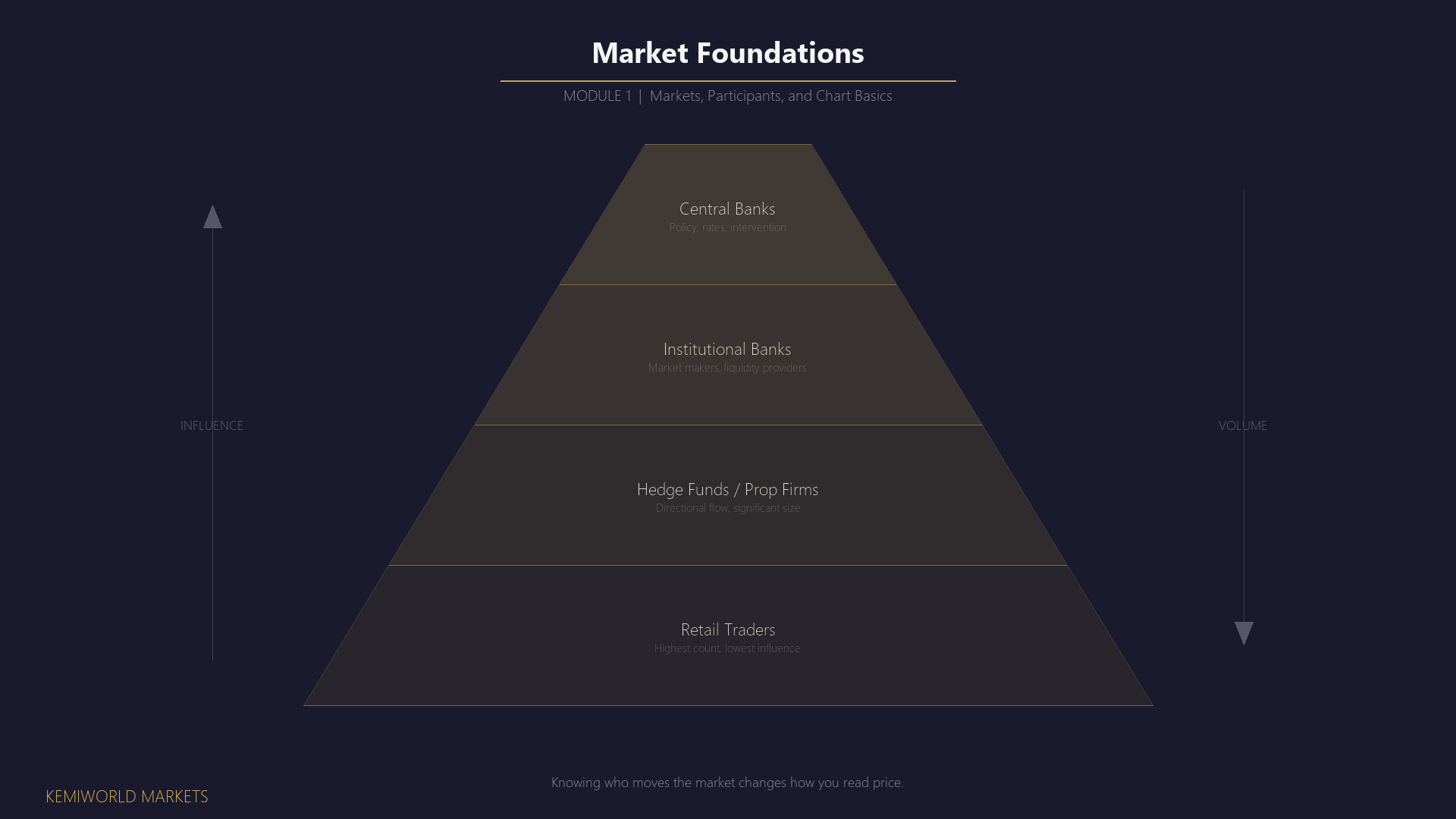
A financial market is a system that allows buyers and sellers to exchange assets at prices they agree on. That is the entire mechanism, stripped to its core. Everything else — the charts, the indicators, the news feeds, the algorithms — is built on top of that single exchange: one party wants to buy, another wants to sell, and between them they agree on a price.
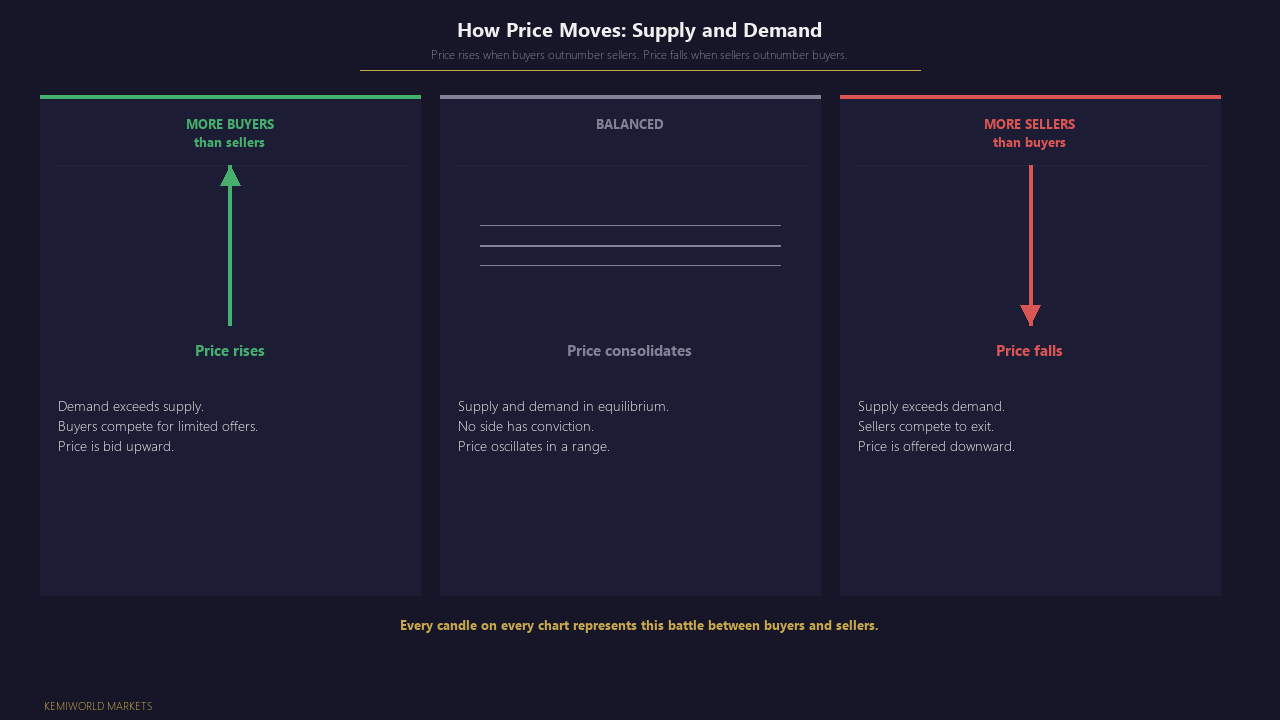
Understanding this clearly matters because most traders skip it. They move straight to chart patterns and indicators without ever building a solid model of what price actually represents. The result is that their analysis is technically correct but contextually wrong — they can spot a pattern on a chart without understanding what produced it or why it might or might not repeat.
What Price Actually Represents
At any given moment, price is not a fact. It is an agreement.
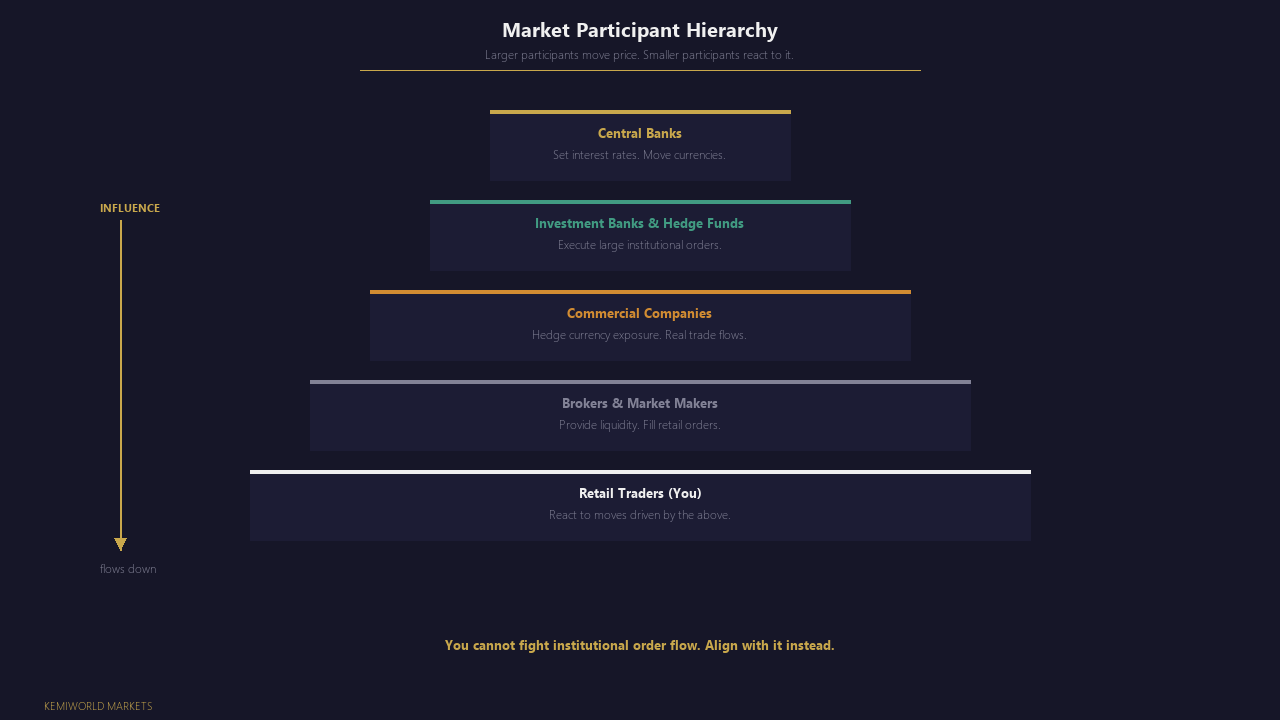
The price of EURUSD at 1.0850 does not mean that the euro is "worth" 1.0850 dollars in some absolute sense. It means that at this moment, the most recent buyer and seller agreed on that number. The next trade might happen at 1.0851 or at 1.0848. Price is the continuous, real-time output of millions of competing judgements about value.
This has an important implication: price does not lie, but it does not tell the whole story on its own. A candlestick moving upward means buyers were more aggressive than sellers in that period. It does not tell you why, or for how long, or whether the buyers have finished or are just getting started.
Reading a chart well means reading this flow of competing pressure, not hunting for geometric shapes.
Why Markets Exist
Financial markets exist to solve a practical problem: matching people who have capital they want to deploy with people who need that capital.
A currency market allows companies operating in multiple countries to exchange one currency for another. A gold market allows miners to sell their output and investors to hold a store of value. An indices market allows investors to buy exposure to the collective performance of a group of companies.
The secondary function — and the one most retail traders participate in — is speculation. Traders take positions not to exchange currency for business purposes, but to profit from price movements. Speculation is a legitimate activity when practised with proper risk management. It is not a reliable income source when practised without one.
The Three Instruments You Will Study in This Course
Forex (currency pairs)
Forex is the world's largest financial market by volume, with an estimated $7.5 trillion traded per day. Currency pairs trade the relative value of two currencies. EURUSD trades the euro against the US dollar. GBPUSD trades the British pound against the dollar. You buy if you believe the first currency will strengthen against the second; you sell if you believe the opposite.
Forex is highly liquid, available nearly 24 hours a day during the trading week, and has low barriers to entry. It is also heavily influenced by macroeconomic data, central bank decisions, and geopolitical events — all of which must be understood at a basic level before trading.
XAUUSD — Gold
Gold is traded as a commodity but behaves like a currency pair on most platforms. XAUUSD means the price of one troy ounce of gold in US dollars. At the time of writing, gold trades above $2,000 per ounce and can move $20–$50 in a single trading session under normal conditions.
Gold has unique characteristics compared to forex pairs: wider spreads, more volatile moves, strong reactions to economic data releases, and a historically inverse relationship with the US dollar. Module 5 covers gold in depth. For now, know that the same structural analysis you will learn in M1–M4 applies directly to gold charts.
Indices
A stock index tracks the collective performance of a group of companies. The S&P 500 (US500) tracks 500 large US companies. The FTSE 100 (UK100) tracks 100 large UK companies. Indices generally trend more consistently than currency pairs, correlate strongly with economic conditions and market sentiment, and can serve as useful macro context for other instruments.
What "Trading" Actually Involves
To be precise about what you are doing when you trade:
You are speculating on the future direction of price relative to a defined entry point, with a defined maximum loss (stop loss) if you are wrong, and a defined profit target if you are right. You are not predicting. You are not investing. You are taking a measured risk with the expectation that over a sufficient number of trades, your wins will outweigh your losses by enough to be profitable after costs.
This distinction — between speculating systematically and guessing with hope — is what separates traders who improve from those who do not. The entire framework of this course is built on that distinction.
Lesson Summary
- A financial market is a mechanism for buyers and sellers to agree on prices for assets.
- Price is not a fact — it is an agreement between the most recent buyer and seller.
- The three instruments in this course are forex pairs, XAUUSD (gold), and indices.
- Trading is speculation with defined risk, not prediction, and not investing.
Lesson Objective
By the end of this lesson, you should be able to explain in plain language what a financial market is, what price represents at any given moment, and describe the main characteristics of forex, gold, and indices in two to three sentences each.
Get notified when new lessons and content are published.