Course Outline — Lesson 17 of 22 ▼
L6.3 — Position Sizing: How to Calculate Lot Size
Position Sizing: How to Calculate Lot Size
Position sizing is the mechanical output of the risk management framework. You have defined your risk percentage (L6.1) and placed your stop at the correct structural level (L6.2). Position sizing is the calculation that determines how large your position must be so that, if the stop is hit, your loss is exactly your defined risk amount — no more.
This calculation is not optional. Estimating lot size by feel or using a round number every time produces inconsistent risk across trades. Inconsistent risk means your results are driven by random variation in position sizes rather than by the quality of your trading.
Lot Sizes: Standard, Mini, and Micro
Before the formula, you need to understand lot sizes:
| Lot type | Size | Typical forex pip value (USD account, USD pair) |
|---|---|---|
| Standard lot | 100,000 units | ~$10 per pip |
| Mini lot | 10,000 units | ~$1 per pip |
| Micro lot | 1,000 units | ~$0.10 per pip |
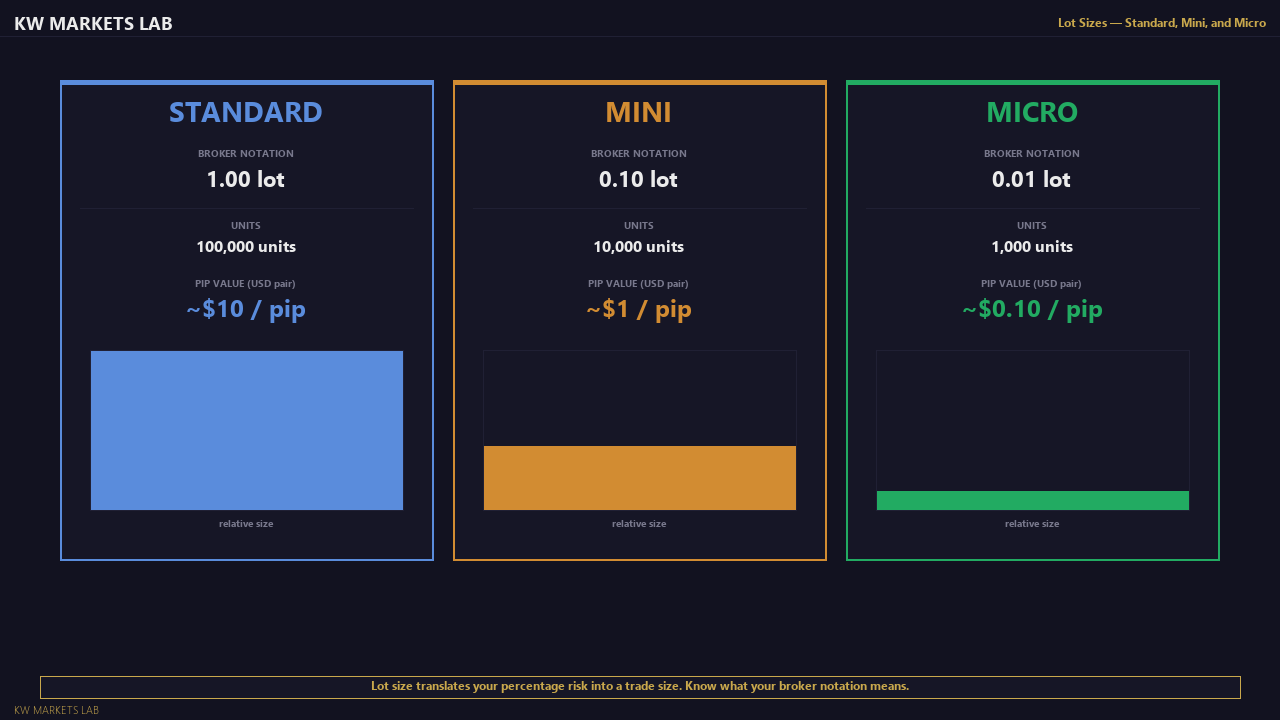
Most retail brokers allow trading in micro lots (0.01 lots on MT5 notation), which allows precise position sizing even on small accounts.
Note on pip values: Pip value varies by instrument and account currency. For EURUSD with a USD account, 1 pip on a standard lot ≈ $10. For GBPUSD, the pip value is similar but fluctuates with the exchange rate. For XAUUSD, pip value is different — gold is typically quoted to 2 decimal places, and a $1.00 move in gold on a standard lot = $100. Broker documentation or a lot size calculator will give you exact pip values for your specific instruments and account currency.
The Position Sizing Formula
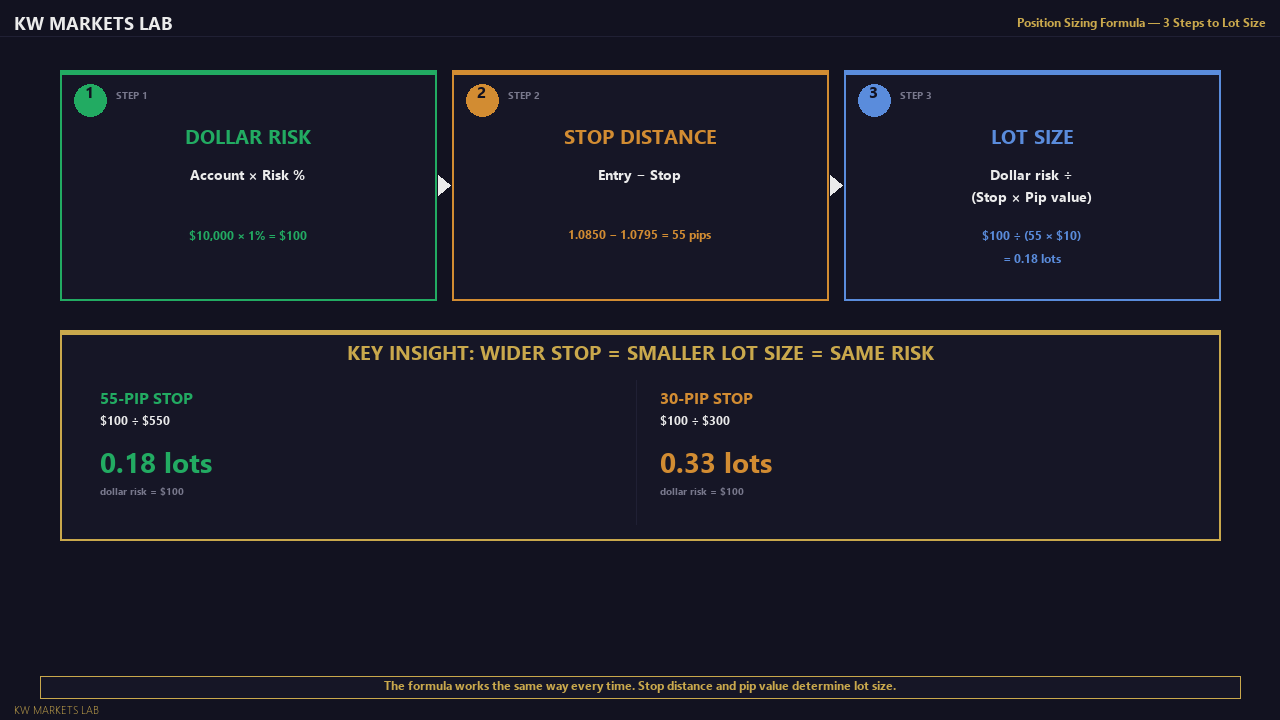
Step 1: Calculate your dollar risk for this trade.
Dollar risk = Account balance × Risk percentage
Example: $10,000 × 1% = $100
Step 2: Calculate your stop loss distance.
Stop distance in pips (or USD for gold) = Entry price − Stop price (for longs)
Example: Entry at 1.0850, stop at 1.0800 = 50 pips
Step 3: Calculate your position size.
Position size (in lots) = Dollar risk ÷ (Stop distance × Pip value per lot)
For forex pairs where pip value ≈ $10 per pip per standard lot:
Position size = $100 ÷ (50 pips × $10) = $100 ÷ $500 = 0.20 standard lots (or 2 mini lots)
Worked Example 1 — EURUSD
Scenario: $10,000 account. Risk 1% per trade. Long EURUSD.
- Entry: 1.0850
- Stop: 1.0795 (below the structural swing low with buffer)
- Stop distance: 55 pips
- Dollar risk: $10,000 × 1% = $100
- Pip value (EURUSD, standard lot, USD account): $10 per pip
Position size: $100 ÷ (55 × $10) = $100 ÷ $550 = 0.18 lots (round to 0.18 or 0.17 on your broker)
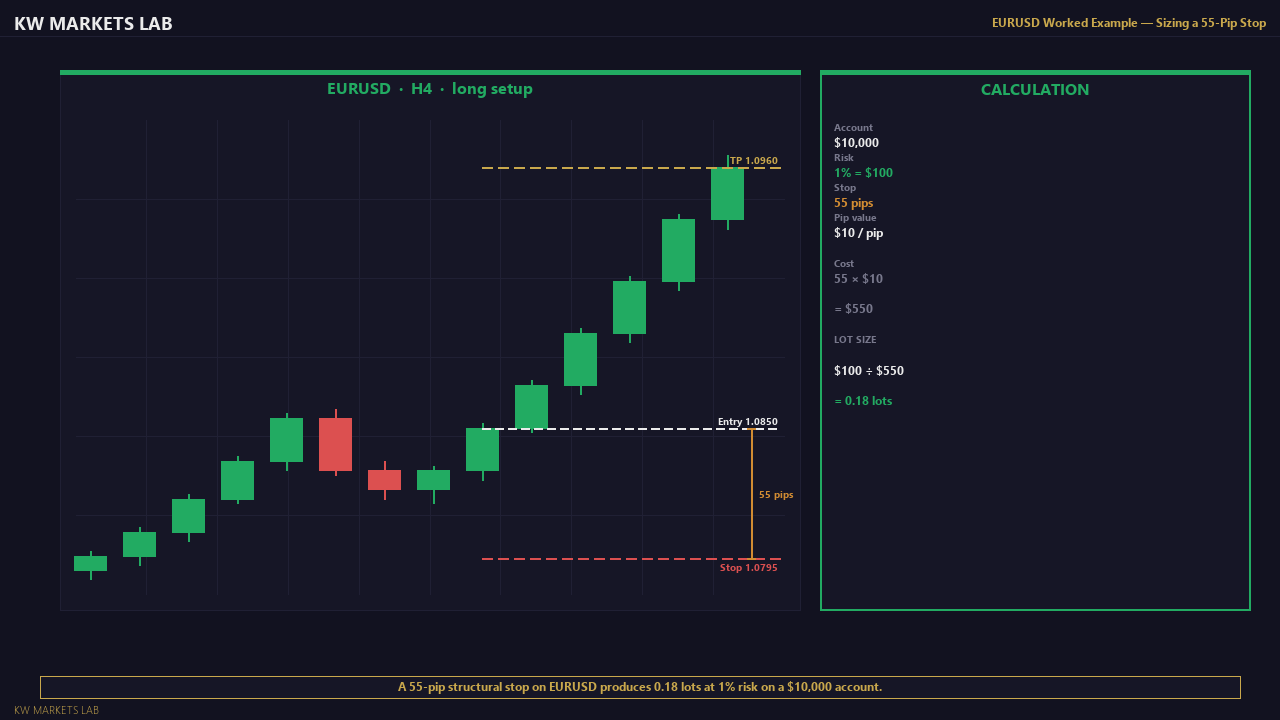
If the stop is hit: loss ≈ 0.18 × 55 × $10 = $99 ≈ $100. Correct.
If the target is at 1.0960 (110 pips away): profit ≈ 0.18 × 110 × $10 = $198 = 1.98R. Risk:reward ≈ 1:2.
Worked Example 2 — XAUUSD (Gold)
Gold has a different pip structure. On most brokers, gold is quoted to 2 decimal places ($2,345.67). A $1.00 move = 100 pips in MT5 notation, but in practical terms we work in dollar move distances.
Pip value on gold (standard lot): $1.00 move = $100 profit/loss per standard lot. So: $1.00 move on a 0.01 lot = $1.00.
Or more simply: loss = (stop distance in dollars) × lot size × 100
Scenario: $10,000 account. Risk 1% per trade. Long XAUUSD.
- Entry: $2,340.00
- Stop: $2,325.00 (below structural support, $15 below entry)
- Stop distance: $15.00
- Dollar risk: $100
Position size: $100 ÷ ($15.00 × $100 per lot) = $100 ÷ $1,500 = 0.067 lots → round to 0.06 or 0.07 lots
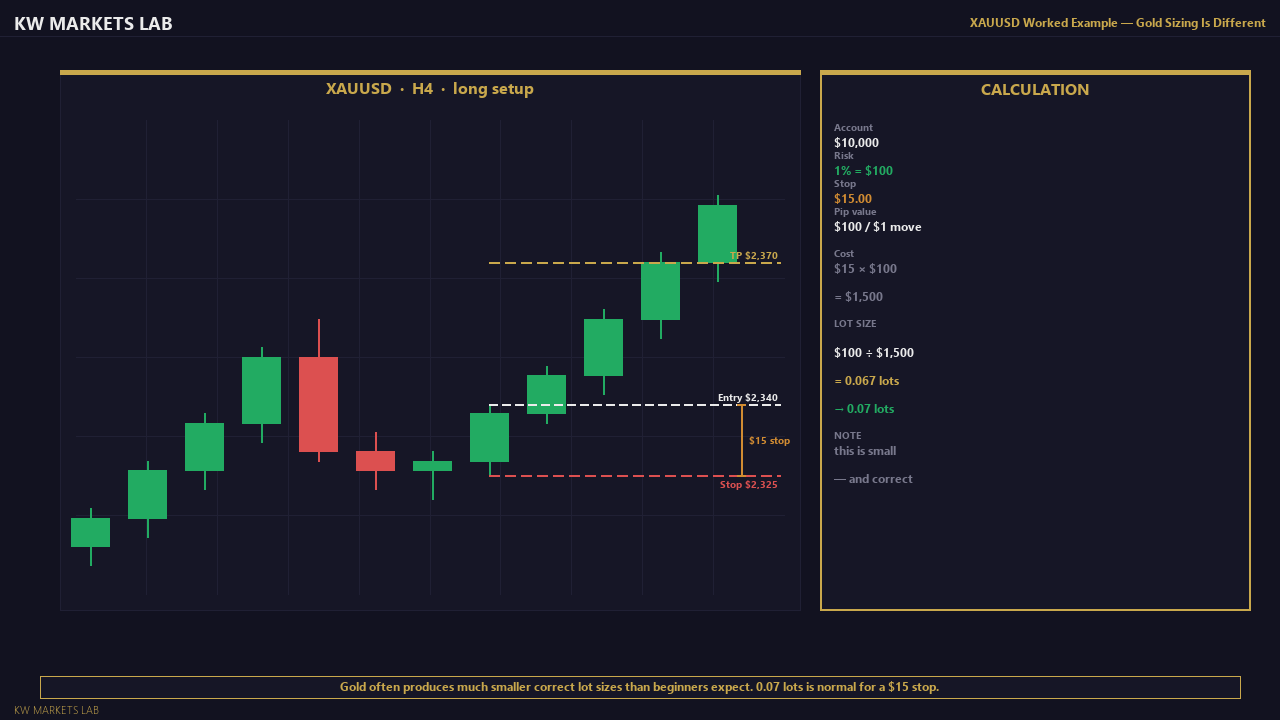
Verify: 0.07 lots × $15 stop × 100 = $105. Close to $100 target risk. Acceptable.
Note how small this is: 0.07 lots on gold is a micro-to-mini position. This is correct for a $15 stop on a $10,000 account at 1% risk. Traders who "always trade 0.5 lots" on gold are risking $750 on a $15 stop — 7.5% of a $10,000 account on a single trade.
Worked Example 3 — Smaller Account
Scenario: $2,000 account. Risk 1% per trade. Long GBPUSD.
- Entry: 1.2700
- Stop: 1.2660 (40 pips)
- Dollar risk: $2,000 × 1% = $20
- Pip value (GBPUSD): approximately $10 per pip per standard lot (fluctuates with GBPUSD rate)
Position size: $20 ÷ (40 × $10) = $20 ÷ $400 = 0.05 lots
This is a micro-lot position. On a $2,000 account, this is correct. Many beginners feel this is too small. At 1:2 risk:reward:
- Risk: $20
- Reward: $40
Over 100 trades at 45% win rate and 1:2 RR:
- 45 wins × $40 = $1,800
- 55 losses × $20 = $1,100
- Net: +$700 on a $2,000 account = 35% return
35% annual return from trades where each one was $20 risk. The size does not need to feel large for the framework to be profitable.
Tools: Lot Size Calculators
Manual calculation is important to understand, but in practice most traders use a lot size calculator for every trade.
Recommended tools:
- MT5 built-in: In the Trade tab, some brokers have a risk% input that calculates lot size automatically. Check your broker's MT5 version.
- Myfxbook Lot Size Calculator — browser-based, supports most instruments.
- Forex calculators on FXBlue — includes spread-adjusted calculations.
- Spreadsheet template — a simple Excel/Google Sheets formula replicating the calculation above. Recommended as a learning exercise, then automate once you understand the maths.
Do not rely on a calculator without understanding the formula behind it. If the calculator gives you an unexpected number, you need to be able to identify why.
Common Errors
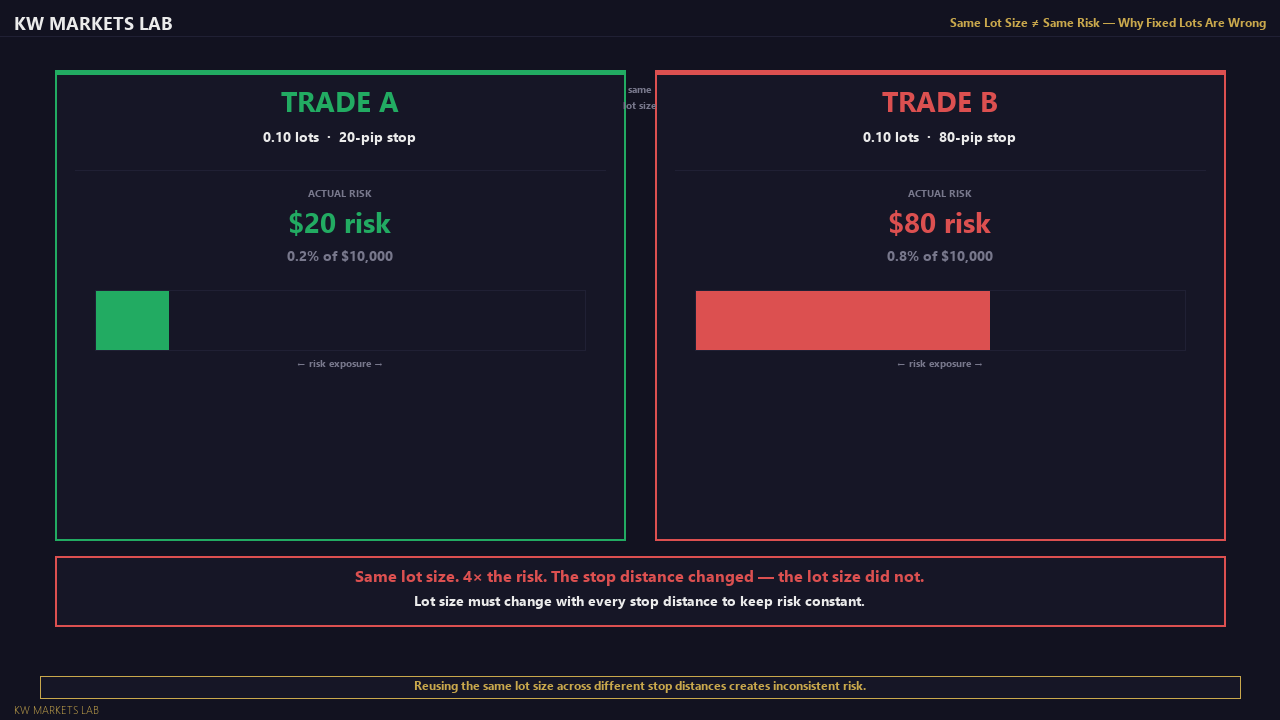
Using the same lot size every trade regardless of stop distance.
A 0.10 lot trade with a 20-pip stop risks $20. A 0.10 lot trade with an 80-pip stop risks $80. Same lot size, very different risk. Lot size must change with stop distance to keep dollar risk consistent.
Round-lotting without calculation.
"0.1 lots feels right" is not position sizing. Calculate first, then round to the nearest tradeable lot size your broker supports.
Forgetting that pip values vary.
EURUSD and GBPJPY have different pip values. XAUUSD has a completely different structure. Using a EURUSD pip value formula for XAUUSD produces a significantly wrong position size.
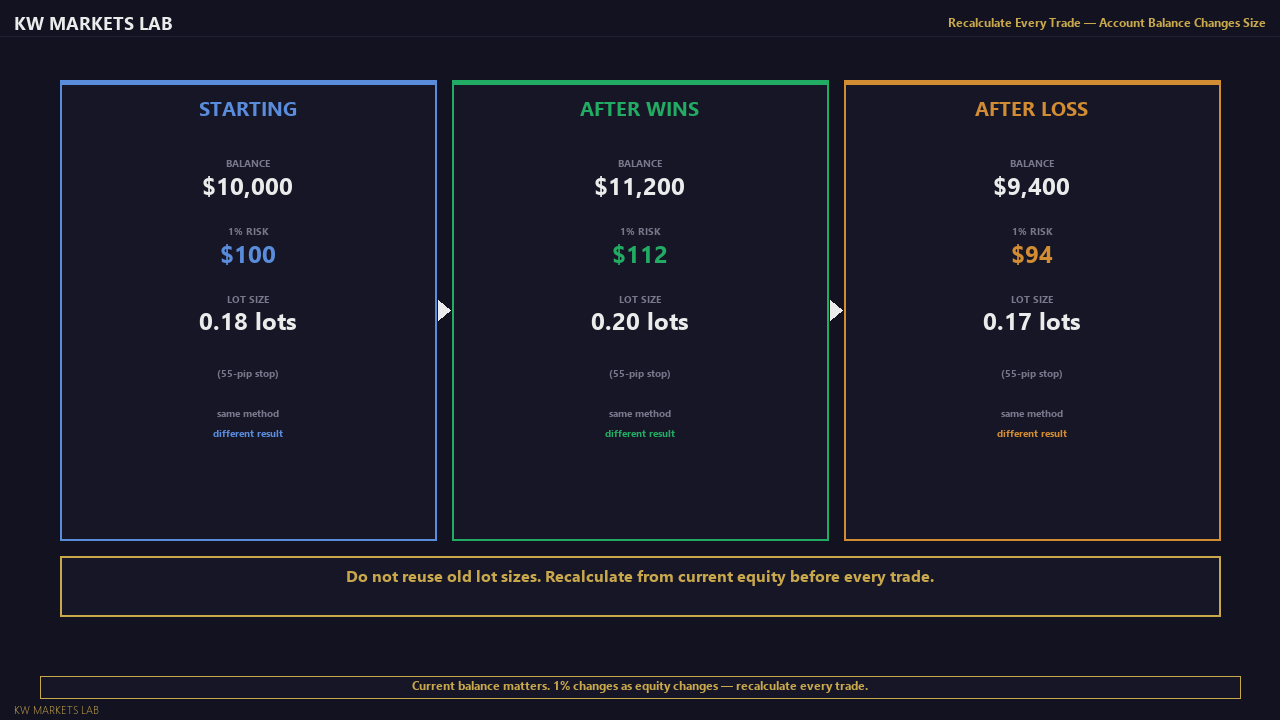
Not recalculating as account grows or shrinks.
Position size should be recalculated for every trade based on current account balance. If your account has grown to $11,200, your 1% risk is now $112, not $100. Recalculate each time.
Ignoring swap (overnight funding costs).
For trades held overnight, your broker charges or pays a swap fee. On large positions held for multiple days, this becomes a meaningful component of actual profit and loss. It is not a position sizing input, but it is a cost to be aware of.
Key Takeaways
- Position size is calculated from three inputs: dollar risk, stop distance, and pip value.
- Formula: Position size = Dollar risk ÷ (Stop distance × Pip value per lot)
- The formula changes by instrument — gold pip structure is different from forex.
- Use a lot size calculator for every trade, but understand the formula behind it.
- Recalculate for every trade using current account balance — do not reuse the same lot size across different trades or account sizes.
Checkpoint: Position Sizing Worksheet
Work through these three scenarios. Show your working.
Scenario A: $8,000 account. Risk 1.5%. Long EURUSD. Entry 1.0920, stop 1.0870 (50 pips). What is the correct lot size?
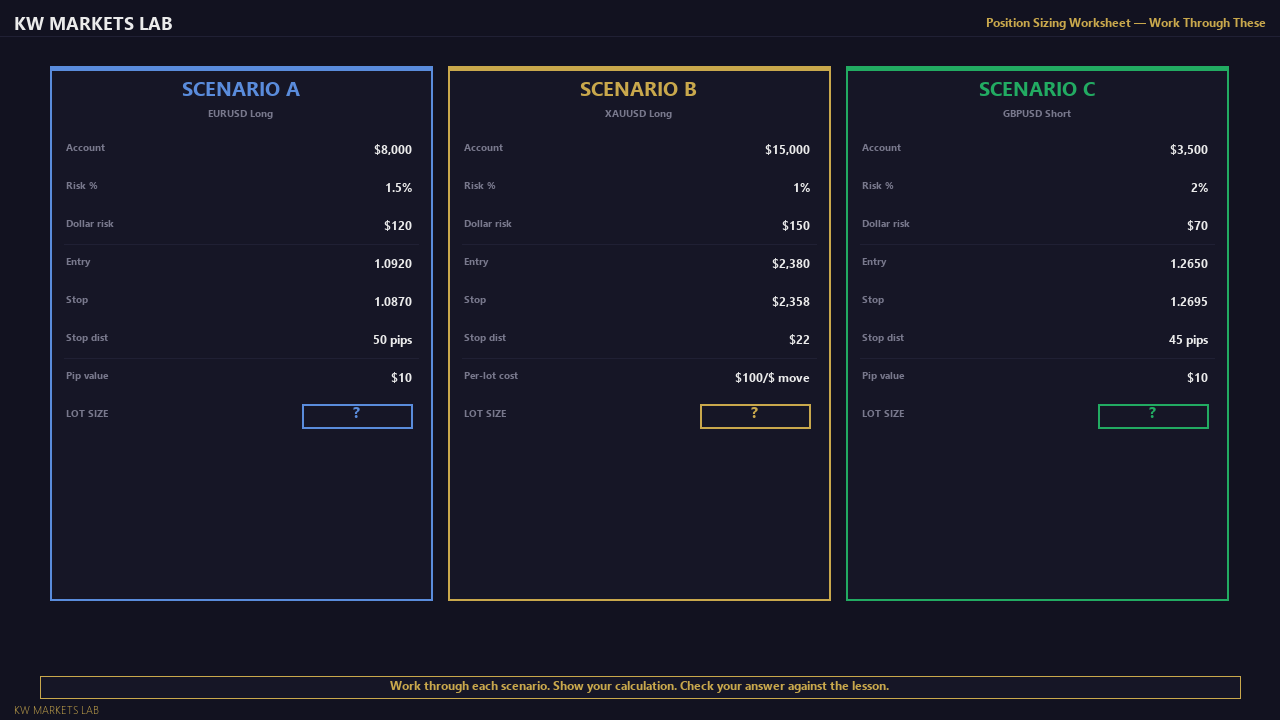
Scenario B: $15,000 account. Risk 1%. Long XAUUSD. Entry $2,380.00, stop $2,358.00 ($22 stop). What is the correct lot size?
Scenario C: $3,500 account. Risk 2%. Short GBPUSD. Entry 1.2650, stop 1.2695 (45 pips). What is the correct lot size?
Check your answers:
- A: $120 ÷ (50 × $10) = 0.24 lots
- B: $150 ÷ ($22 × $100) = 0.068 lots → 0.07 lots
- C: $70 ÷ (45 × $10) = 0.156 lots → 0.15 lots
Lesson Objective
By the end of this lesson, you should be able to calculate the correct lot size for a forex or XAUUSD trade given account balance, risk percentage, stop distance, and pip value — and correctly apply different formulas to different instruments.
Get notified when new lessons and content are published.