Advanced Trading Psychology and Discipline / Module 5: Avoiding Self-Sabotage Lesson 16 of 16
Course Outline — Lesson 16 of 16
M1 Emotional Traps in Trading
1 L1.1 — Why Smart Traders Make Irrational Decisions 2 L1.2 — The Five Emotional Traps: FOMO, Revenge, Hope, Overconfidence, Paralysis 3 L1.3 — Cognitive Biases That Affect Trading Decisions 4 L1.4 — Identifying Your Personal Trigger Patterns
M2 Building a Discipline Framework
1 L2.1 — Rules vs Intentions: Why Intentions Are Not Enough 2 L2.2 — The Pre-Session Routine as a Performance Tool 3 L2.3 — The Post-Session Review: Closing the Loop
M3 Journaling and Performance Review
1 L3.1 — What a Useful Trade Journal Looks Like 2 L3.2 — Separating Process Failures from Variance 3 L3.3 — Monthly Review: Pattern Recognition Across Sessions
M4 Building Repeatable Behaviour
1 L4.1 — Habit Architecture for Traders 2 L4.2 — Measuring Process Compliance as a KPI 3 L4.3 — Accountability Structures: Making Your Rules Hard to Break
M5 Avoiding Self-Sabotage
1 L5.1 — Self-Sabotage Patterns in Trading 2 L5.2 — Identity and the Professional Trader Mindset 3 L5.3 — Building a Long-Term Discipline Practice
Lesson 16 of 16

L5.3 — Building a Long-Term Discipline Practice

Discipline in trading is not a state you achieve — it is a practice you maintain. The framework built in this course requires ongoing application: daily pre-session routines, post-session reviews, weekly compliance measurement, monthly performance reviews, and quarterly rule updates. Each of these is a small, repeatable action. The compound effect of maintaining them consistently over 12-24 months produces a level of process maturity that is genuinely difficult to develop in any other way.

The most important single habit: journaling. Every other discipline mechanism in this course is supported by the journal. Without it, patterns are invisible, compliance is unmeasured, and improvement is subjective. With it, the trading process becomes transparent, measurable, and improvable.
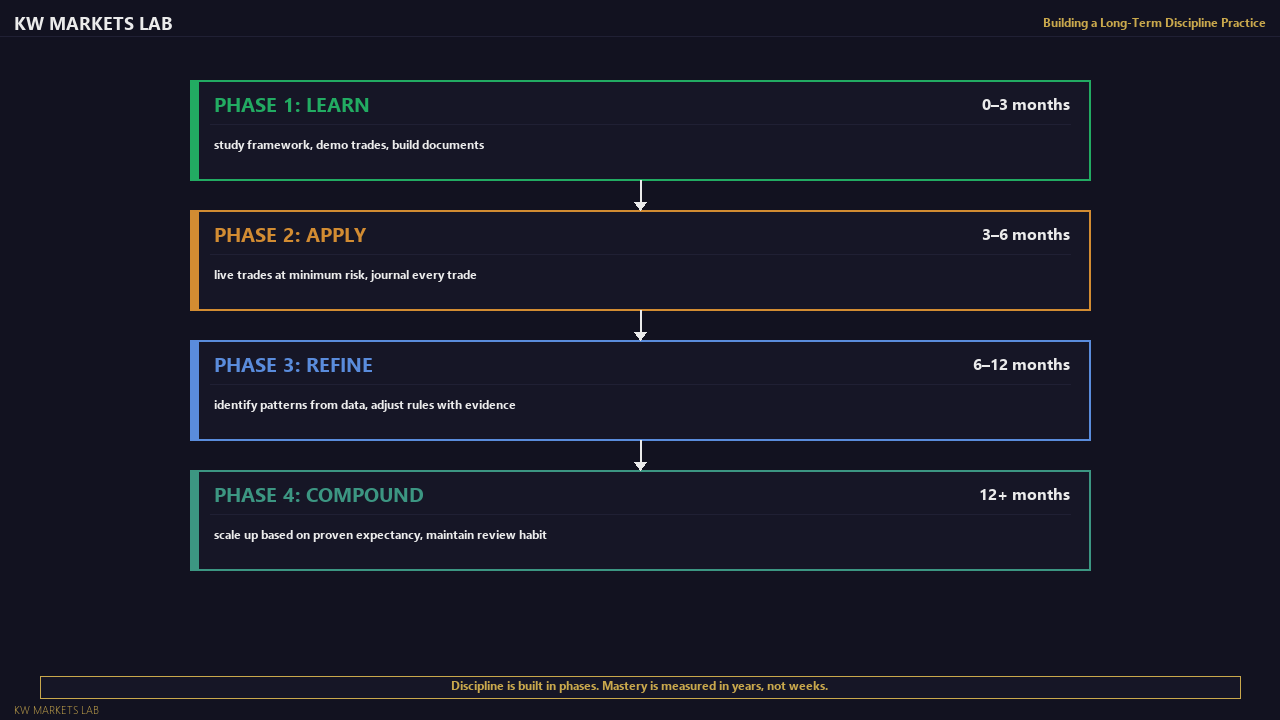
Long-Term Discipline Practice
Long-Term Discipline PracticeMastery is measured in years, not weeks.

Commit to the minimum viable discipline practice: one pre-session routine, one journal entry per trade, one post-session review. Do this for 90 days. Do not add more complexity until the baseline is automatic. At 90 days, review your compliance rate and your performance. The correlation between the two will be the most compelling argument for maintaining the practice permanently.

Course Complete — Next in Path
Gold-specific sessions, volatility, stop buffers, and kill z →
Stay Updated

Get notified when new lessons and content are published.