Advanced Trading Psychology and Discipline / Module 1: Emotional Traps in Trading Lesson 1 of 16
Course Outline — Lesson 1 of 16
M1 Emotional Traps in Trading
1 L1.1 — Why Smart Traders Make Irrational Decisions 2 L1.2 — The Five Emotional Traps: FOMO, Revenge, Hope, Overconfidence, Paralysis 3 L1.3 — Cognitive Biases That Affect Trading Decisions 4 L1.4 — Identifying Your Personal Trigger Patterns
M2 Building a Discipline Framework
1 L2.1 — Rules vs Intentions: Why Intentions Are Not Enough 2 L2.2 — The Pre-Session Routine as a Performance Tool 3 L2.3 — The Post-Session Review: Closing the Loop
M3 Journaling and Performance Review
1 L3.1 — What a Useful Trade Journal Looks Like 2 L3.2 — Separating Process Failures from Variance 3 L3.3 — Monthly Review: Pattern Recognition Across Sessions
M4 Building Repeatable Behaviour
1 L4.1 — Habit Architecture for Traders 2 L4.2 — Measuring Process Compliance as a KPI 3 L4.3 — Accountability Structures: Making Your Rules Hard to Break
M5 Avoiding Self-Sabotage
1 L5.1 — Self-Sabotage Patterns in Trading 2 L5.2 — Identity and the Professional Trader Mindset 3 L5.3 — Building a Long-Term Discipline Practice
Lesson 1 of 16

L1.1 — Why Smart Traders Make Irrational Decisions

Trading activates the same neural circuits as gambling. When real money is at stake, the brain's threat-response system — the amygdala — fires before the prefrontal cortex has processed the situation rationally. This is not a character flaw. It is biology. The question is not whether your emotional system will influence your trading decisions — it will. The question is whether you have a structure that constrains those influences before they cause damage.

Intelligent, disciplined professionals — doctors, lawyers, engineers — frequently make systematically irrational trading decisions. The trading environment is specifically designed by its structure (variable rewards, near-miss losses, intermittent reinforcement) to produce exactly the behaviours that destroy performance. Understanding this is the first step toward building a defence against it.
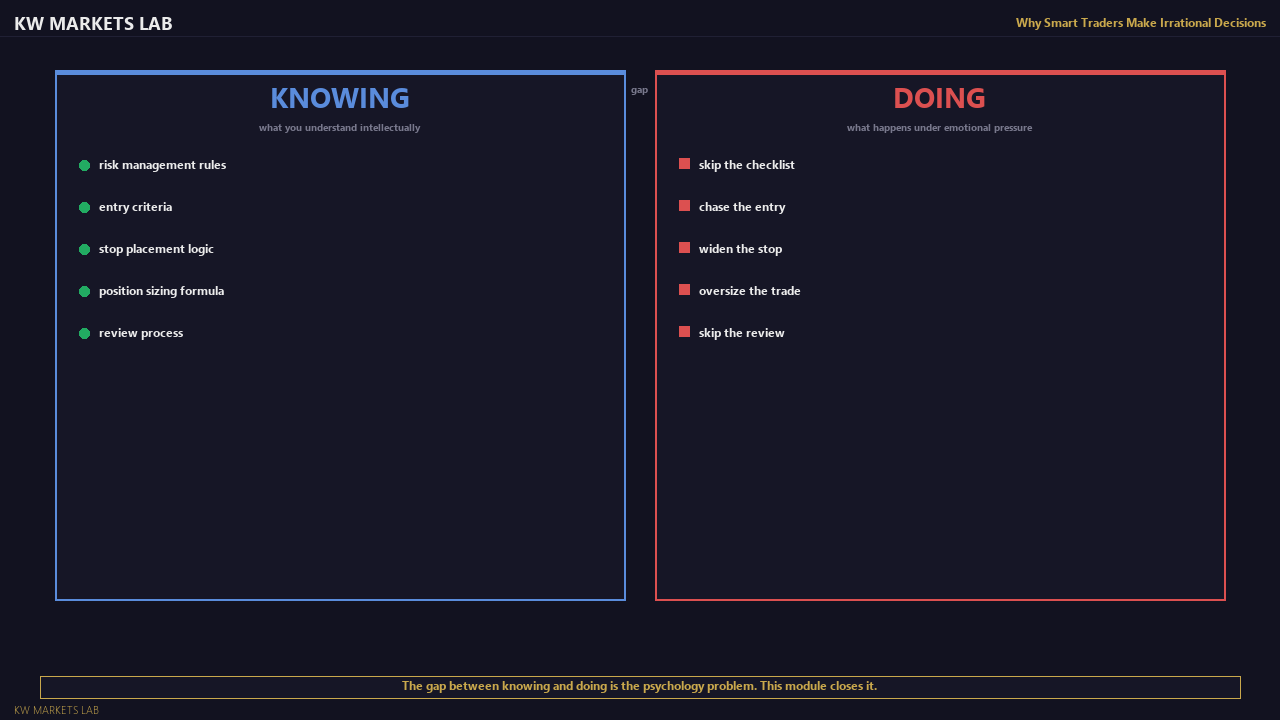
Knowing vs Doing Gap
Knowing vs Doing GapThe gap between knowing and doing is the psychology problem.

The defence is not willpower — willpower degrades under pressure. The defence is structure: rules defined in advance that remove the need for in-the-moment decisions. The discipline modules in this course build that structure. But first, you need to understand exactly which emotional patterns you are defending against.

Continue Learning
L1.2 — The Five Emotional Traps: FOMO, Revenge, Hope, Overconfidence, Paralysis →
Stay Updated

Get notified when new lessons and content are published.