Advanced Trading Psychology and Discipline / Module 3: Journaling and Performance Review Lesson 9 of 16
Course Outline — Lesson 9 of 16
M1 Emotional Traps in Trading
1 L1.1 — Why Smart Traders Make Irrational Decisions 2 L1.2 — The Five Emotional Traps: FOMO, Revenge, Hope, Overconfidence, Paralysis 3 L1.3 — Cognitive Biases That Affect Trading Decisions 4 L1.4 — Identifying Your Personal Trigger Patterns
M2 Building a Discipline Framework
1 L2.1 — Rules vs Intentions: Why Intentions Are Not Enough 2 L2.2 — The Pre-Session Routine as a Performance Tool 3 L2.3 — The Post-Session Review: Closing the Loop
M3 Journaling and Performance Review
1 L3.1 — What a Useful Trade Journal Looks Like 2 L3.2 — Separating Process Failures from Variance 3 L3.3 — Monthly Review: Pattern Recognition Across Sessions
M4 Building Repeatable Behaviour
1 L4.1 — Habit Architecture for Traders 2 L4.2 — Measuring Process Compliance as a KPI 3 L4.3 — Accountability Structures: Making Your Rules Hard to Break
M5 Avoiding Self-Sabotage
1 L5.1 — Self-Sabotage Patterns in Trading 2 L5.2 — Identity and the Professional Trader Mindset 3 L5.3 — Building a Long-Term Discipline Practice
Lesson 9 of 16

L3.2 — Separating Process Failures from Variance

A process failure is a trade where you violated your rules. A variance event is a trade where you followed your rules perfectly and it still lost. These are fundamentally different events with different implications. A process failure requires a behavioural adjustment. A variance event requires nothing — it is the statistical reality of trading a probabilistic edge. Treating them the same is one of the most common causes of strategy abandonment and rule tinkering.

The practical test: go through your last 20 losing trades and categorise each one. Process failure: you can identify a specific rule that was violated. Variance: the rules were followed and the trade did not work. If your process failures are concentrated in specific emotional conditions or setup types, that is actionable. If your losses are primarily variance, the process is working and needs time, not adjustment.
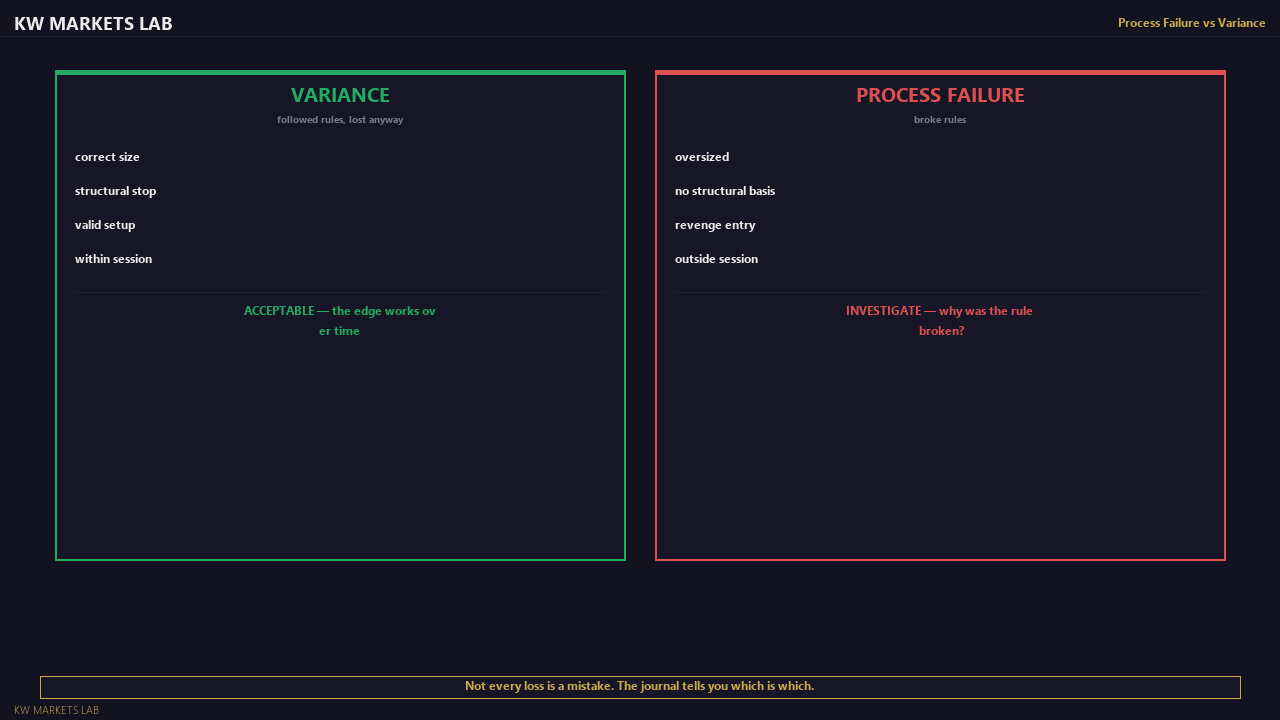
Process Failure vs Variance
Process Failure vs VarianceNot every loss is a mistake.

Traders who cannot make this distinction typically change their strategy after every losing streak, never accumulating the sample size needed to prove whether the edge actually works. The discipline of maintaining the process long enough to distinguish variance from failure is the prerequisite for all genuine improvement.

Continue Learning
L3.3 — Monthly Review: Pattern Recognition Across Sessions →
Stay Updated

Get notified when new lessons and content are published.