Advanced Trading Psychology and Discipline / Module 4: Building Repeatable Behaviour Lesson 12 of 16
Course Outline — Lesson 12 of 16
M1 Emotional Traps in Trading
1 L1.1 — Why Smart Traders Make Irrational Decisions 2 L1.2 — The Five Emotional Traps: FOMO, Revenge, Hope, Overconfidence, Paralysis 3 L1.3 — Cognitive Biases That Affect Trading Decisions 4 L1.4 — Identifying Your Personal Trigger Patterns
M2 Building a Discipline Framework
1 L2.1 — Rules vs Intentions: Why Intentions Are Not Enough 2 L2.2 — The Pre-Session Routine as a Performance Tool 3 L2.3 — The Post-Session Review: Closing the Loop
M3 Journaling and Performance Review
1 L3.1 — What a Useful Trade Journal Looks Like 2 L3.2 — Separating Process Failures from Variance 3 L3.3 — Monthly Review: Pattern Recognition Across Sessions
M4 Building Repeatable Behaviour
1 L4.1 — Habit Architecture for Traders 2 L4.2 — Measuring Process Compliance as a KPI 3 L4.3 — Accountability Structures: Making Your Rules Hard to Break
M5 Avoiding Self-Sabotage
1 L5.1 — Self-Sabotage Patterns in Trading 2 L5.2 — Identity and the Professional Trader Mindset 3 L5.3 — Building a Long-Term Discipline Practice
Lesson 12 of 16

L4.2 — Measuring Process Compliance as a KPI

Process compliance rate is the percentage of trades where you followed every rule in your checklist. A 95% compliance rate means 1 in 20 trades involved a rule violation. A 70% compliance rate means 3 in 10 trades were placed outside your rules. Both traders may have the same win rate, but the 70% trader has no idea whether their strategy works because their execution is too inconsistent to measure.

Track compliance as a weekly number. At the end of each week, count total trades and total fully compliant trades. The ratio is your compliance rate. Target 90%+ before drawing any conclusions about whether your edge is positive or negative. Below 90%, the edge is not being tested — the behaviour is.
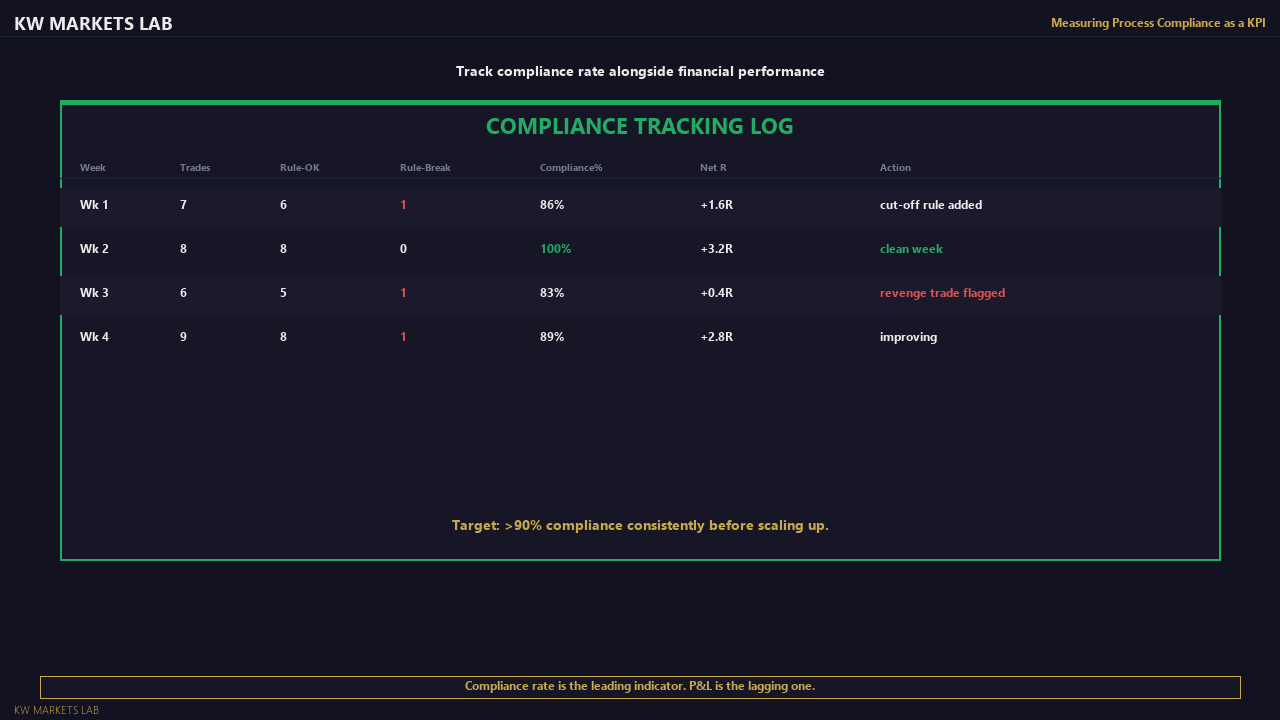
Process Compliance as KPI
Process Compliance as KPICompliance rate is the leading indicator.

When the compliance rate drops, investigate before assuming the strategy is failing. In most cases, a performance decline coincides with a drop in compliance. Fixing the compliance — not the strategy — restores performance. This insight, documented in your journal, is the single most valuable lesson most improving traders eventually learn.

Continue Learning
L4.3 — Accountability Structures: Making Your Rules Hard to Break →
Stay Updated

Get notified when new lessons and content are published.