Advanced Trading Psychology and Discipline / Module 2: Building a Discipline Framework Lesson 5 of 16
Course Outline — Lesson 5 of 16
M1 Emotional Traps in Trading
1 L1.1 — Why Smart Traders Make Irrational Decisions 2 L1.2 — The Five Emotional Traps: FOMO, Revenge, Hope, Overconfidence, Paralysis 3 L1.3 — Cognitive Biases That Affect Trading Decisions 4 L1.4 — Identifying Your Personal Trigger Patterns
M2 Building a Discipline Framework
1 L2.1 — Rules vs Intentions: Why Intentions Are Not Enough 2 L2.2 — The Pre-Session Routine as a Performance Tool 3 L2.3 — The Post-Session Review: Closing the Loop
M3 Journaling and Performance Review
1 L3.1 — What a Useful Trade Journal Looks Like 2 L3.2 — Separating Process Failures from Variance 3 L3.3 — Monthly Review: Pattern Recognition Across Sessions
M4 Building Repeatable Behaviour
1 L4.1 — Habit Architecture for Traders 2 L4.2 — Measuring Process Compliance as a KPI 3 L4.3 — Accountability Structures: Making Your Rules Hard to Break
M5 Avoiding Self-Sabotage
1 L5.1 — Self-Sabotage Patterns in Trading 2 L5.2 — Identity and the Professional Trader Mindset 3 L5.3 — Building a Long-Term Discipline Practice
Lesson 5 of 16

L2.1 — Rules vs Intentions: Why Intentions Are Not Enough

An intention is something you plan to do. A rule is something you have committed to doing with a defined consequence for violation. The difference is specificity and accountability. "I intend to not chase entries" is an intention. "If price has moved more than 15 pips past my intended entry, I do not take the trade" is a rule. One can be overridden with a rationalisation. The other cannot.

The trading rule must be: observable (you can check whether it was followed), binary (yes or no — no partial compliance), and consequenced (a defined response to violation — typically a mandatory break or reduced sizing for the remainder of the session).
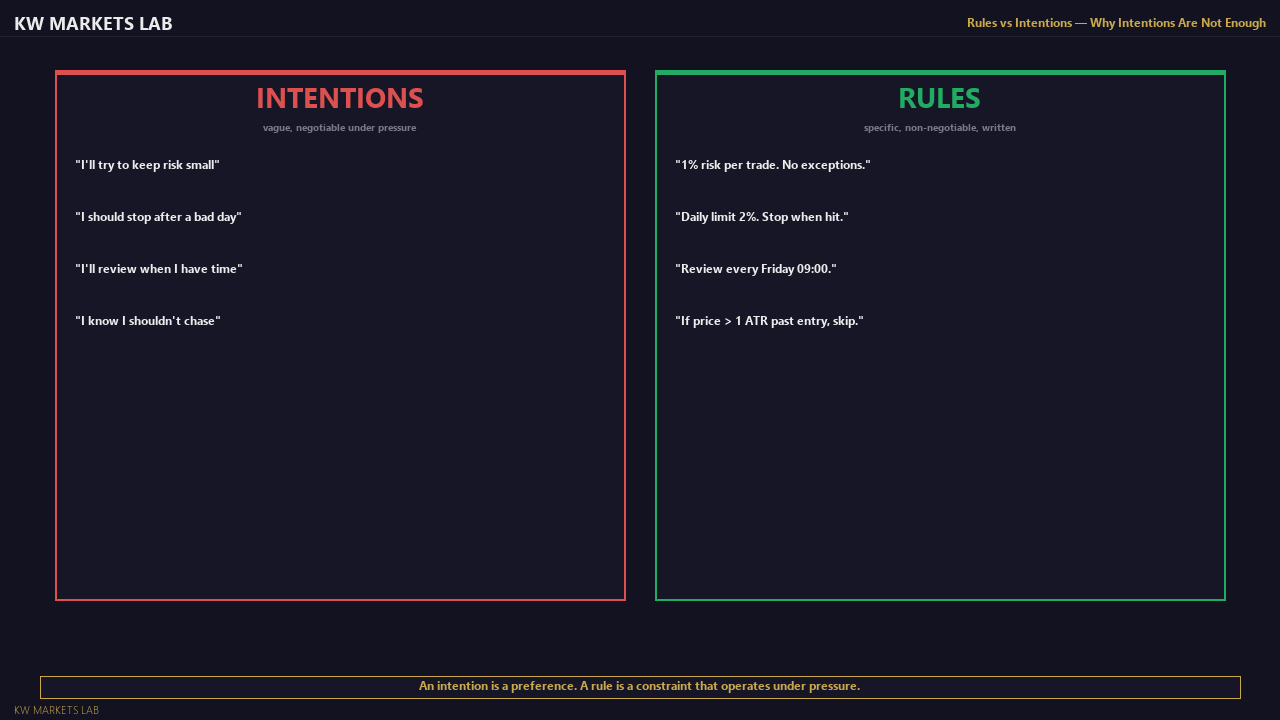
Rules vs Intentions
Rules vs IntentionsAn intention is a preference. A rule is a constraint.

Write your rules as conditional statements: "If X, then Y." "If I have taken three trades in a session, I stop for the day." "If I feel the urge to enter without my checklist complete, I wait 10 minutes and re-evaluate." The conditional structure forces the rule to cover the specific situation it was designed for.

Continue Learning
L2.2 — The Pre-Session Routine as a Performance Tool →
Stay Updated

Get notified when new lessons and content are published.