Advanced Trading Psychology and Discipline / Module 4: Building Repeatable Behaviour Lesson 13 of 16
Course Outline — Lesson 13 of 16
M1 Emotional Traps in Trading
1 L1.1 — Why Smart Traders Make Irrational Decisions 2 L1.2 — The Five Emotional Traps: FOMO, Revenge, Hope, Overconfidence, Paralysis 3 L1.3 — Cognitive Biases That Affect Trading Decisions 4 L1.4 — Identifying Your Personal Trigger Patterns
M2 Building a Discipline Framework
1 L2.1 — Rules vs Intentions: Why Intentions Are Not Enough 2 L2.2 — The Pre-Session Routine as a Performance Tool 3 L2.3 — The Post-Session Review: Closing the Loop
M3 Journaling and Performance Review
1 L3.1 — What a Useful Trade Journal Looks Like 2 L3.2 — Separating Process Failures from Variance 3 L3.3 — Monthly Review: Pattern Recognition Across Sessions
M4 Building Repeatable Behaviour
1 L4.1 — Habit Architecture for Traders 2 L4.2 — Measuring Process Compliance as a KPI 3 L4.3 — Accountability Structures: Making Your Rules Hard to Break
M5 Avoiding Self-Sabotage
1 L5.1 — Self-Sabotage Patterns in Trading 2 L5.2 — Identity and the Professional Trader Mindset 3 L5.3 — Building a Long-Term Discipline Practice
Lesson 13 of 16

L4.3 — Accountability Structures: Making Your Rules Hard to Break

Rules are easier to follow when breaking them has a visible consequence that others observe. An accountability structure is a mechanism that makes your compliance visible to someone other than yourself — a trading partner, a mentor, a community, or even a public trading journal. The awareness of external observation significantly reduces the frequency of rule violations compared to fully private rule sets.

Practical accountability structures: a weekly trade review shared with one other trader (not for validation — for accountability); a public trading journal with performance statistics published; a mentor review of your journal entries monthly. The content shared does not need to be detailed — the commitment that it will be shared creates the accountability effect.
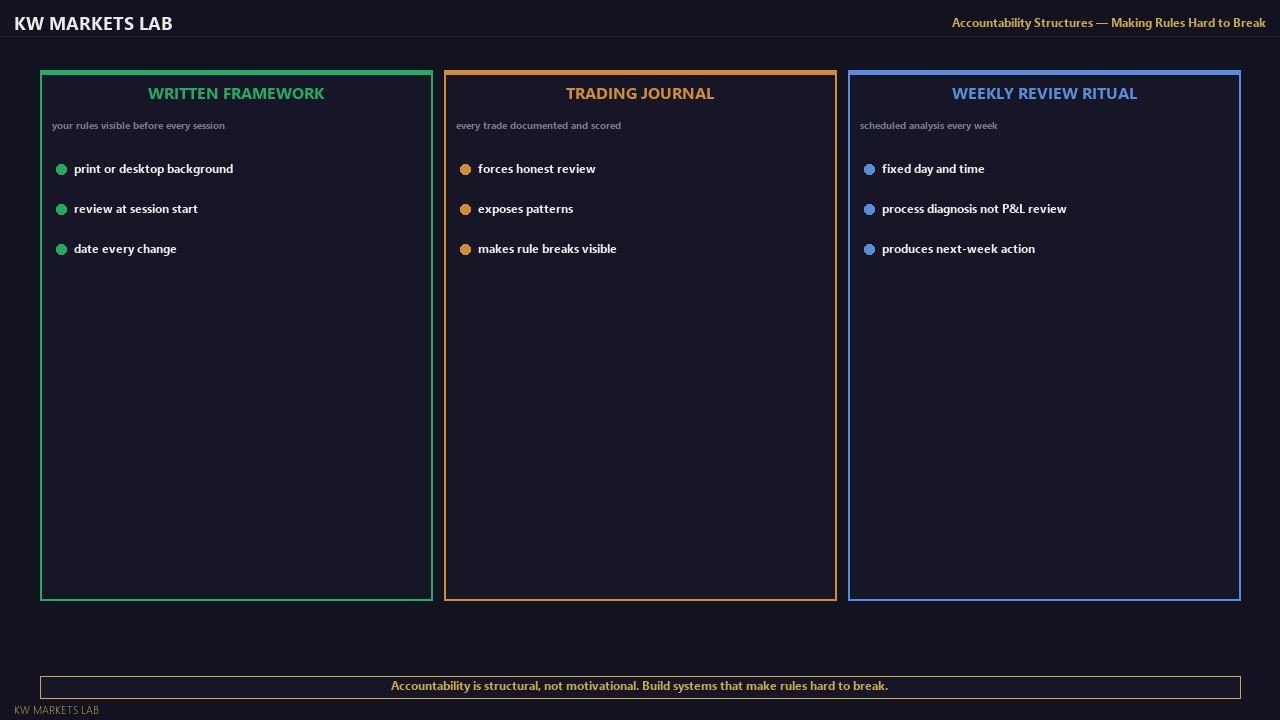
Accountability Structures
Accountability StructuresBuild systems that make rules hard to break.

The goal is not to perform for an audience. It is to create enough friction in the moment of a potential rule violation that your rational brain has time to intervene. Accountability structures do not make rule-following automatic — they slow down the emotional response long enough for the process to reassert itself.

Continue Learning
L5.1 — Self-Sabotage Patterns in Trading →
Stay Updated

Get notified when new lessons and content are published.