Advanced Trading Psychology and Discipline / Module 1: Emotional Traps in Trading Lesson 4 of 16
Course Outline — Lesson 4 of 16
M1 Emotional Traps in Trading
1 L1.1 — Why Smart Traders Make Irrational Decisions 2 L1.2 — The Five Emotional Traps: FOMO, Revenge, Hope, Overconfidence, Paralysis 3 L1.3 — Cognitive Biases That Affect Trading Decisions 4 L1.4 — Identifying Your Personal Trigger Patterns
M2 Building a Discipline Framework
1 L2.1 — Rules vs Intentions: Why Intentions Are Not Enough 2 L2.2 — The Pre-Session Routine as a Performance Tool 3 L2.3 — The Post-Session Review: Closing the Loop
M3 Journaling and Performance Review
1 L3.1 — What a Useful Trade Journal Looks Like 2 L3.2 — Separating Process Failures from Variance 3 L3.3 — Monthly Review: Pattern Recognition Across Sessions
M4 Building Repeatable Behaviour
1 L4.1 — Habit Architecture for Traders 2 L4.2 — Measuring Process Compliance as a KPI 3 L4.3 — Accountability Structures: Making Your Rules Hard to Break
M5 Avoiding Self-Sabotage
1 L5.1 — Self-Sabotage Patterns in Trading 2 L5.2 — Identity and the Professional Trader Mindset 3 L5.3 — Building a Long-Term Discipline Practice
Lesson 4 of 16

L1.4 — Identifying Your Personal Trigger Patterns

Every trader has a personal emotional profile — specific conditions that trigger their most destructive behaviours. For one trader, it is a fast market moving without them. For another, it is two consecutive losses. For another, it is boredom during a slow session. Identifying your personal triggers requires honest review of your trade history and an audit of the conditions present before each rule violation.

The audit process: review your last 30 trades. For every trade where you violated a rule, write down: what happened in the market before that trade, what your account state was, what you were feeling, and which emotional trap it falls into. After 30 trades, patterns will emerge. These patterns are the specific inputs to your discipline framework.
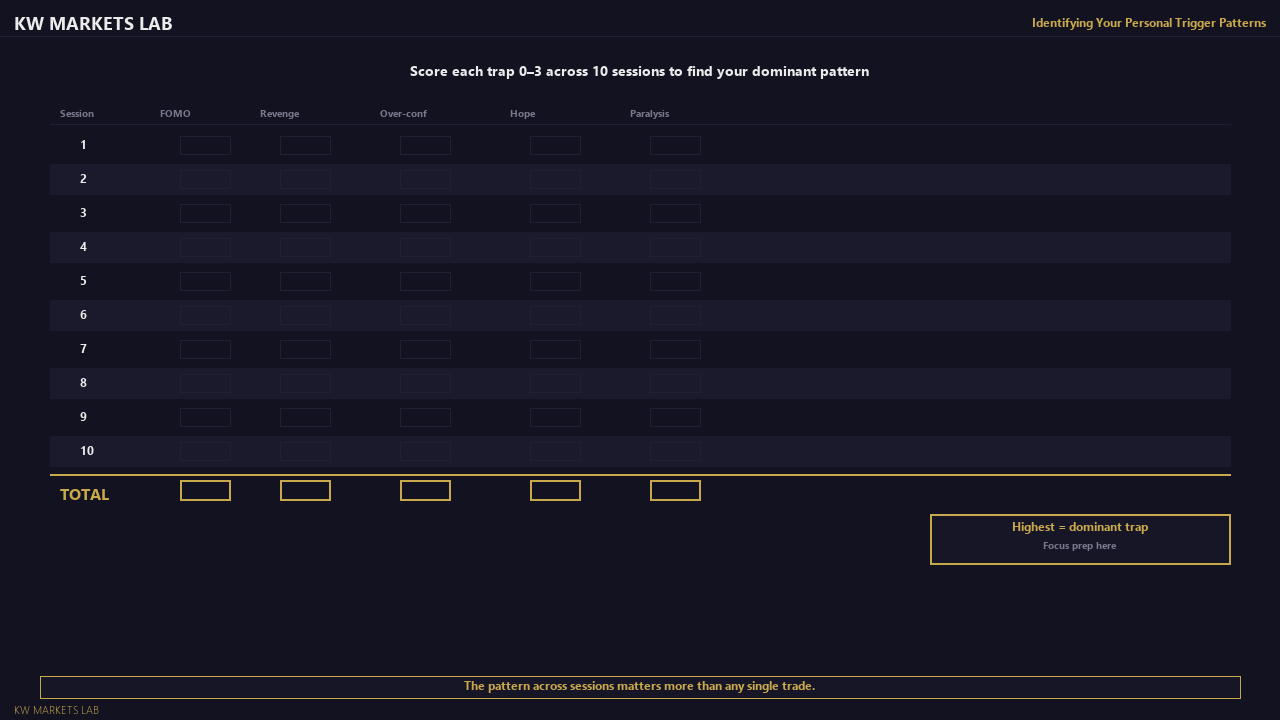
Personal Trigger Patterns
Personal Trigger PatternsThe pattern across sessions matters more than any single trade.

A discipline framework that is generic — "don't let emotions affect your trading" — is useless. A discipline framework that says "when I have just taken a loss on a failed BOS setup, I will not enter another trade for two hours" is specific, actionable, and addresses a real personal pattern. The audit produces the data for specific rules.

Continue Learning
L2.1 — Rules vs Intentions: Why Intentions Are Not Enough →
Stay Updated

Get notified when new lessons and content are published.