Advanced Trading Psychology and Discipline / Module 5: Avoiding Self-Sabotage Lesson 15 of 16
Course Outline — Lesson 15 of 16
M1 Emotional Traps in Trading
1 L1.1 — Why Smart Traders Make Irrational Decisions 2 L1.2 — The Five Emotional Traps: FOMO, Revenge, Hope, Overconfidence, Paralysis 3 L1.3 — Cognitive Biases That Affect Trading Decisions 4 L1.4 — Identifying Your Personal Trigger Patterns
M2 Building a Discipline Framework
1 L2.1 — Rules vs Intentions: Why Intentions Are Not Enough 2 L2.2 — The Pre-Session Routine as a Performance Tool 3 L2.3 — The Post-Session Review: Closing the Loop
M3 Journaling and Performance Review
1 L3.1 — What a Useful Trade Journal Looks Like 2 L3.2 — Separating Process Failures from Variance 3 L3.3 — Monthly Review: Pattern Recognition Across Sessions
M4 Building Repeatable Behaviour
1 L4.1 — Habit Architecture for Traders 2 L4.2 — Measuring Process Compliance as a KPI 3 L4.3 — Accountability Structures: Making Your Rules Hard to Break
M5 Avoiding Self-Sabotage
1 L5.1 — Self-Sabotage Patterns in Trading 2 L5.2 — Identity and the Professional Trader Mindset 3 L5.3 — Building a Long-Term Discipline Practice
Lesson 15 of 16

L5.2 — Identity and the Professional Trader Mindset

Behaviour follows identity. A trader who identifies as "someone who gets lucky sometimes" will behave differently from one who identifies as "a professional executing a defined process." The first identity produces hope-based trading. The second produces process-based trading. The identity is chosen, not assigned — but it must be chosen deliberately and then reinforced through consistent behaviour.

Professional identity in trading is built through process, not through outcomes. A trader who follows their rules on a losing trade and journals it honestly is behaving like a professional. A trader who makes a large profit by violating their rules is not — regardless of the outcome. The identity of a professional trader is anchored to the behaviour, not the P&L.
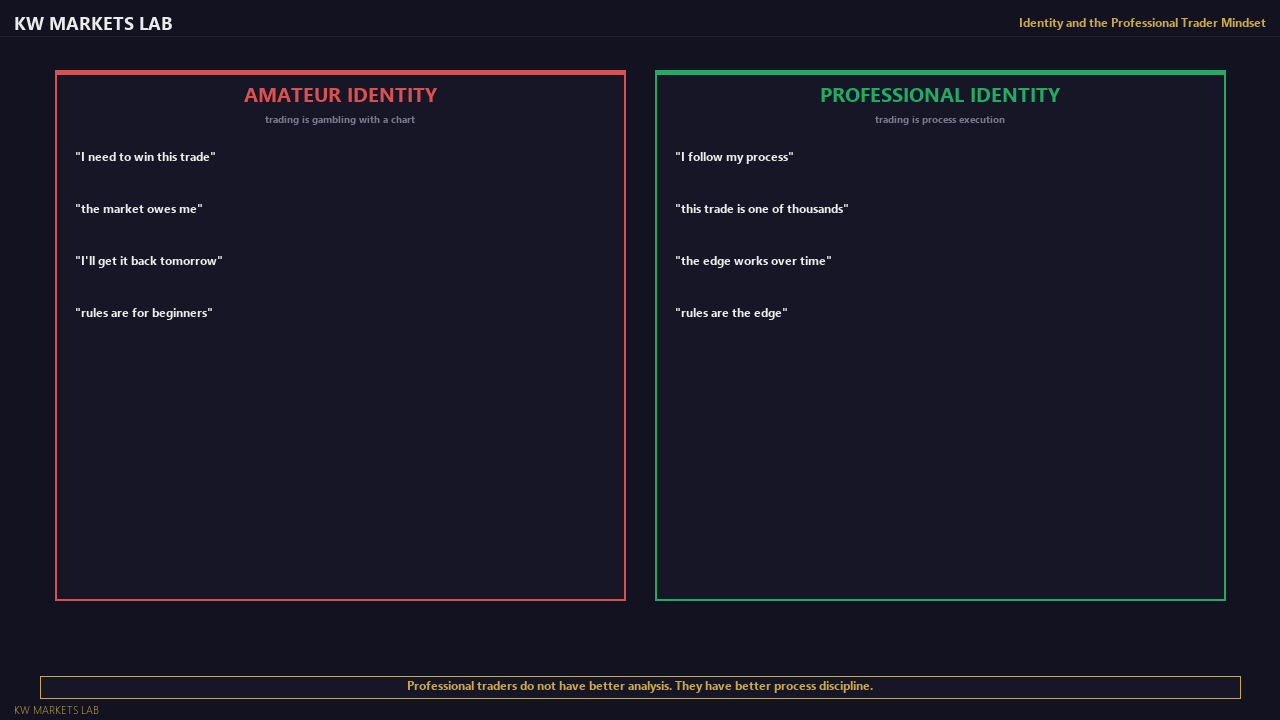
Professional Trader Identity
Professional Trader IdentityProfessional traders have better process discipline.

The practical exercise: write down three specific behaviours that a professional trader in your strategy style always does. Then check your compliance with those three behaviours for the past 20 trades. Where the gap exists between the professional identity and the actual behaviour, there is the work to do.

Continue Learning
L5.3 — Building a Long-Term Discipline Practice →
Stay Updated

Get notified when new lessons and content are published.