Advanced Trading Psychology and Discipline / Module 1: Emotional Traps in Trading Lesson 2 of 16
Course Outline — Lesson 2 of 16
M1 Emotional Traps in Trading
1 L1.1 — Why Smart Traders Make Irrational Decisions 2 L1.2 — The Five Emotional Traps: FOMO, Revenge, Hope, Overconfidence, Paralysis 3 L1.3 — Cognitive Biases That Affect Trading Decisions 4 L1.4 — Identifying Your Personal Trigger Patterns
M2 Building a Discipline Framework
1 L2.1 — Rules vs Intentions: Why Intentions Are Not Enough 2 L2.2 — The Pre-Session Routine as a Performance Tool 3 L2.3 — The Post-Session Review: Closing the Loop
M3 Journaling and Performance Review
1 L3.1 — What a Useful Trade Journal Looks Like 2 L3.2 — Separating Process Failures from Variance 3 L3.3 — Monthly Review: Pattern Recognition Across Sessions
M4 Building Repeatable Behaviour
1 L4.1 — Habit Architecture for Traders 2 L4.2 — Measuring Process Compliance as a KPI 3 L4.3 — Accountability Structures: Making Your Rules Hard to Break
M5 Avoiding Self-Sabotage
1 L5.1 — Self-Sabotage Patterns in Trading 2 L5.2 — Identity and the Professional Trader Mindset 3 L5.3 — Building a Long-Term Discipline Practice
Lesson 2 of 16

L1.2 — The Five Emotional Traps: FOMO, Revenge, Hope, Overconfidence, Paralysis

Fear of missing out (FOMO) produces chase entries, breakout fades, and entries without confirmation. Revenge trading produces oversized positions and rule violations immediately after a loss. Hope produces late exits, removed stops, and position additions into losing trades. Overconfidence produces oversizing, skipped confirmation, and assumption that the current winning streak is evidence of permanent skill. Paralysis produces missed valid setups, excessive second-guessing, and abandonment of process.

These five states are not random. They are triggered by specific market conditions and personal patterns. FOMO appears most often after a missed trade or during strong trend days. Revenge appears after losses. Overconfidence appears after winning streaks. Knowing your patterns is the first step to interrupting them.
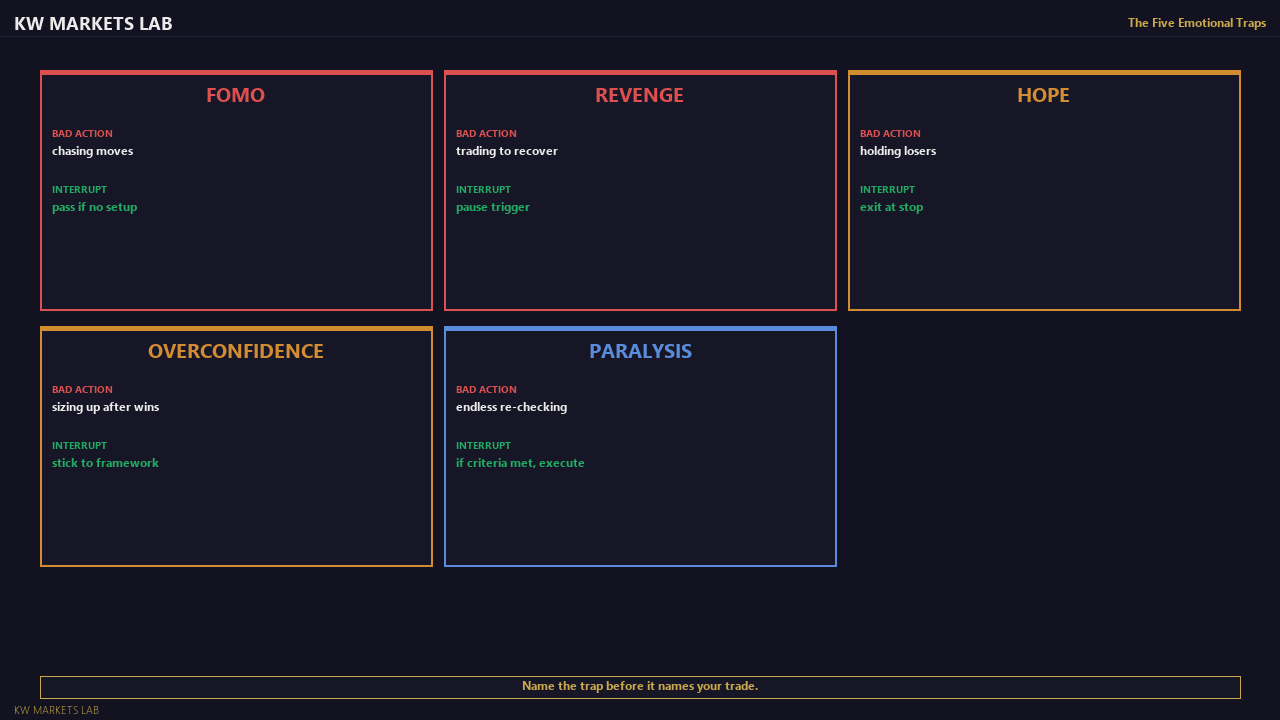
The Five Emotional Traps
The Five Emotional TrapsName the trap before it names your trade.

For each of the five traps, identify your own history with it. When did it last cause a rule violation? What was the market condition? What was your account state at the time? This self-audit is not comfortable — but it is more useful than any technical analysis improvement you could make at this stage of your development.

Continue Learning
L1.3 — Cognitive Biases That Affect Trading Decisions →
Stay Updated

Get notified when new lessons and content are published.