Advanced Trading Psychology and Discipline / Module 5: Avoiding Self-Sabotage Lesson 14 of 16
Course Outline — Lesson 14 of 16
M1 Emotional Traps in Trading
1 L1.1 — Why Smart Traders Make Irrational Decisions 2 L1.2 — The Five Emotional Traps: FOMO, Revenge, Hope, Overconfidence, Paralysis 3 L1.3 — Cognitive Biases That Affect Trading Decisions 4 L1.4 — Identifying Your Personal Trigger Patterns
M2 Building a Discipline Framework
1 L2.1 — Rules vs Intentions: Why Intentions Are Not Enough 2 L2.2 — The Pre-Session Routine as a Performance Tool 3 L2.3 — The Post-Session Review: Closing the Loop
M3 Journaling and Performance Review
1 L3.1 — What a Useful Trade Journal Looks Like 2 L3.2 — Separating Process Failures from Variance 3 L3.3 — Monthly Review: Pattern Recognition Across Sessions
M4 Building Repeatable Behaviour
1 L4.1 — Habit Architecture for Traders 2 L4.2 — Measuring Process Compliance as a KPI 3 L4.3 — Accountability Structures: Making Your Rules Hard to Break
M5 Avoiding Self-Sabotage
1 L5.1 — Self-Sabotage Patterns in Trading 2 L5.2 — Identity and the Professional Trader Mindset 3 L5.3 — Building a Long-Term Discipline Practice
Lesson 14 of 16

L5.1 — Self-Sabotage Patterns in Trading

Self-sabotage in trading refers to behaviours that consistently undermine performance despite the trader's stated intention to succeed. Common patterns: abandoning a strategy just before it would have produced a winning period; increasing risk after a good performance streak and then giving back gains; setting up to fail by trading during known poor-performance conditions despite knowing to avoid them; and subtle forms of avoidance such as not reviewing the journal because it will reveal uncomfortable patterns.

Self-sabotage often reflects an unconscious belief that success is undeserved, that the results will not be sustained, or that the identity of a profitable trader is incompatible with the trader's self-image. These are not trading problems — they are psychological ones. Trading systems cannot fix them. Awareness and deliberate behavioural work can.
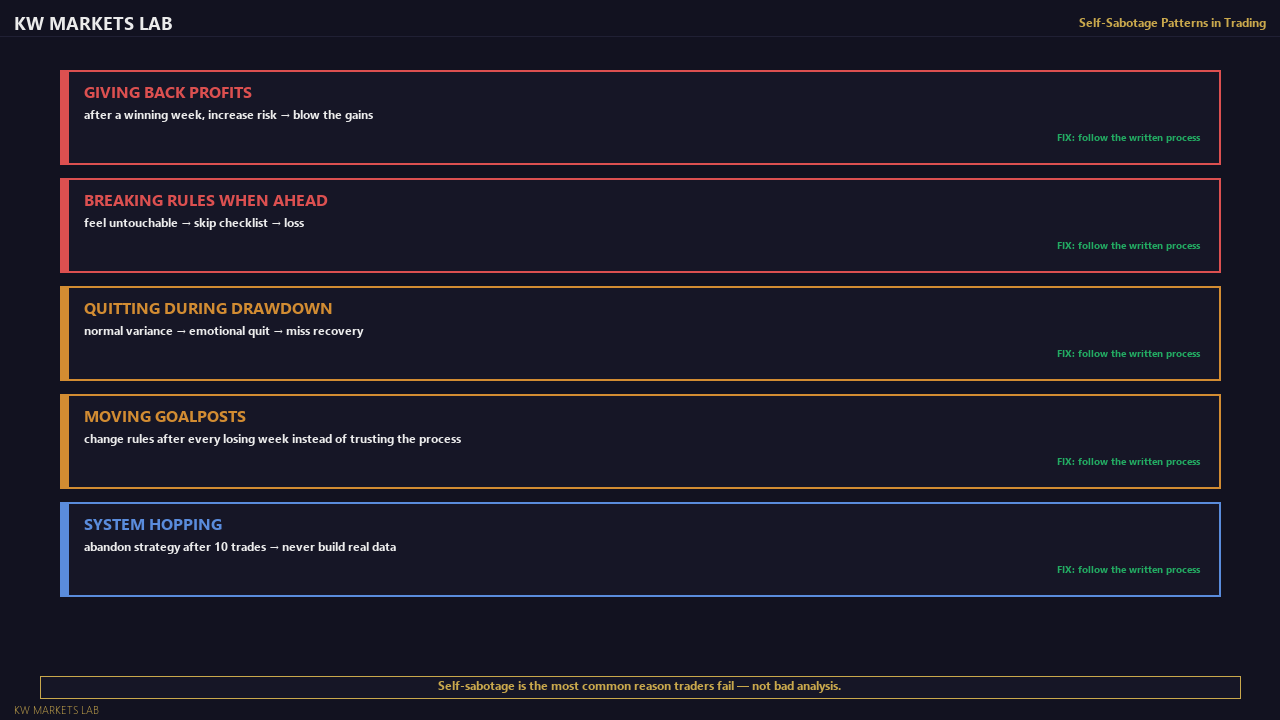
Self-Sabotage Patterns
Self-Sabotage PatternsSelf-sabotage is the most common reason traders fail.

Identify your own patterns by asking: what do I do immediately after a good trading week? What do I do immediately after a bad one? If the answers consistently involve behaviours that increase risk or reduce process compliance, you are likely operating a self-sabotage cycle. Naming the cycle is the first step to interrupting it.

Continue Learning
L5.2 — Identity and the Professional Trader Mindset →
Stay Updated

Get notified when new lessons and content are published.