Advanced Trading Psychology and Discipline / Module 2: Building a Discipline Framework Lesson 7 of 16
Course Outline — Lesson 7 of 16
M1 Emotional Traps in Trading
1 L1.1 — Why Smart Traders Make Irrational Decisions 2 L1.2 — The Five Emotional Traps: FOMO, Revenge, Hope, Overconfidence, Paralysis 3 L1.3 — Cognitive Biases That Affect Trading Decisions 4 L1.4 — Identifying Your Personal Trigger Patterns
M2 Building a Discipline Framework
1 L2.1 — Rules vs Intentions: Why Intentions Are Not Enough 2 L2.2 — The Pre-Session Routine as a Performance Tool 3 L2.3 — The Post-Session Review: Closing the Loop
M3 Journaling and Performance Review
1 L3.1 — What a Useful Trade Journal Looks Like 2 L3.2 — Separating Process Failures from Variance 3 L3.3 — Monthly Review: Pattern Recognition Across Sessions
M4 Building Repeatable Behaviour
1 L4.1 — Habit Architecture for Traders 2 L4.2 — Measuring Process Compliance as a KPI 3 L4.3 — Accountability Structures: Making Your Rules Hard to Break
M5 Avoiding Self-Sabotage
1 L5.1 — Self-Sabotage Patterns in Trading 2 L5.2 — Identity and the Professional Trader Mindset 3 L5.3 — Building a Long-Term Discipline Practice
Lesson 7 of 16

L2.3 — The Post-Session Review: Closing the Loop

A post-session review is conducted after the trading session is complete and all positions are closed or managed. It asks three questions: (1) Did I follow my process? (2) If not, which rules were violated and what triggered the violation? (3) What is the one adjustment I will make for the next session? It is not a trade outcome review — it is a process compliance review. A session can be profitable and still be a failure if the rules were violated. A session can produce a loss and still be a success if the process was followed perfectly.

Keep post-session reviews brief: 5-10 minutes, written in your journal, immediately after the session closes. The longer the delay, the less honest and detailed the review will be. The compounding of daily post-session reviews over 6 months produces a detailed self-portrait of your trading behaviour — the most valuable data set in your trading library.
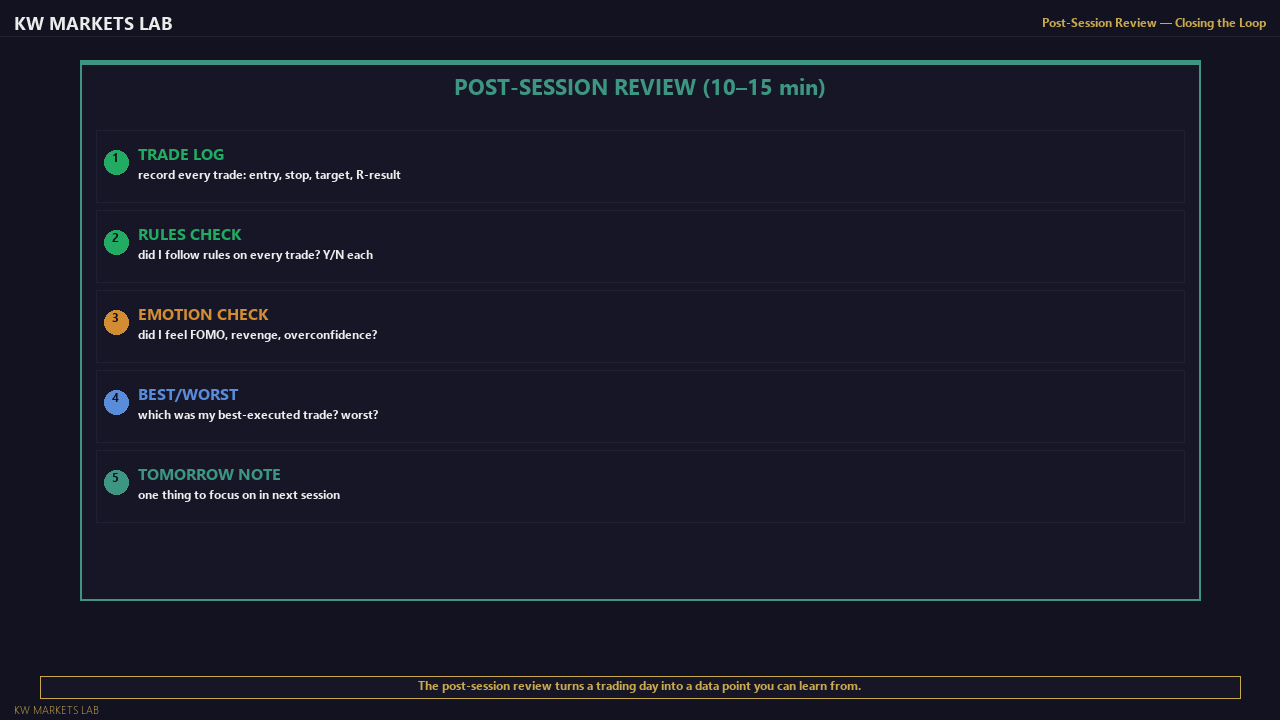
Post-Session Review
Post-Session ReviewThe post-session review turns a trading day into a data point.

After 30 consecutive daily reviews, read them in sequence. Patterns become unmistakable. You will see which days produce rule violations (typically Mondays, or days after losses), which setups you consistently mismanage, and which emotional states precede your worst trading days. This is the information that makes improvement specific and measurable.

Continue Learning
L3.1 — What a Useful Trade Journal Looks Like →
Stay Updated

Get notified when new lessons and content are published.