Advanced Trading Psychology and Discipline / Module 2: Building a Discipline Framework Lesson 6 of 16
Course Outline — Lesson 6 of 16
M1 Emotional Traps in Trading
1 L1.1 — Why Smart Traders Make Irrational Decisions 2 L1.2 — The Five Emotional Traps: FOMO, Revenge, Hope, Overconfidence, Paralysis 3 L1.3 — Cognitive Biases That Affect Trading Decisions 4 L1.4 — Identifying Your Personal Trigger Patterns
M2 Building a Discipline Framework
1 L2.1 — Rules vs Intentions: Why Intentions Are Not Enough 2 L2.2 — The Pre-Session Routine as a Performance Tool 3 L2.3 — The Post-Session Review: Closing the Loop
M3 Journaling and Performance Review
1 L3.1 — What a Useful Trade Journal Looks Like 2 L3.2 — Separating Process Failures from Variance 3 L3.3 — Monthly Review: Pattern Recognition Across Sessions
M4 Building Repeatable Behaviour
1 L4.1 — Habit Architecture for Traders 2 L4.2 — Measuring Process Compliance as a KPI 3 L4.3 — Accountability Structures: Making Your Rules Hard to Break
M5 Avoiding Self-Sabotage
1 L5.1 — Self-Sabotage Patterns in Trading 2 L5.2 — Identity and the Professional Trader Mindset 3 L5.3 — Building a Long-Term Discipline Practice
Lesson 6 of 16

L2.2 — The Pre-Session Routine as a Performance Tool

High-performance athletes and surgeons use pre-performance routines to reduce the cognitive load of their work and enter a focused, deliberate state. Traders have the same need. A pre-session routine is not a ritual — it is a structured process that ensures you have done the analytical work before the market is live and you are in a clear, rule-governed mental state before any position is considered.

A minimal pre-session routine: review the higher-timeframe structure on the markets you are watching, mark the key levels, document your directional bias and the condition that would invalidate it, confirm your maximum risk parameters for the session, and review whether any personal triggers are active from recent trading. This takes 15-20 minutes and replaces the alternative — opening the platform cold and reacting to whatever is moving.
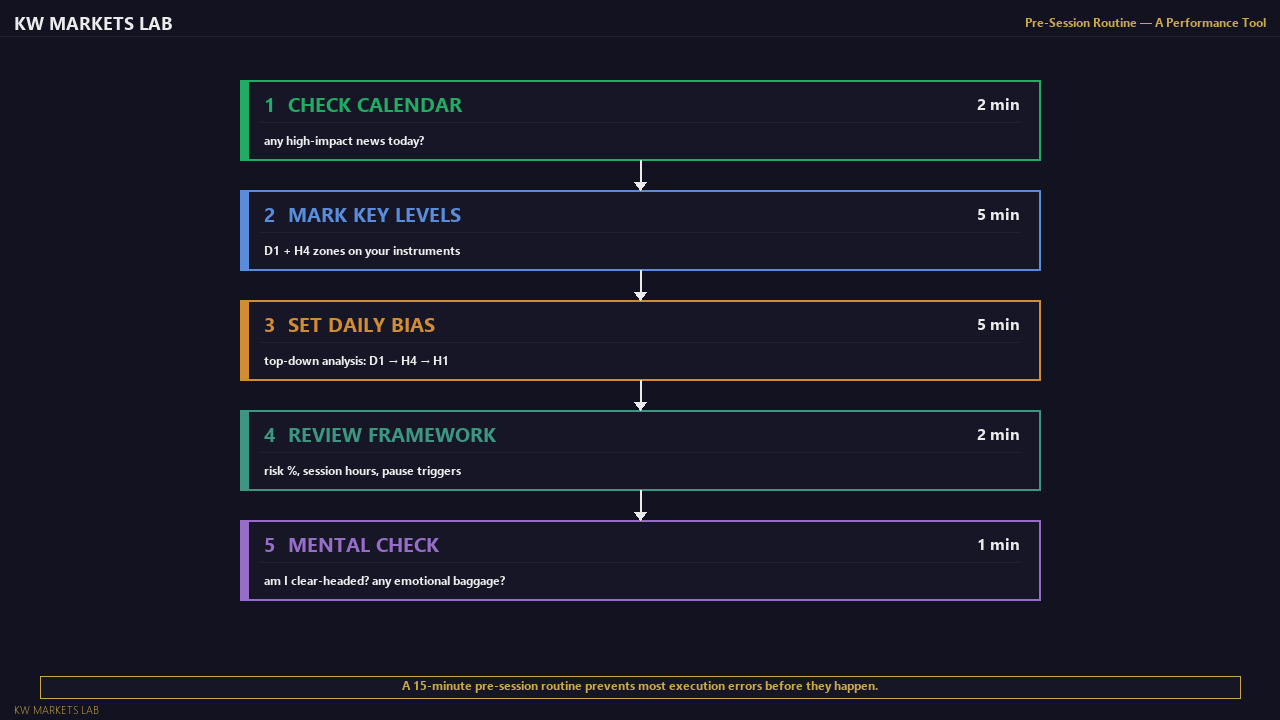
Pre-Session Routine
Pre-Session RoutineA 15-minute routine prevents most execution errors.

The routine creates a boundary between preparation and execution. Everything before the first alarm on your pre-session checklist is preparation. Nothing is live until the checklist is complete. This boundary is enforced by the routine, not by willpower in the moment.

Continue Learning
L2.3 — The Post-Session Review: Closing the Loop →
Stay Updated

Get notified when new lessons and content are published.