Advanced Trading Psychology and Discipline / Module 1: Emotional Traps in Trading Lesson 3 of 16
Course Outline — Lesson 3 of 16
M1 Emotional Traps in Trading
1 L1.1 — Why Smart Traders Make Irrational Decisions 2 L1.2 — The Five Emotional Traps: FOMO, Revenge, Hope, Overconfidence, Paralysis 3 L1.3 — Cognitive Biases That Affect Trading Decisions 4 L1.4 — Identifying Your Personal Trigger Patterns
M2 Building a Discipline Framework
1 L2.1 — Rules vs Intentions: Why Intentions Are Not Enough 2 L2.2 — The Pre-Session Routine as a Performance Tool 3 L2.3 — The Post-Session Review: Closing the Loop
M3 Journaling and Performance Review
1 L3.1 — What a Useful Trade Journal Looks Like 2 L3.2 — Separating Process Failures from Variance 3 L3.3 — Monthly Review: Pattern Recognition Across Sessions
M4 Building Repeatable Behaviour
1 L4.1 — Habit Architecture for Traders 2 L4.2 — Measuring Process Compliance as a KPI 3 L4.3 — Accountability Structures: Making Your Rules Hard to Break
M5 Avoiding Self-Sabotage
1 L5.1 — Self-Sabotage Patterns in Trading 2 L5.2 — Identity and the Professional Trader Mindset 3 L5.3 — Building a Long-Term Discipline Practice
Lesson 3 of 16

L1.3 — Cognitive Biases That Affect Trading Decisions

Recency bias causes traders to weight recent trades far more heavily than the full statistical sample. After three losses, the strategy feels broken. After three wins, it feels unbeatable. Neither conclusion is statistically justified from three data points — but the emotional weight of recent experience overwhelms the rational interpretation of small samples.

Confirmation bias causes traders to search for evidence that supports the trade they already want to take and ignore evidence that argues against it. The chart is read selectively. Timeframes that agree with the bias are examined; timeframes that disagree are dismissed or not consulted. Loss aversion causes traders to hold losing trades far too long — the psychological pain of realising a loss is approximately twice the pleasure of an equivalent gain, creating an asymmetric reluctance to close.
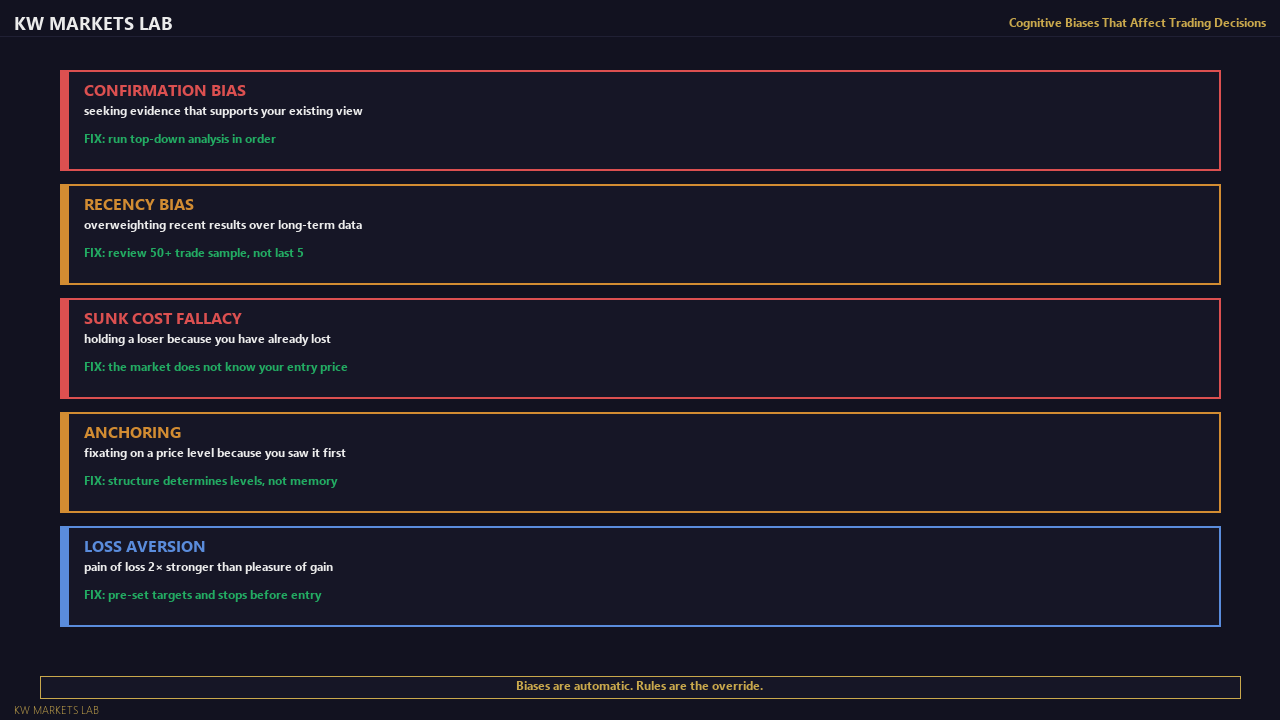
Cognitive Biases in Trading
Cognitive Biases in TradingBiases are automatic. Rules are the override.

The countermeasure for all three: write down your analysis before looking at the chart in the direction of your intended trade. Force yourself to articulate the case against the trade. Use a checklist that requires you to check the opposing timeframe. These are friction tools — they slow down the emotional brain long enough for the rational brain to contribute.

Continue Learning
L1.4 — Identifying Your Personal Trigger Patterns →
Stay Updated

Get notified when new lessons and content are published.