Advanced Trading Psychology and Discipline / Module 4: Building Repeatable Behaviour Lesson 11 of 16
Course Outline — Lesson 11 of 16
M1 Emotional Traps in Trading
1 L1.1 — Why Smart Traders Make Irrational Decisions 2 L1.2 — The Five Emotional Traps: FOMO, Revenge, Hope, Overconfidence, Paralysis 3 L1.3 — Cognitive Biases That Affect Trading Decisions 4 L1.4 — Identifying Your Personal Trigger Patterns
M2 Building a Discipline Framework
1 L2.1 — Rules vs Intentions: Why Intentions Are Not Enough 2 L2.2 — The Pre-Session Routine as a Performance Tool 3 L2.3 — The Post-Session Review: Closing the Loop
M3 Journaling and Performance Review
1 L3.1 — What a Useful Trade Journal Looks Like 2 L3.2 — Separating Process Failures from Variance 3 L3.3 — Monthly Review: Pattern Recognition Across Sessions
M4 Building Repeatable Behaviour
1 L4.1 — Habit Architecture for Traders 2 L4.2 — Measuring Process Compliance as a KPI 3 L4.3 — Accountability Structures: Making Your Rules Hard to Break
M5 Avoiding Self-Sabotage
1 L5.1 — Self-Sabotage Patterns in Trading 2 L5.2 — Identity and the Professional Trader Mindset 3 L5.3 — Building a Long-Term Discipline Practice
Lesson 11 of 16

L4.1 — Habit Architecture for Traders

Habits are behaviours that occur without deliberate decision-making. The goal of a discipline framework is to make correct trading behaviour habitual — so that following your process requires less and less willpower over time. Habits are formed through three elements: cue (trigger), routine (behaviour), reward (reinforcement).

For trading: the cue is the market open or your scheduled analysis time. The routine is your pre-session checklist. The reward is the clarity and confidence that comes from having done the work before entering a position. Deliberately engineering this loop — cue, routine, reward — accelerates the formation of the analytical habit. Within weeks, skipping the pre-session routine will feel uncomfortable, not the reverse.
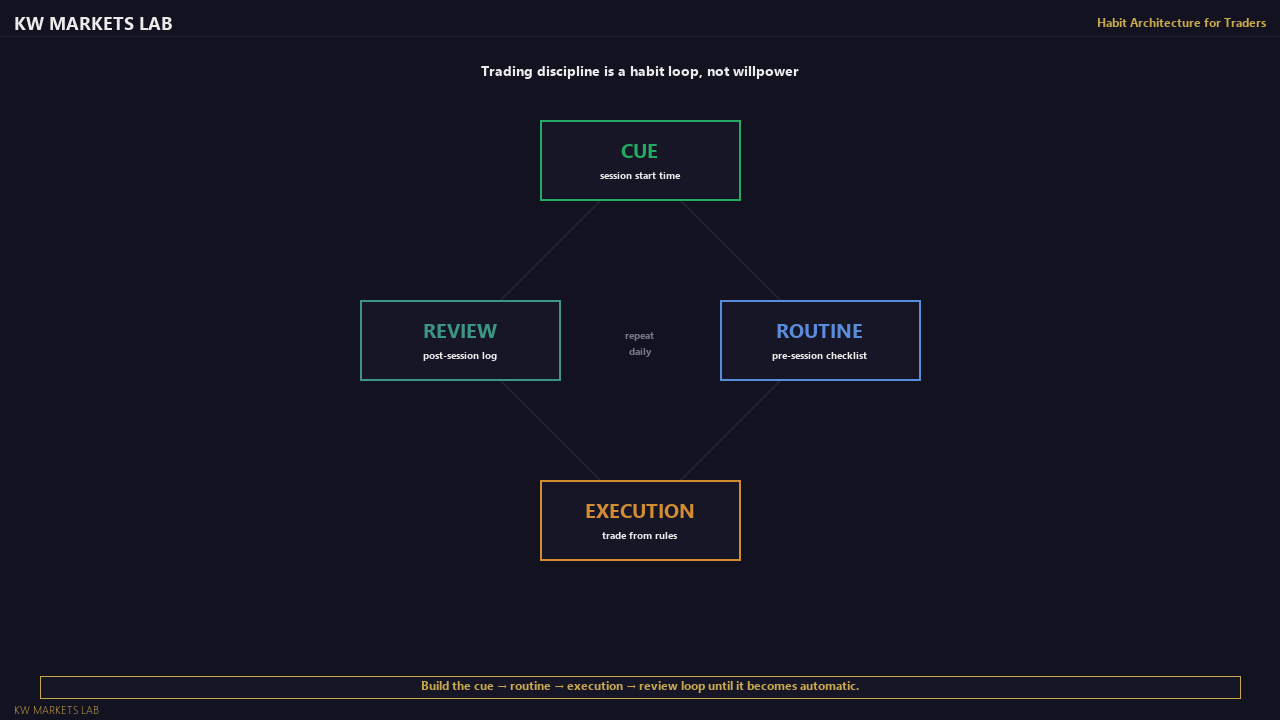
Habit Architecture for Traders
Habit Architecture for TradersBuild the loop until it becomes automatic.

The same architecture applies to the post-session review: cue (market close or session end time), routine (5-minute journal entry), reward (the closure and self-knowledge it produces). Stack your trading discipline habits onto existing habits where possible — for example, the pre-session review after the same daily coffee, at the same desk, at the same time.

Continue Learning
L4.2 — Measuring Process Compliance as a KPI →
Stay Updated

Get notified when new lessons and content are published.