Advanced Trading Psychology and Discipline / Module 3: Journaling and Performance Review Lesson 10 of 16
Course Outline — Lesson 10 of 16
M1 Emotional Traps in Trading
1 L1.1 — Why Smart Traders Make Irrational Decisions 2 L1.2 — The Five Emotional Traps: FOMO, Revenge, Hope, Overconfidence, Paralysis 3 L1.3 — Cognitive Biases That Affect Trading Decisions 4 L1.4 — Identifying Your Personal Trigger Patterns
M2 Building a Discipline Framework
1 L2.1 — Rules vs Intentions: Why Intentions Are Not Enough 2 L2.2 — The Pre-Session Routine as a Performance Tool 3 L2.3 — The Post-Session Review: Closing the Loop
M3 Journaling and Performance Review
1 L3.1 — What a Useful Trade Journal Looks Like 2 L3.2 — Separating Process Failures from Variance 3 L3.3 — Monthly Review: Pattern Recognition Across Sessions
M4 Building Repeatable Behaviour
1 L4.1 — Habit Architecture for Traders 2 L4.2 — Measuring Process Compliance as a KPI 3 L4.3 — Accountability Structures: Making Your Rules Hard to Break
M5 Avoiding Self-Sabotage
1 L5.1 — Self-Sabotage Patterns in Trading 2 L5.2 — Identity and the Professional Trader Mindset 3 L5.3 — Building a Long-Term Discipline Practice
Lesson 10 of 16

L3.3 — Monthly Review: Pattern Recognition Across Sessions

A monthly review aggregates daily journal entries and performance data to identify patterns that are invisible at the individual session level. A single bad Monday session is noise. Six consecutive Monday sessions with below-average performance is a pattern worth investigating. A monthly review is the appropriate resolution for that kind of signal.

Monthly review questions: Which setup types produced positive expectancy this month? Which produced negative? Which session times performed best? Was my process compliance rate above or below 90%? What was my average R:R on actual exits versus intended targets? Did any new behavioural patterns appear that require a rule adjustment?
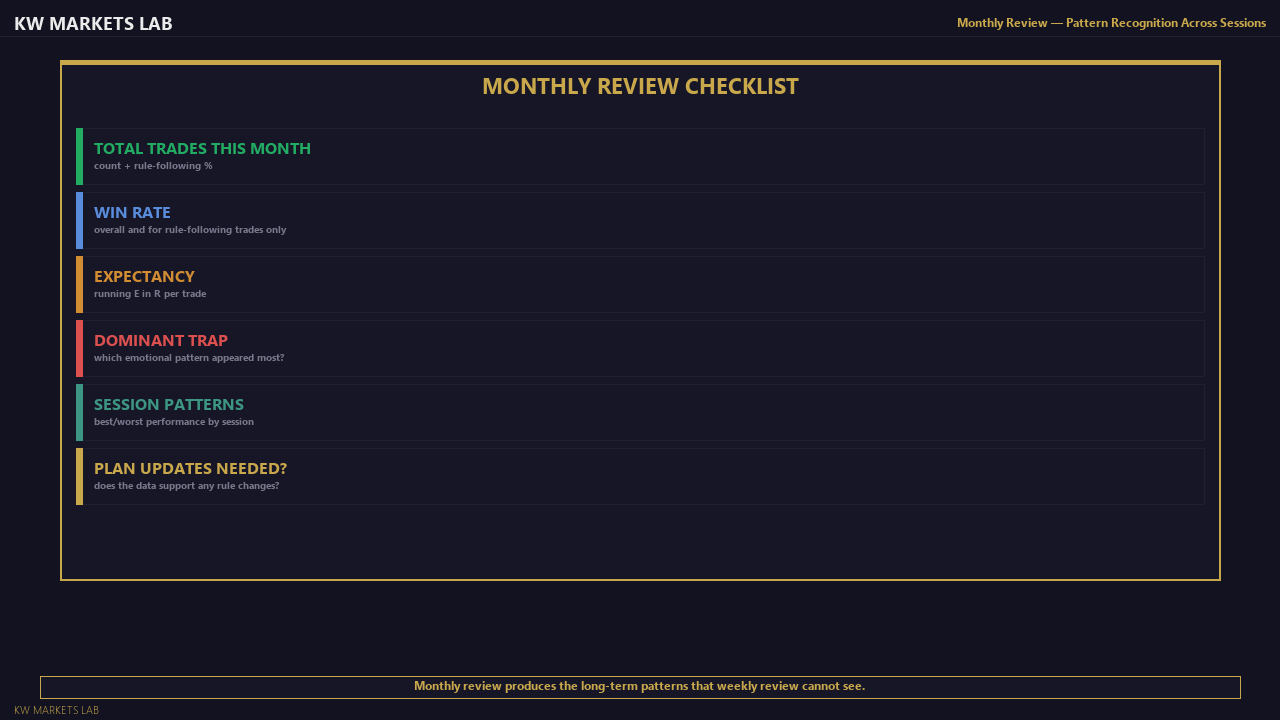
Monthly Review Checklist
Monthly Review ChecklistMonthly review produces long-term patterns.

The monthly review is also the appropriate moment to make rule changes — not after individual trades. A rule that seems wrong after one loss may be perfectly correct when evaluated across 20 trades. Monthly reviews prevent the reactive rule-tinkering that destroys strategy consistency and makes performance measurement impossible.

Continue Learning
L4.1 — Habit Architecture for Traders →
Stay Updated

Get notified when new lessons and content are published.