Intermediate Entry Models and Execution / Module 5: Trigger Quality and the No-Chase Rule Lesson 16 of 16
Course Outline — Lesson 16 of 16
M1 Entry Model Types
1 L1.1 — The Three Entry Model Archetypes 2 L1.2 — Limit Orders vs Stop Orders at Structure 3 L1.3 — The Rejection Candle: Your Confirmation Trigger 4 L1.4 — The BOS Entry: Trading the Continuation After the Break
M2 Confirmation Logic
1 L2.1 — What Confirmation Actually Means 2 L2.2 — The Pre-Entry Checklist 3 L2.3 — When a Valid Setup Should Still Be Skipped
M3 Session-Based Execution
1 L3.1 — The Three Sessions and Their Structural Behaviour 2 L3.2 — Using Session Highs and Lows as Execution Anchors 3 L3.3 — Time-of-Day Filters for Entry Quality
M4 Execution Discipline
1 L4.1 — Stop Placement Before Entry: The Non-Negotiable Rule 2 L4.2 — The No-Chase Rule 3 L4.3 — Managing the Trade After Entry
M5 Trigger Quality and the No-Chase Rule
1 L5.1 — Grading Your Setups: A Quality Framework 2 L5.2 — Common Execution Errors and How to Prevent Them 3 L5.3 — Building Your Personal Execution Protocol
Lesson 16 of 16

L5.3 — Building Your Personal Execution Protocol

An execution protocol is a written document that describes every step of your entry and exit process. It covers: how you build your pre-session bias, the conditions that qualify a setup, the confirmation trigger you require, where the stop goes, how you calculate position size, your management rules, and your exit criteria. It is the operating manual for your trading process.

Writing this document forces clarity. Ambiguous rules — "I enter when it looks right" or "I exit when I feel the trade is done" — cannot be in the protocol. Every rule must be specific enough that another person could follow it and produce the same execution decisions you would.
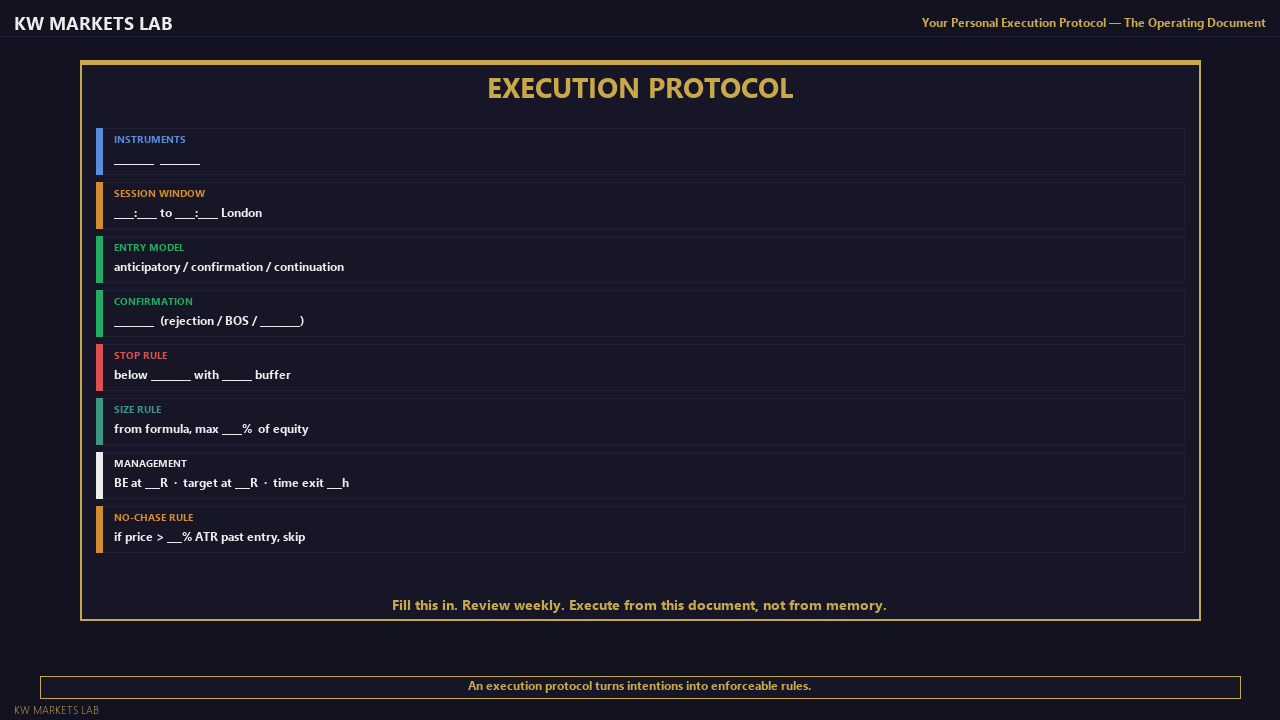
Personal Execution Protocol
Personal Execution ProtocolAn execution protocol turns intentions into enforceable rules.

The protocol is not permanent. Review it after every 20-30 trades. Update rules that are too vague, too rigid, or consistently violated for a good reason. The protocol should evolve as your understanding improves — but it should always be current, written, and followed.

Course Complete — Next in Path
Position sizing, drawdown management, expectancy, and capita →
Stay Updated

Get notified when new lessons and content are published.