Intermediate Entry Models and Execution / Module 2: Confirmation Logic Lesson 5 of 16
Course Outline — Lesson 5 of 16
M1 Entry Model Types
1 L1.1 — The Three Entry Model Archetypes 2 L1.2 — Limit Orders vs Stop Orders at Structure 3 L1.3 — The Rejection Candle: Your Confirmation Trigger 4 L1.4 — The BOS Entry: Trading the Continuation After the Break
M2 Confirmation Logic
1 L2.1 — What Confirmation Actually Means 2 L2.2 — The Pre-Entry Checklist 3 L2.3 — When a Valid Setup Should Still Be Skipped
M3 Session-Based Execution
1 L3.1 — The Three Sessions and Their Structural Behaviour 2 L3.2 — Using Session Highs and Lows as Execution Anchors 3 L3.3 — Time-of-Day Filters for Entry Quality
M4 Execution Discipline
1 L4.1 — Stop Placement Before Entry: The Non-Negotiable Rule 2 L4.2 — The No-Chase Rule 3 L4.3 — Managing the Trade After Entry
M5 Trigger Quality and the No-Chase Rule
1 L5.1 — Grading Your Setups: A Quality Framework 2 L5.2 — Common Execution Errors and How to Prevent Them 3 L5.3 — Building Your Personal Execution Protocol
Lesson 5 of 16

L2.1 — What Confirmation Actually Means

Confirmation in entry execution is a defined event that must occur before you place the trade. It is not a feeling, and it is not "the chart looks right." It is a specific, observable price action condition that your rules say must be present before you act.

Common confirmation conditions: a candle close beyond a level, a rejection candle at a zone, a BOS on the entry timeframe after a pullback, or a defined number of consecutive closes in the trade direction. The key requirement is that the confirmation can be described in writing before the trade and checked as a binary yes/no condition at the time of execution.
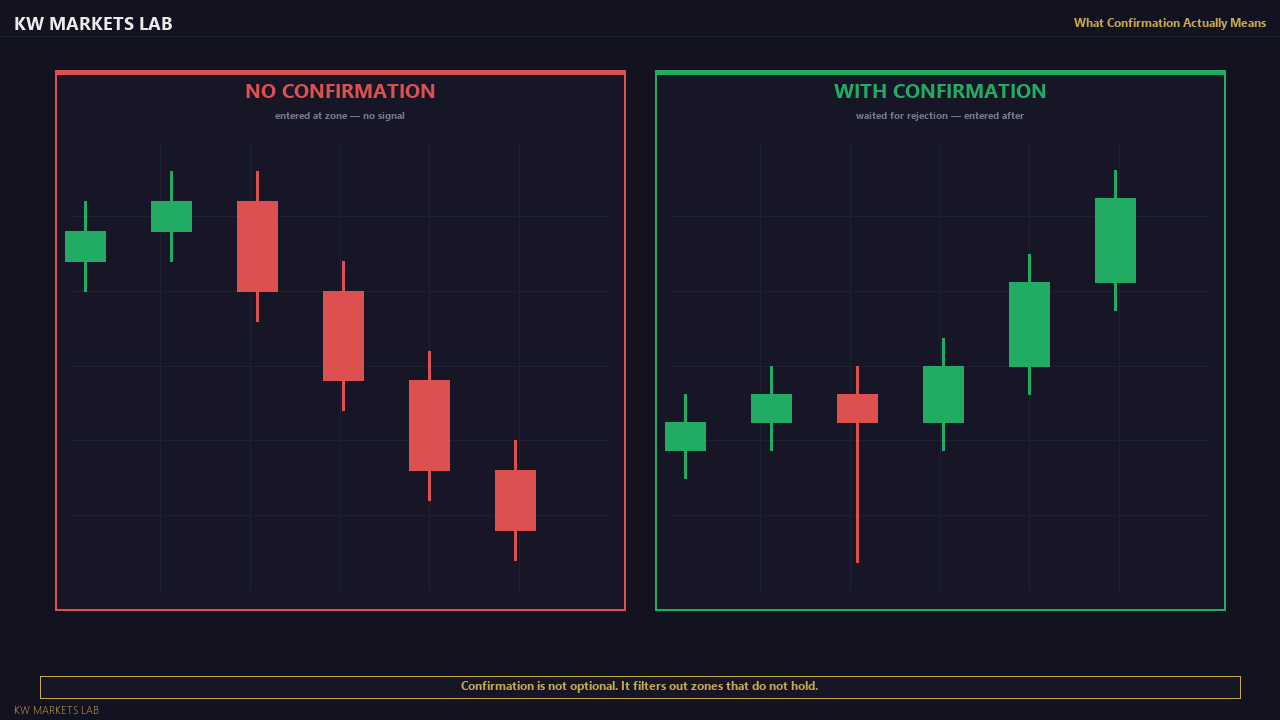
What Confirmation Means — Chart View
What Confirmation Means — Chart ViewConfirmation filters out zones that do not hold.

Traders who skip confirmation typically do so because they are afraid of missing the move. This fear is the single biggest driver of impulsive execution. The cost of missing a trade that would have worked is zero. The cost of entering a trade that had no confirmation and then failed compounds over hundreds of trades into significant capital erosion.

Continue Learning
L2.2 — The Pre-Entry Checklist →
Stay Updated

Get notified when new lessons and content are published.