L4.3 — Managing the Trade After Entry
Once a trade is entered, the decisions are: hold to target, partial exit at a key level, trail the stop, or close at a defined event. Each of these requires a rule, not a real-time judgement under the pressure of a live position. Traders who manage open positions reactively — moving stops to break even too early, closing at the first sign of retracement — systematically underperform their own entry model.
The minimum management rule: do not touch the stop for an arbitrary reason. Move it only when structure justifies it — for example, after a new higher low has formed on the entry timeframe, you can trail the stop to below that new structural low. Do not move the stop to break even just because the trade is in profit by a fixed pip amount.
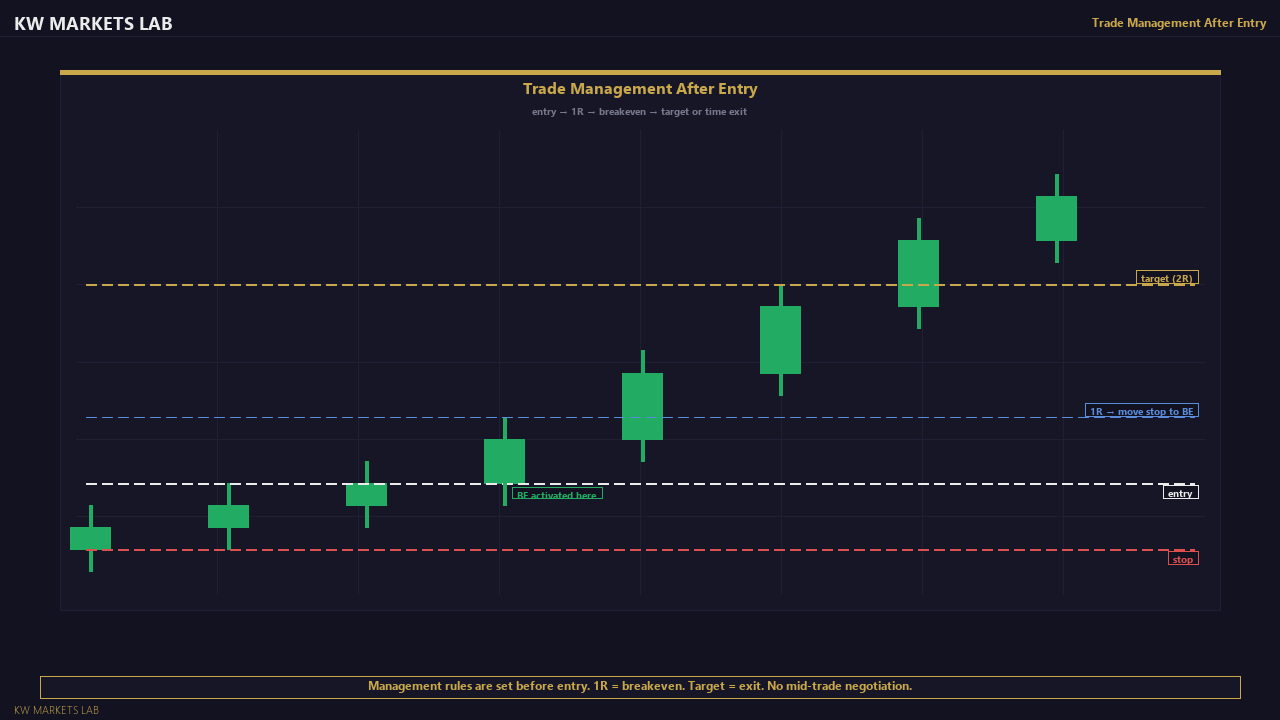
Define your management rules in writing before you enter any trade: target level, first partial exit (if any), stop trail condition. Then execute those rules mechanically. The objective of management rules is not to maximise every individual trade — it is to produce consistent outcomes across a large sample of trades. Consistency compounds. Reactive management does not.
Get notified when new lessons and content are published.