Intermediate Entry Models and Execution / Module 2: Confirmation Logic Lesson 6 of 16
Course Outline — Lesson 6 of 16
M1 Entry Model Types
1 L1.1 — The Three Entry Model Archetypes 2 L1.2 — Limit Orders vs Stop Orders at Structure 3 L1.3 — The Rejection Candle: Your Confirmation Trigger 4 L1.4 — The BOS Entry: Trading the Continuation After the Break
M2 Confirmation Logic
1 L2.1 — What Confirmation Actually Means 2 L2.2 — The Pre-Entry Checklist 3 L2.3 — When a Valid Setup Should Still Be Skipped
M3 Session-Based Execution
1 L3.1 — The Three Sessions and Their Structural Behaviour 2 L3.2 — Using Session Highs and Lows as Execution Anchors 3 L3.3 — Time-of-Day Filters for Entry Quality
M4 Execution Discipline
1 L4.1 — Stop Placement Before Entry: The Non-Negotiable Rule 2 L4.2 — The No-Chase Rule 3 L4.3 — Managing the Trade After Entry
M5 Trigger Quality and the No-Chase Rule
1 L5.1 — Grading Your Setups: A Quality Framework 2 L5.2 — Common Execution Errors and How to Prevent Them 3 L5.3 — Building Your Personal Execution Protocol
Lesson 6 of 16

L2.2 — The Pre-Entry Checklist

A pre-entry checklist is a written set of conditions that must all be true before you execute a trade. It is the mechanism that enforces your rules when emotion is pushing you toward the entry button. Without it, your rules exist only in theory.

A minimal structural checklist: (1) higher-timeframe bias defined and documented; (2) setup aligns with bias direction; (3) key structural level identified and marked; (4) confirmation signal present at the level; (5) stop-loss placed at a structurally valid location; (6) position size calculated from the stop distance. If any item is missing, the trade does not happen.
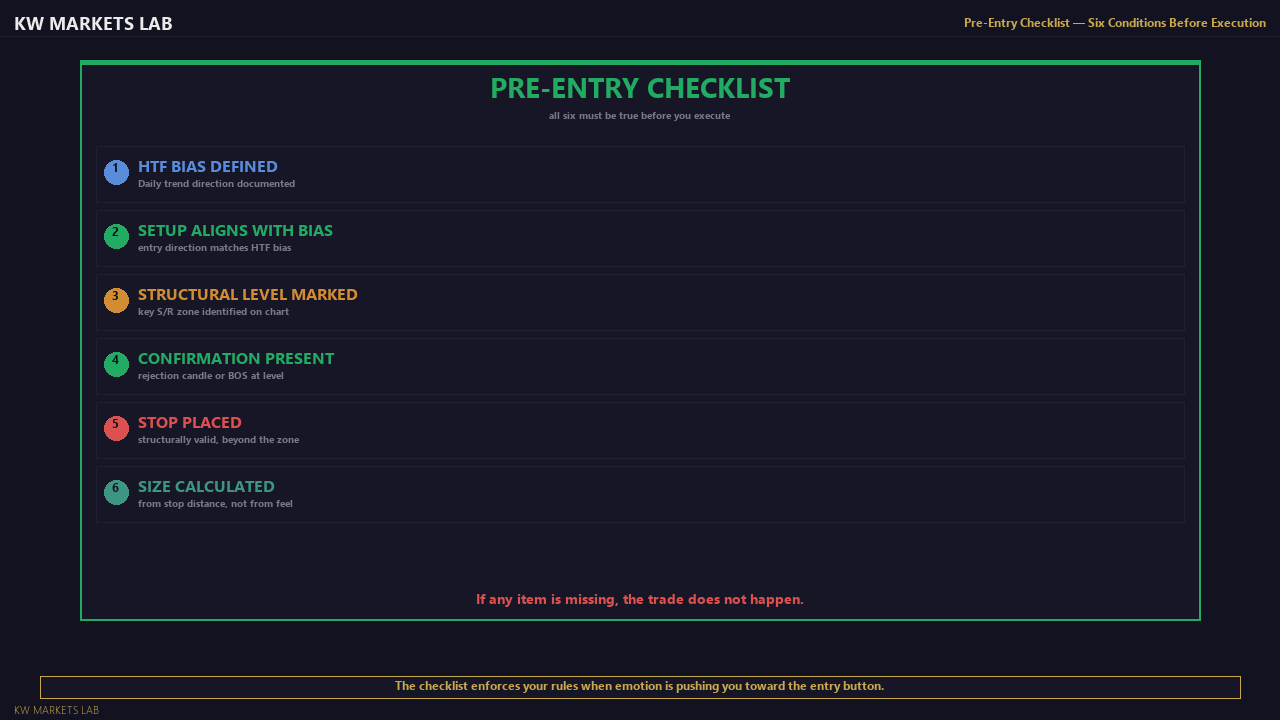
Pre-Entry Checklist
Pre-Entry ChecklistThe checklist enforces your rules when emotion is pushing you toward the entry button.

The checklist is not bureaucracy. It is the difference between a professional process and a gambling habit. Trading without a checklist is making a series of individually justified but collectively inconsistent decisions. The checklist makes your process consistent so you can measure and improve it over time.

Continue Learning
L2.3 — When a Valid Setup Should Still Be Skipped →
Stay Updated

Get notified when new lessons and content are published.