Intermediate Entry Models and Execution / Module 1: Entry Model Types Lesson 4 of 16
Course Outline — Lesson 4 of 16
M1 Entry Model Types
1 L1.1 — The Three Entry Model Archetypes 2 L1.2 — Limit Orders vs Stop Orders at Structure 3 L1.3 — The Rejection Candle: Your Confirmation Trigger 4 L1.4 — The BOS Entry: Trading the Continuation After the Break
M2 Confirmation Logic
1 L2.1 — What Confirmation Actually Means 2 L2.2 — The Pre-Entry Checklist 3 L2.3 — When a Valid Setup Should Still Be Skipped
M3 Session-Based Execution
1 L3.1 — The Three Sessions and Their Structural Behaviour 2 L3.2 — Using Session Highs and Lows as Execution Anchors 3 L3.3 — Time-of-Day Filters for Entry Quality
M4 Execution Discipline
1 L4.1 — Stop Placement Before Entry: The Non-Negotiable Rule 2 L4.2 — The No-Chase Rule 3 L4.3 — Managing the Trade After Entry
M5 Trigger Quality and the No-Chase Rule
1 L5.1 — Grading Your Setups: A Quality Framework 2 L5.2 — Common Execution Errors and How to Prevent Them 3 L5.3 — Building Your Personal Execution Protocol
Lesson 4 of 16

L1.4 — The BOS Entry: Trading the Continuation After the Break

After a confirmed Break of Structure, price has proven directional commitment by closing beyond a key swing point. The BOS itself is not the entry — it is the confirmation that the direction is valid. The entry comes on the pullback to the broken level, which has now flipped from resistance to support (in a bullish BOS).

The BOS entry model has two phases: (1) identify and confirm the BOS by candle close beyond the swing point; (2) wait for price to pull back to the flipped level and show a re-engagement signal (rejection candle or structural hold) before entering. The stop sits below the flipped level. A close below it means the flip has failed.
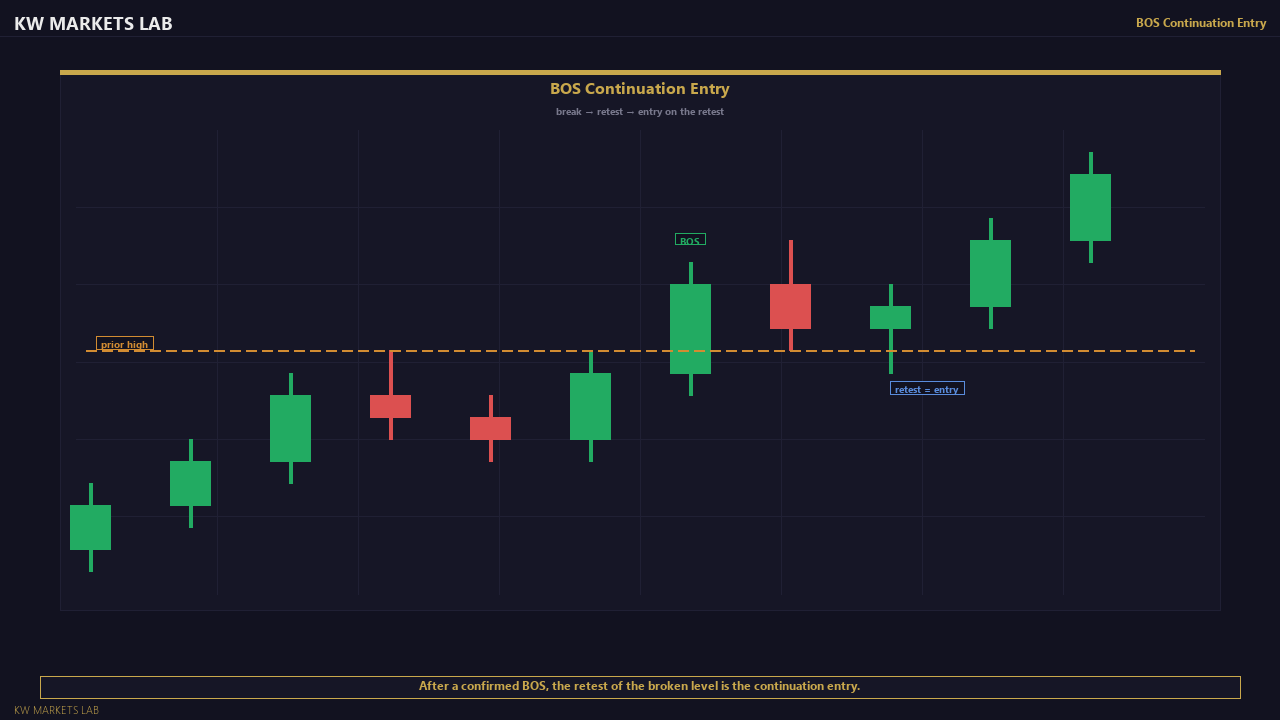
BOS Continuation Entry — Chart View
BOS Continuation Entry — Chart ViewAfter a confirmed BOS, the retest of the broken level is the continuation entry.

The most common error with BOS entries is entering on the BOS candle itself rather than waiting for the pullback. The BOS candle is often extended, placing the entry far from the stop and producing a poor risk-to-reward ratio. The discipline of waiting for the pullback is what makes this entry model structurally sound rather than reactive.

Continue Learning
L2.1 — What Confirmation Actually Means →
Stay Updated

Get notified when new lessons and content are published.