Intermediate Entry Models and Execution / Module 5: Trigger Quality and the No-Chase Rule Lesson 14 of 16
Course Outline — Lesson 14 of 16
M1 Entry Model Types
1 L1.1 — The Three Entry Model Archetypes 2 L1.2 — Limit Orders vs Stop Orders at Structure 3 L1.3 — The Rejection Candle: Your Confirmation Trigger 4 L1.4 — The BOS Entry: Trading the Continuation After the Break
M2 Confirmation Logic
1 L2.1 — What Confirmation Actually Means 2 L2.2 — The Pre-Entry Checklist 3 L2.3 — When a Valid Setup Should Still Be Skipped
M3 Session-Based Execution
1 L3.1 — The Three Sessions and Their Structural Behaviour 2 L3.2 — Using Session Highs and Lows as Execution Anchors 3 L3.3 — Time-of-Day Filters for Entry Quality
M4 Execution Discipline
1 L4.1 — Stop Placement Before Entry: The Non-Negotiable Rule 2 L4.2 — The No-Chase Rule 3 L4.3 — Managing the Trade After Entry
M5 Trigger Quality and the No-Chase Rule
1 L5.1 — Grading Your Setups: A Quality Framework 2 L5.2 — Common Execution Errors and How to Prevent Them 3 L5.3 — Building Your Personal Execution Protocol
Lesson 14 of 16

L5.1 — Grading Your Setups: A Quality Framework

Not all setups that meet your criteria are equal. A grading framework allows you to distinguish between high-quality and marginal setups and size your risk accordingly — or skip the marginal ones entirely. A simple three-tier framework: A-grade (multiple confluences, clean structure, strong confirmation), B-grade (clear setup but only one or two confluences), C-grade (technically valid but weak context).

The practical application: full risk on A-grade setups, reduced risk on B-grade, skip C-grade entirely. This is not a rigid formula — it is a discipline tool that prevents you from treating all valid setups as interchangeable. A setup that barely qualifies is not worth the same risk as one that strongly qualifies.
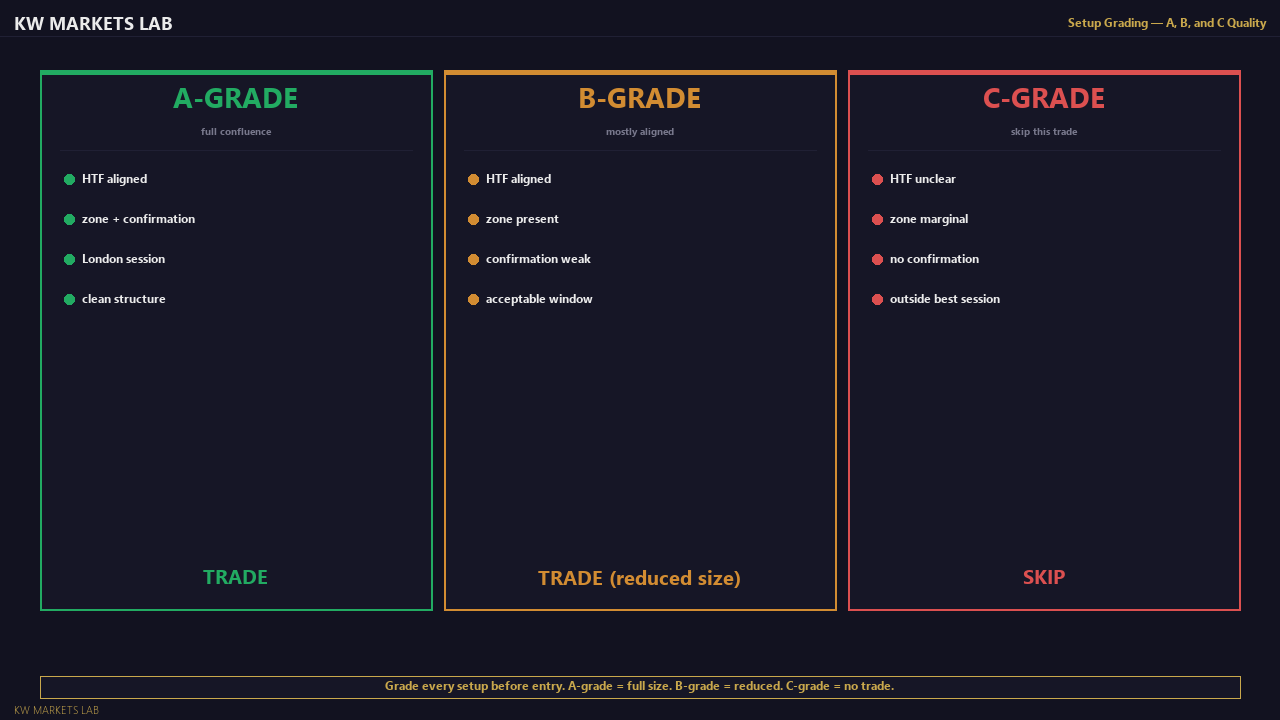
Setup Grading: A, B, C Quality
Setup Grading: A, B, C QualityGrade every setup before entry. A = full size. B = reduced. C = no trade.

Grading requires honest self-assessment. The tendency is to retroactively upgrade the grade of a trade you want to take. Counter this by grading before you look at the potential reward — assess the quality of the setup independently of how attractive the target looks.

Continue Learning
L5.2 — Common Execution Errors and How to Prevent Them →
Stay Updated

Get notified when new lessons and content are published.