Intermediate Entry Models and Execution / Module 3: Session-Based Execution Lesson 10 of 16
Course Outline — Lesson 10 of 16
M1 Entry Model Types
1 L1.1 — The Three Entry Model Archetypes 2 L1.2 — Limit Orders vs Stop Orders at Structure 3 L1.3 — The Rejection Candle: Your Confirmation Trigger 4 L1.4 — The BOS Entry: Trading the Continuation After the Break
M2 Confirmation Logic
1 L2.1 — What Confirmation Actually Means 2 L2.2 — The Pre-Entry Checklist 3 L2.3 — When a Valid Setup Should Still Be Skipped
M3 Session-Based Execution
1 L3.1 — The Three Sessions and Their Structural Behaviour 2 L3.2 — Using Session Highs and Lows as Execution Anchors 3 L3.3 — Time-of-Day Filters for Entry Quality
M4 Execution Discipline
1 L4.1 — Stop Placement Before Entry: The Non-Negotiable Rule 2 L4.2 — The No-Chase Rule 3 L4.3 — Managing the Trade After Entry
M5 Trigger Quality and the No-Chase Rule
1 L5.1 — Grading Your Setups: A Quality Framework 2 L5.2 — Common Execution Errors and How to Prevent Them 3 L5.3 — Building Your Personal Execution Protocol
Lesson 10 of 16

L3.3 — Time-of-Day Filters for Entry Quality

Not all hours within a session are equal. The first 30-60 minutes of London and New York are typically the highest-activity periods with the clearest directional intent. Mid-session drift — the period between peak London activity and the New York open — is often lower conviction and generates setups with less follow-through.

A practical time filter: restrict new entries to specific windows within sessions rather than trading the full 24-hour clock. For XAUUSD and major pairs, the 07:00-10:00 UTC (London open) and 13:30-16:00 UTC (New York open) windows produce the most structurally clean entries. Entries placed outside these windows should require a higher structural confirmation bar before execution.
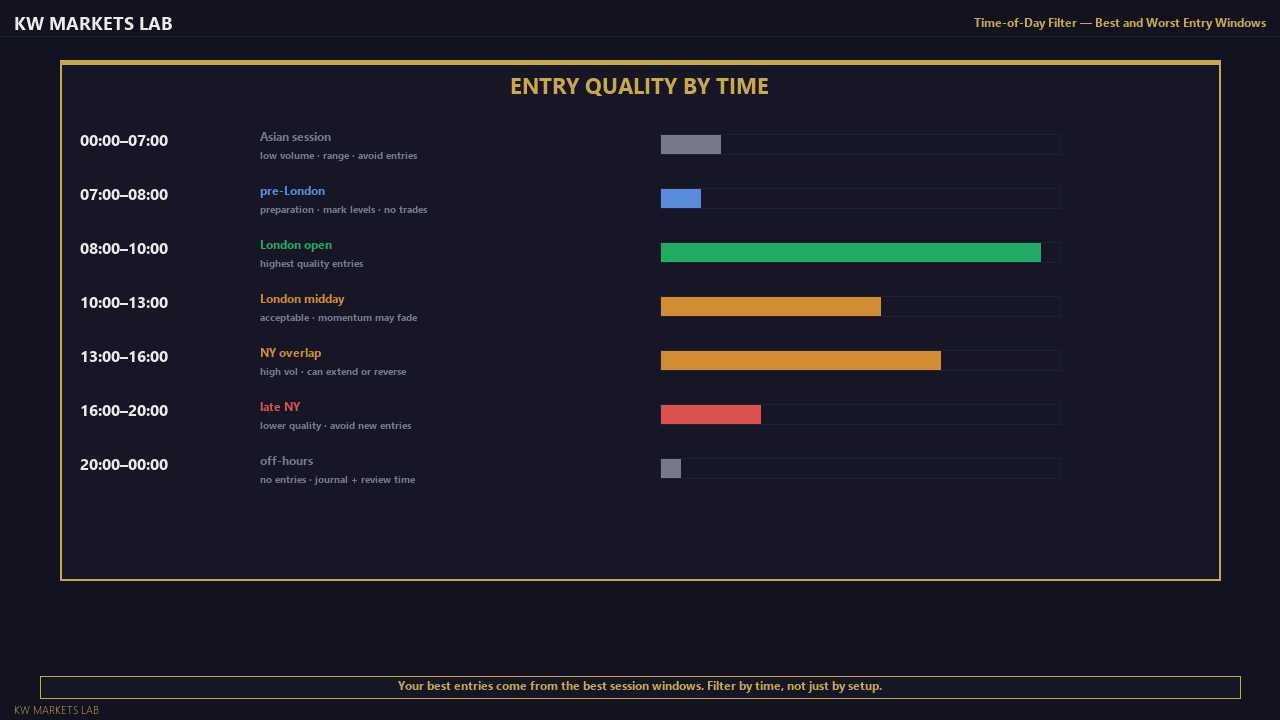
Time-of-Day Entry Quality Filter
Time-of-Day Entry Quality FilterYour best entries come from the best session windows.

Apply your time filter by writing it into your pre-entry checklist. "Is the current time within my preferred entry window?" is a binary check that takes two seconds and prevents a significant portion of low-conviction entries that erode performance over time.

Continue Learning
L4.1 — Stop Placement Before Entry: The Non-Negotiable Rule →
Stay Updated

Get notified when new lessons and content are published.