Intermediate Entry Models and Execution / Module 2: Confirmation Logic Lesson 7 of 16
Course Outline — Lesson 7 of 16
M1 Entry Model Types
1 L1.1 — The Three Entry Model Archetypes 2 L1.2 — Limit Orders vs Stop Orders at Structure 3 L1.3 — The Rejection Candle: Your Confirmation Trigger 4 L1.4 — The BOS Entry: Trading the Continuation After the Break
M2 Confirmation Logic
1 L2.1 — What Confirmation Actually Means 2 L2.2 — The Pre-Entry Checklist 3 L2.3 — When a Valid Setup Should Still Be Skipped
M3 Session-Based Execution
1 L3.1 — The Three Sessions and Their Structural Behaviour 2 L3.2 — Using Session Highs and Lows as Execution Anchors 3 L3.3 — Time-of-Day Filters for Entry Quality
M4 Execution Discipline
1 L4.1 — Stop Placement Before Entry: The Non-Negotiable Rule 2 L4.2 — The No-Chase Rule 3 L4.3 — Managing the Trade After Entry
M5 Trigger Quality and the No-Chase Rule
1 L5.1 — Grading Your Setups: A Quality Framework 2 L5.2 — Common Execution Errors and How to Prevent Them 3 L5.3 — Building Your Personal Execution Protocol
Lesson 7 of 16

L2.3 — When a Valid Setup Should Still Be Skipped

A setup can meet all of your structural and confirmation criteria and still be a setup worth skipping. The additional filter is context. High-impact news events, sessions with historically poor liquidity, a market that has already moved significantly in the trade direction, or a personal state (fatigue, distraction, emotional disturbance) that compromises execution quality are all valid reasons to pass.

The rule: a setup you skip costs you nothing. A setup you enter in poor context costs you capital even when the structural analysis is correct. Markets repeat. The same structural setup will appear again in better conditions. Protecting your ability to participate in those future setups by not degrading your capital in poor-context versions is a legitimate edge.
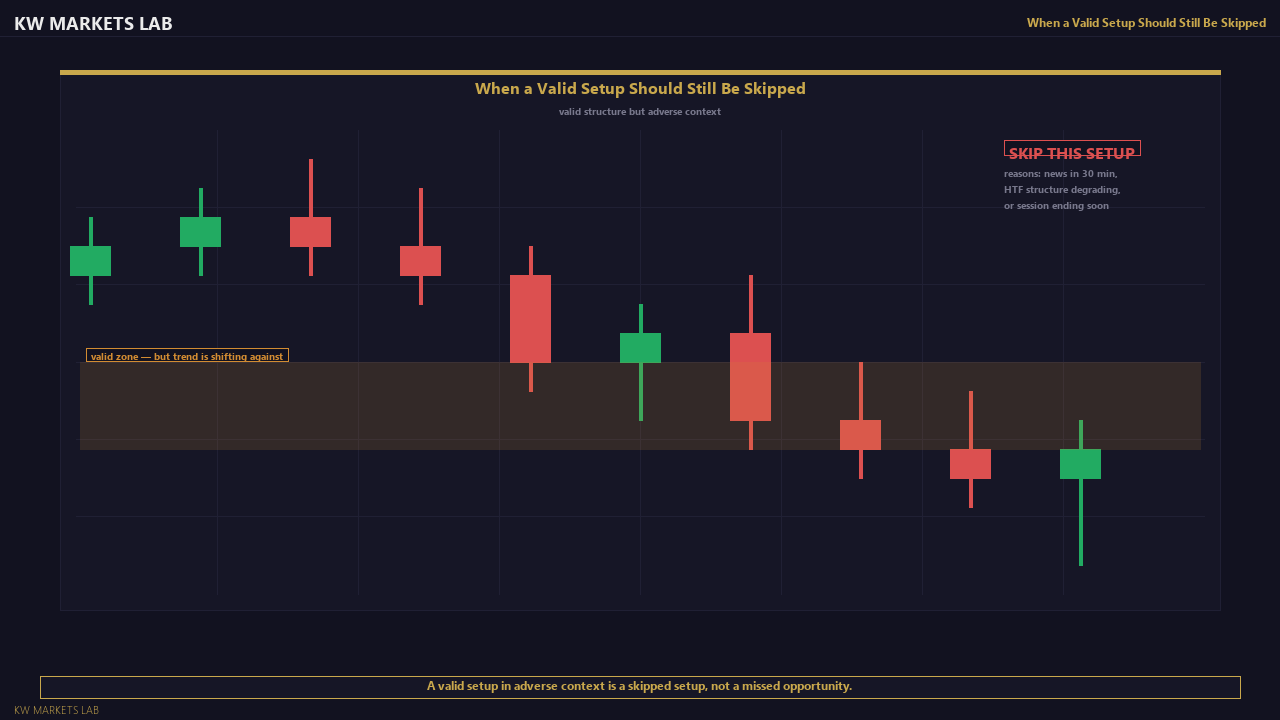
When to Skip a Valid Setup — Chart View
When to Skip a Valid Setup — Chart ViewA valid setup in adverse context is a skipped setup, not a missed opportunity.

Common skip conditions to pre-define: within 30 minutes of high-impact news on the traded instrument; more than two standard-deviation moves already completed in the session; Sunday open or Friday close sessions for XAUUSD; personal rule violations on the current trading day. Define yours in writing before you encounter them under pressure.

Continue Learning
L3.1 — The Three Sessions and Their Structural Behaviour →
Stay Updated

Get notified when new lessons and content are published.