Intermediate Entry Models and Execution / Module 4: Execution Discipline Lesson 12 of 16
Course Outline — Lesson 12 of 16
M1 Entry Model Types
1 L1.1 — The Three Entry Model Archetypes 2 L1.2 — Limit Orders vs Stop Orders at Structure 3 L1.3 — The Rejection Candle: Your Confirmation Trigger 4 L1.4 — The BOS Entry: Trading the Continuation After the Break
M2 Confirmation Logic
1 L2.1 — What Confirmation Actually Means 2 L2.2 — The Pre-Entry Checklist 3 L2.3 — When a Valid Setup Should Still Be Skipped
M3 Session-Based Execution
1 L3.1 — The Three Sessions and Their Structural Behaviour 2 L3.2 — Using Session Highs and Lows as Execution Anchors 3 L3.3 — Time-of-Day Filters for Entry Quality
M4 Execution Discipline
1 L4.1 — Stop Placement Before Entry: The Non-Negotiable Rule 2 L4.2 — The No-Chase Rule 3 L4.3 — Managing the Trade After Entry
M5 Trigger Quality and the No-Chase Rule
1 L5.1 — Grading Your Setups: A Quality Framework 2 L5.2 — Common Execution Errors and How to Prevent Them 3 L5.3 — Building Your Personal Execution Protocol
Lesson 12 of 16

L4.2 — The No-Chase Rule

Chasing an entry means placing a trade after the optimal entry point has passed — typically entering a strong momentum candle well above your intended level because you are afraid of missing the move. The result is an entry with a worse price, a larger gap to the stop, and a risk-to-reward ratio that no longer justifies the trade. You have accepted all the same risk for less potential reward.

The no-chase rule is a hard stop: if price has moved more than X pips (or X percent of the average true range) beyond your intended entry, the trade does not happen. The specific threshold depends on the instrument and timeframe, but the rule must be written down in advance and applied mechanically. "I will let it go" is the sentence that prevents the chase.
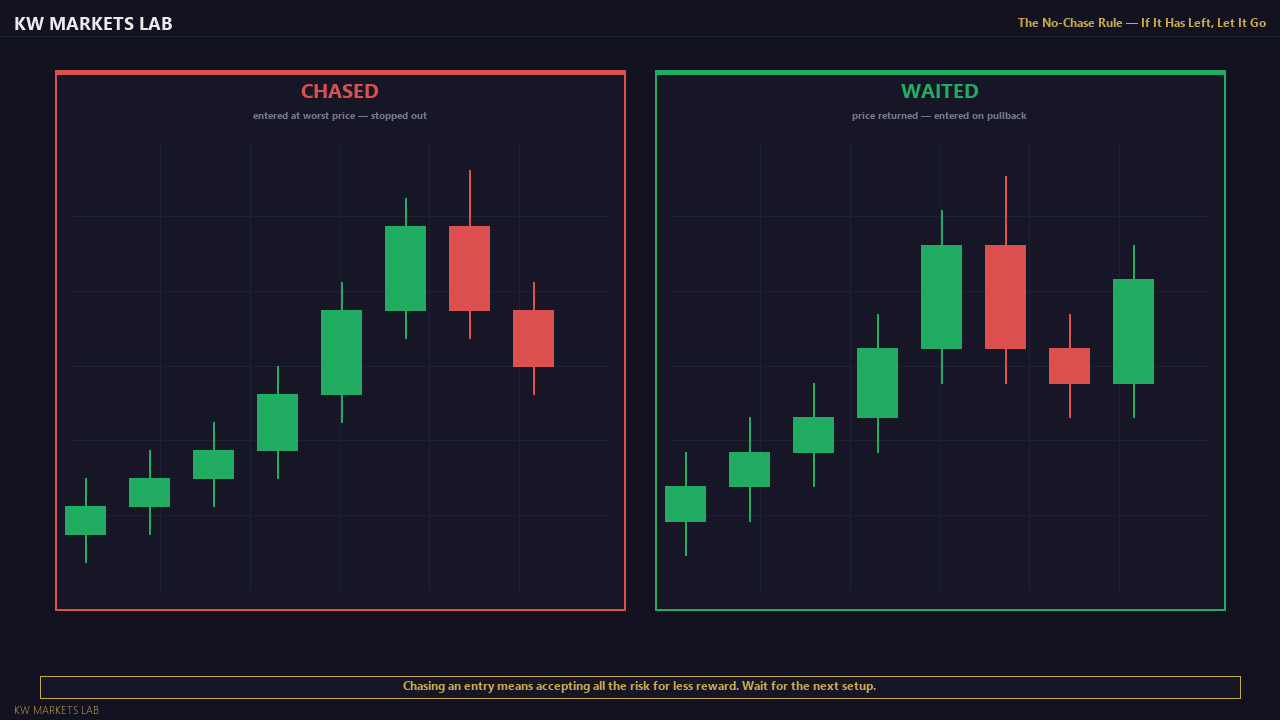
The No-Chase Rule — Chart View
The No-Chase Rule — Chart ViewChasing an entry means accepting all the risk for less reward.

The discipline of the no-chase rule builds over time. Every time you successfully decline a chase entry, you reinforce that there will always be another setup. The traders who destroy accounts are not those who miss setups — they are those who chase setups and compound poor entries into larger and larger losses.

Continue Learning
L4.3 — Managing the Trade After Entry →
Stay Updated

Get notified when new lessons and content are published.