Intermediate Entry Models and Execution / Module 3: Session-Based Execution Lesson 8 of 16
Course Outline — Lesson 8 of 16
M1 Entry Model Types
1 L1.1 — The Three Entry Model Archetypes 2 L1.2 — Limit Orders vs Stop Orders at Structure 3 L1.3 — The Rejection Candle: Your Confirmation Trigger 4 L1.4 — The BOS Entry: Trading the Continuation After the Break
M2 Confirmation Logic
1 L2.1 — What Confirmation Actually Means 2 L2.2 — The Pre-Entry Checklist 3 L2.3 — When a Valid Setup Should Still Be Skipped
M3 Session-Based Execution
1 L3.1 — The Three Sessions and Their Structural Behaviour 2 L3.2 — Using Session Highs and Lows as Execution Anchors 3 L3.3 — Time-of-Day Filters for Entry Quality
M4 Execution Discipline
1 L4.1 — Stop Placement Before Entry: The Non-Negotiable Rule 2 L4.2 — The No-Chase Rule 3 L4.3 — Managing the Trade After Entry
M5 Trigger Quality and the No-Chase Rule
1 L5.1 — Grading Your Setups: A Quality Framework 2 L5.2 — Common Execution Errors and How to Prevent Them 3 L5.3 — Building Your Personal Execution Protocol
Lesson 8 of 16

L3.1 — The Three Sessions and Their Structural Behaviour

The forex and gold markets run through three major sessions: Asian, London, and New York. Each has a distinct structural behaviour that affects entry quality. The Asian session is typically low-volatility and range-bound — setups formed here often lack follow-through. London open is the highest-probability period for trend initiation and structural breaks. New York open adds a second high-liquidity window that often either continues the London move or reverses it.

Session overlap (London-New York, roughly 13:00–16:00 UTC) is when volume peaks and structural moves carry the most conviction. Entries taken within a strong session window at a valid structural level have higher probability of follow-through than the same entry taken during the Asian consolidation.
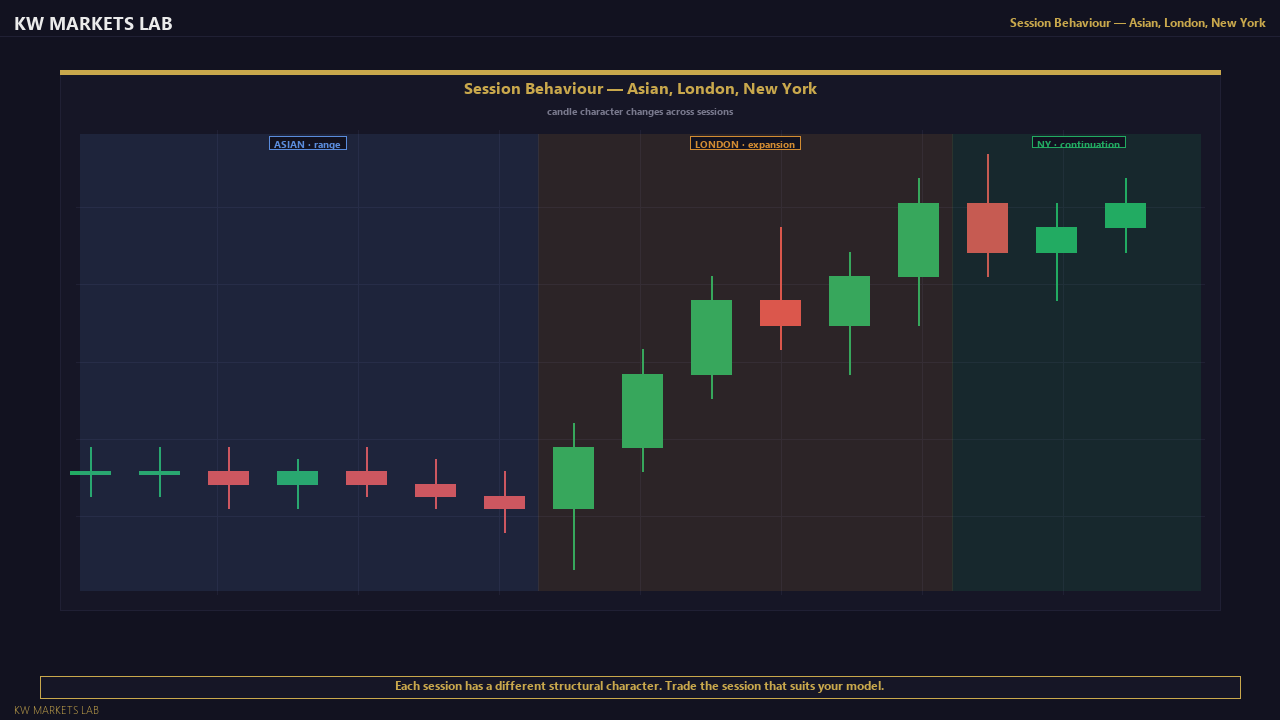
Three Sessions — Chart View
Three Sessions — Chart ViewEach session has a different structural character.

The practical rule: identify your setup in advance, mark the level, and wait for London or New York open to provide the directional catalyst. Do not force entries during the Asian session unless the setup is exceptionally clean and risk is tightly defined.

Continue Learning
L3.2 — Using Session Highs and Lows as Execution Anchors →
Stay Updated

Get notified when new lessons and content are published.