Intermediate Entry Models and Execution / Module 1: Entry Model Types Lesson 1 of 16
Course Outline — Lesson 1 of 16
M1 Entry Model Types
1 L1.1 — The Three Entry Model Archetypes 2 L1.2 — Limit Orders vs Stop Orders at Structure 3 L1.3 — The Rejection Candle: Your Confirmation Trigger 4 L1.4 — The BOS Entry: Trading the Continuation After the Break
M2 Confirmation Logic
1 L2.1 — What Confirmation Actually Means 2 L2.2 — The Pre-Entry Checklist 3 L2.3 — When a Valid Setup Should Still Be Skipped
M3 Session-Based Execution
1 L3.1 — The Three Sessions and Their Structural Behaviour 2 L3.2 — Using Session Highs and Lows as Execution Anchors 3 L3.3 — Time-of-Day Filters for Entry Quality
M4 Execution Discipline
1 L4.1 — Stop Placement Before Entry: The Non-Negotiable Rule 2 L4.2 — The No-Chase Rule 3 L4.3 — Managing the Trade After Entry
M5 Trigger Quality and the No-Chase Rule
1 L5.1 — Grading Your Setups: A Quality Framework 2 L5.2 — Common Execution Errors and How to Prevent Them 3 L5.3 — Building Your Personal Execution Protocol
Lesson 1 of 16

L1.1 — The Three Entry Model Archetypes

Every entry model falls into one of three archetypes: anticipatory, confirmation, or continuation. An anticipatory entry is placed in advance of confirmation — typically a limit order at a structural level before price has shown a reaction. A confirmation entry waits for a defined signal at the level before triggering. A continuation entry is taken after a structural event (BOS, CHOCH) has already occurred, targeting the next move.

Each archetype has a different risk profile. Anticipatory entries get better prices but face higher failure rates when the level does not hold. Confirmation entries sacrifice some of the move for a higher-probability trigger. Continuation entries are lower risk in terms of structural alignment but may enter late relative to the initial move.
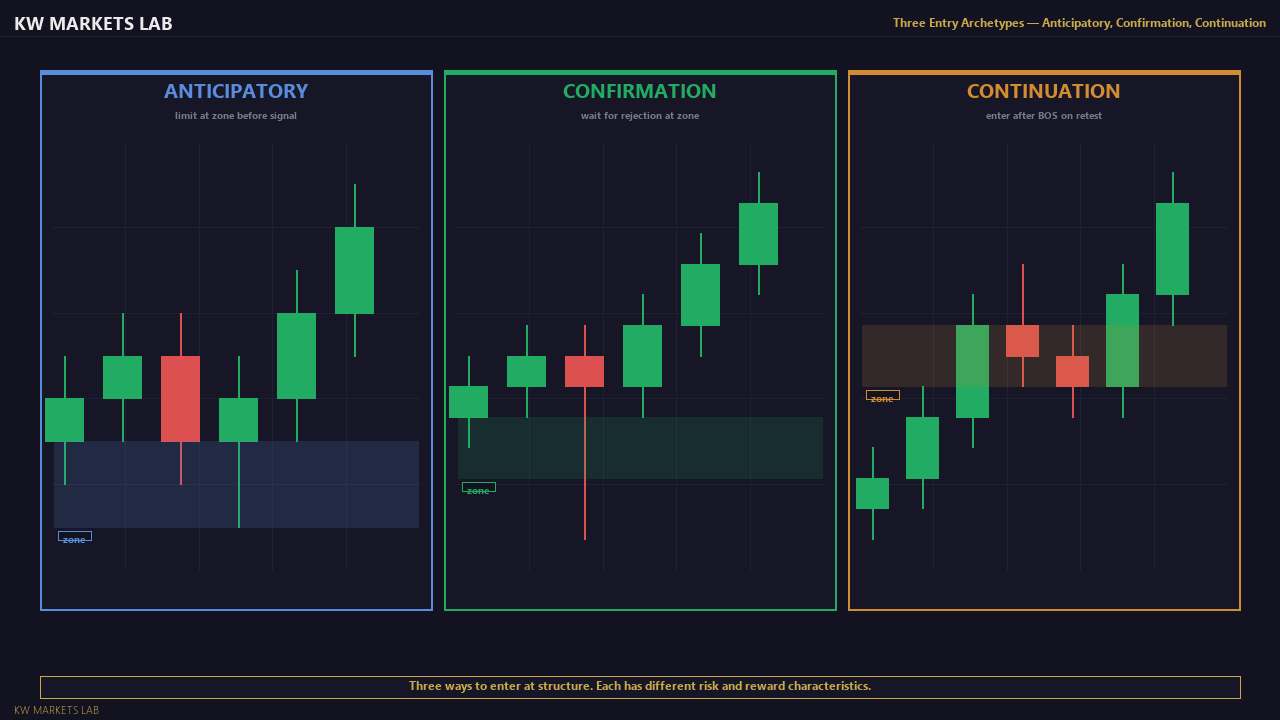
Three Entry Archetypes — Chart View
Three Entry Archetypes — Chart ViewThree ways to enter at structure. Each has different risk and reward characteristics.

Most retail traders unknowingly mix these three archetypes based on emotion rather than a defined system: they use anticipatory entries when confident and wait for confirmation when fearful, with no consistent rule. The goal of this module is to make your entry model explicit so you can apply it consistently and measure its actual performance.

Continue Learning
L1.2 — Limit Orders vs Stop Orders at Structure →
Stay Updated

Get notified when new lessons and content are published.