Intermediate Entry Models and Execution / Module 1: Entry Model Types Lesson 2 of 16
Course Outline — Lesson 2 of 16
M1 Entry Model Types
1 L1.1 — The Three Entry Model Archetypes 2 L1.2 — Limit Orders vs Stop Orders at Structure 3 L1.3 — The Rejection Candle: Your Confirmation Trigger 4 L1.4 — The BOS Entry: Trading the Continuation After the Break
M2 Confirmation Logic
1 L2.1 — What Confirmation Actually Means 2 L2.2 — The Pre-Entry Checklist 3 L2.3 — When a Valid Setup Should Still Be Skipped
M3 Session-Based Execution
1 L3.1 — The Three Sessions and Their Structural Behaviour 2 L3.2 — Using Session Highs and Lows as Execution Anchors 3 L3.3 — Time-of-Day Filters for Entry Quality
M4 Execution Discipline
1 L4.1 — Stop Placement Before Entry: The Non-Negotiable Rule 2 L4.2 — The No-Chase Rule 3 L4.3 — Managing the Trade After Entry
M5 Trigger Quality and the No-Chase Rule
1 L5.1 — Grading Your Setups: A Quality Framework 2 L5.2 — Common Execution Errors and How to Prevent Them 3 L5.3 — Building Your Personal Execution Protocol
Lesson 2 of 16

L1.2 — Limit Orders vs Stop Orders at Structure

A limit order is placed at a specific price with the intention of being filled when price returns to that level. At a structural support zone, a buy limit is placed at or near the zone to capture the anticipated bounce. The advantage: you get filled at your intended price. The risk: price may blast through the level without a bounce, and you are now long into a structural break.

A stop entry (buy stop above a swing high, sell stop below a swing low) waits for price to break a defined level before entering — typically used for BOS-continuation trades. This entry model requires price to prove the break before you participate. The disadvantage is slippage and potentially entering at a worse price than the initial break candle offers.
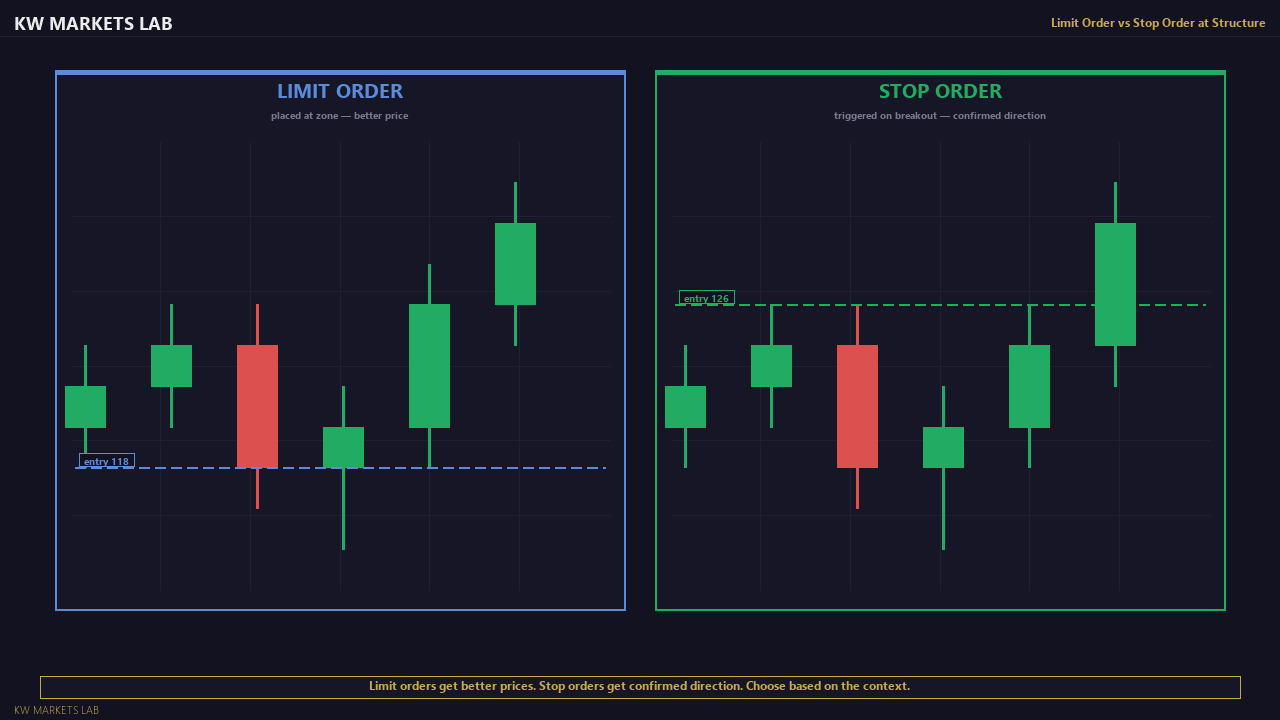
Limit Order vs Stop Order — Chart View
Limit Order vs Stop Order — Chart ViewLimit orders get better prices. Stop orders get confirmed direction.

A market order is used when precision matters less than speed — for example, entering at the open of a strong momentum candle after a confirmation close. Market orders should be the exception, not the default. The habit of market-ordering every entry removes the discipline of waiting for a defined price and degrades long-term execution quality.

Continue Learning
L1.3 — The Rejection Candle: Your Confirmation Trigger →
Stay Updated

Get notified when new lessons and content are published.