Intermediate Market Structure Mastery / Module 5: Advanced BOS and CHOCH Lesson 15 of 16
Course Outline — Lesson 15 of 16
M1 Multi-Timeframe Structure Analysis
1 L1.1 — What Market Structure Actually Means 2 L1.2 — Swing Highs, Swing Lows, and How to Mark Them Consistently 3 L1.3 — The Multi-Timeframe Cascade 4 L1.4 — Reading Structure on Higher Timeframes to Filter Lower-Timeframe Noise
M2 Internal vs External Structure
1 L2.1 — External Structure: The Major Swing Points That Define the Trend 2 L2.2 — Internal Structure: Swing Points Within a Trend Leg 3 L2.3 — When Internal Structure Breaks Before External Structure Does
M3 Structure Traps and Liquidity
1 L3.1 — What Is Liquidity and Why Does Price Hunt It? 2 L3.2 — Recognising False Breaks and Stop Hunts at Structure 3 L3.3 — Range Edges and the Liquidity Trap at Equal Highs and Lows
M4 Context and Bias Filtering
1 L4.1 — Building a Daily Directional Bias 2 L4.2 — When to Stand Aside: Markets Not Worth Trading 3 L4.3 — Confluence: When Multiple Structural Factors Align
M5 Advanced BOS and CHOCH
1 L5.1 — Break of Structure vs Change of Character: The Critical Difference 2 L5.2 — Higher-Probability BOS: Quality Filters 3 L5.3 — Structural Analysis in Practice: A Full Worked Example
Lesson 15 of 16

L5.2 — Higher-Probability BOS: Quality Filters

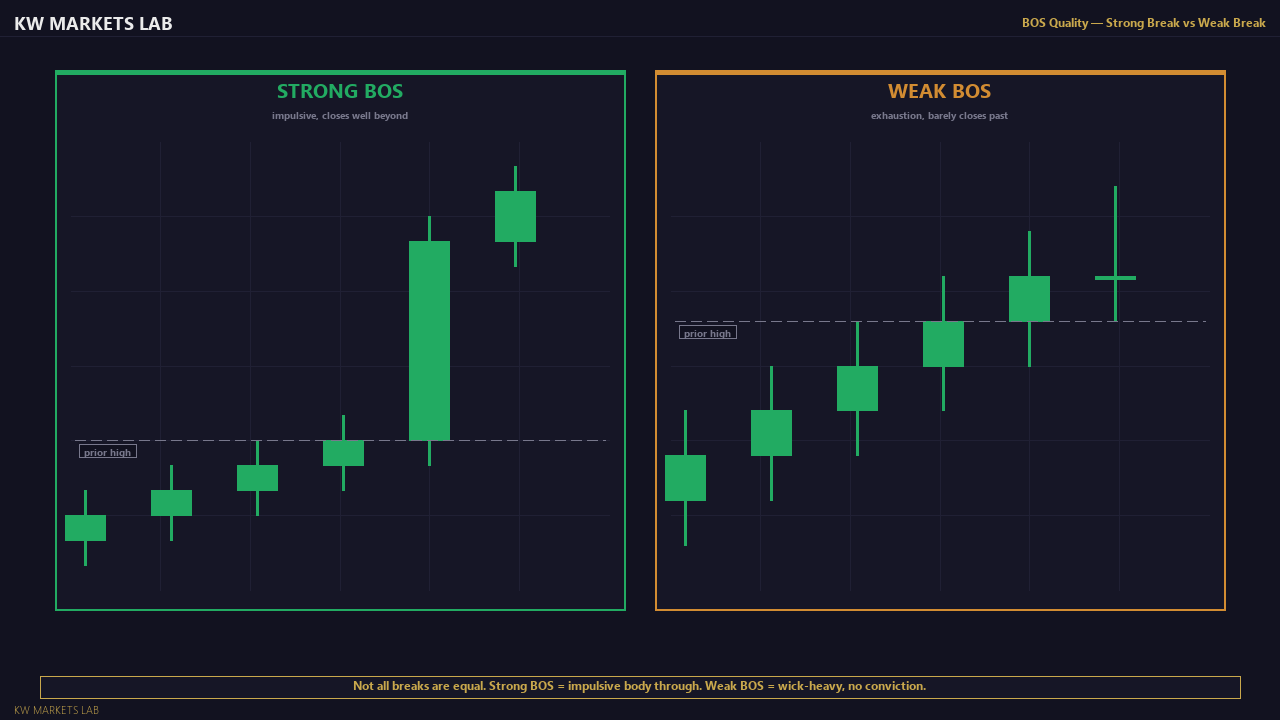
Not every BOS is equal. A BOS from a strong, impulsive move carries more weight than a BOS generated by a slow, grinding candle that barely clears the prior high. The impulse quality of the break is a useful filter for how much confidence to place in the subsequent continuation setup.

Quality filters for a BOS: (1) the break candle is large relative to recent candles, suggesting genuine momentum; (2) the candle closes well beyond the swing point rather than just piercing it; (3) the break is accompanied by a structural sequence that supports it (prior higher highs and higher lows for a bullish BOS). A BOS that fails all three of these filters is a weak signal at best.
BOS Quality Filters — Chart View
BOS Quality Filters — Chart ViewNot all breaks are equal. Strong BOS = impulsive body through. Weak BOS = no conviction.

The practical application: after a high-quality BOS, the pullback to the broken level is the entry opportunity. After a low-quality BOS, the pullback should be watched with more caution — the probability of the level failing on the retest is higher. Setting a minimum quality standard for the breaks you act on is a form of trade filtering that improves selectivity without adding indicators.

Continue Learning
L5.3 — Structural Analysis in Practice: A Full Worked Example →
Stay Updated

Get notified when new lessons and content are published.