Intermediate Market Structure Mastery / Module 2: Internal vs External Structure Lesson 6 of 16
Course Outline — Lesson 6 of 16
M1 Multi-Timeframe Structure Analysis
1 L1.1 — What Market Structure Actually Means 2 L1.2 — Swing Highs, Swing Lows, and How to Mark Them Consistently 3 L1.3 — The Multi-Timeframe Cascade 4 L1.4 — Reading Structure on Higher Timeframes to Filter Lower-Timeframe Noise
M2 Internal vs External Structure
1 L2.1 — External Structure: The Major Swing Points That Define the Trend 2 L2.2 — Internal Structure: Swing Points Within a Trend Leg 3 L2.3 — When Internal Structure Breaks Before External Structure Does
M3 Structure Traps and Liquidity
1 L3.1 — What Is Liquidity and Why Does Price Hunt It? 2 L3.2 — Recognising False Breaks and Stop Hunts at Structure 3 L3.3 — Range Edges and the Liquidity Trap at Equal Highs and Lows
M4 Context and Bias Filtering
1 L4.1 — Building a Daily Directional Bias 2 L4.2 — When to Stand Aside: Markets Not Worth Trading 3 L4.3 — Confluence: When Multiple Structural Factors Align
M5 Advanced BOS and CHOCH
1 L5.1 — Break of Structure vs Change of Character: The Critical Difference 2 L5.2 — Higher-Probability BOS: Quality Filters 3 L5.3 — Structural Analysis in Practice: A Full Worked Example
Lesson 6 of 16

L2.2 — Internal Structure: Swing Points Within a Trend Leg

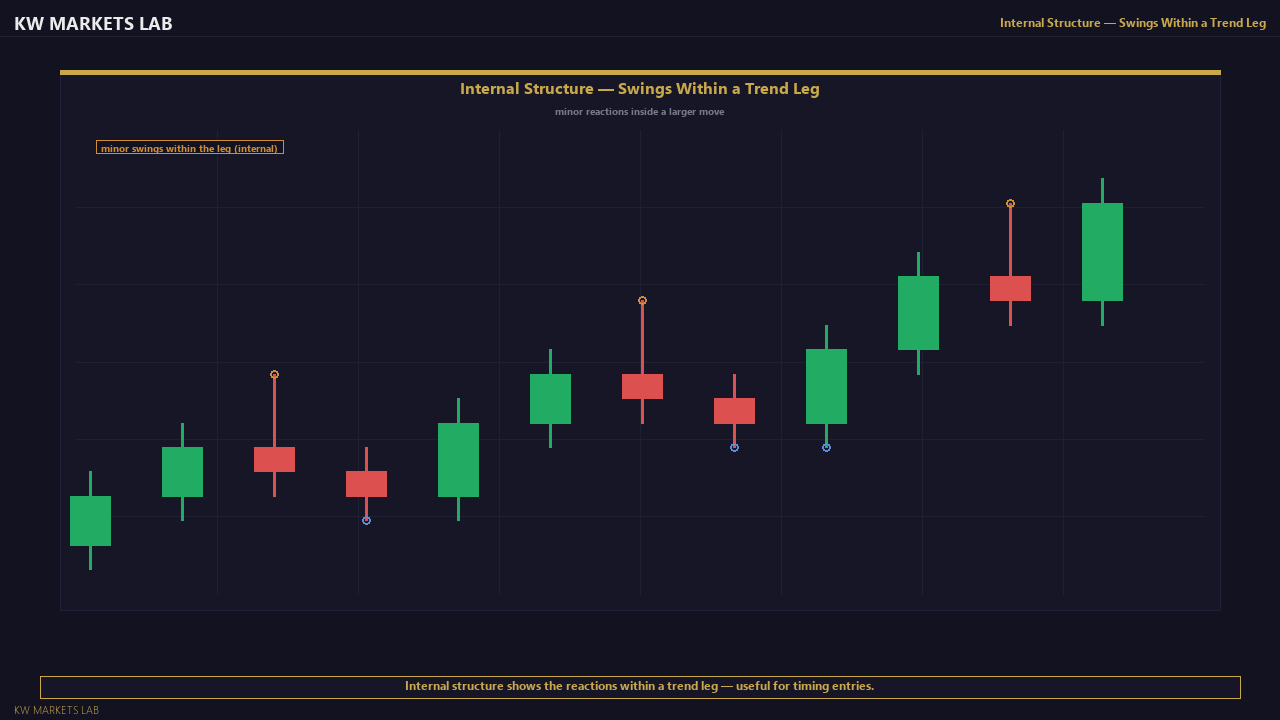
Internal structure consists of the minor swing points that form within a larger trending move. In a bullish external leg from point A to point B, price does not move in a straight line — it makes a series of smaller higher highs and higher lows on the way up. These minor swings are internal structure. They live inside the trend leg and are only relevant within the context of that leg.

Internal structure matters for two reasons. First, it helps identify pullbacks within a trend — the retracement is complete when internal structure holds and resumes the direction of external structure. Second, it provides early warning signs: if internal structure begins printing lower highs within an external bullish leg, momentum is weakening before the external swing point is broken.
Internal Structure — Chart View
Internal Structure — Chart ViewInternal structure shows reactions within a trend leg — useful for timing entries.

The distinction between internal and external is relative to timeframe. What is external structure on the M15 is likely internal structure on the H4. This is why reading structure top-down prevents the confusion of treating every minor swing as a significant level.

Continue Learning
L2.3 — When Internal Structure Breaks Before External Structure Does →
Stay Updated

Get notified when new lessons and content are published.