Intermediate Market Structure Mastery / Module 2: Internal vs External Structure Lesson 5 of 16
Course Outline — Lesson 5 of 16
M1 Multi-Timeframe Structure Analysis
1 L1.1 — What Market Structure Actually Means 2 L1.2 — Swing Highs, Swing Lows, and How to Mark Them Consistently 3 L1.3 — The Multi-Timeframe Cascade 4 L1.4 — Reading Structure on Higher Timeframes to Filter Lower-Timeframe Noise
M2 Internal vs External Structure
1 L2.1 — External Structure: The Major Swing Points That Define the Trend 2 L2.2 — Internal Structure: Swing Points Within a Trend Leg 3 L2.3 — When Internal Structure Breaks Before External Structure Does
M3 Structure Traps and Liquidity
1 L3.1 — What Is Liquidity and Why Does Price Hunt It? 2 L3.2 — Recognising False Breaks and Stop Hunts at Structure 3 L3.3 — Range Edges and the Liquidity Trap at Equal Highs and Lows
M4 Context and Bias Filtering
1 L4.1 — Building a Daily Directional Bias 2 L4.2 — When to Stand Aside: Markets Not Worth Trading 3 L4.3 — Confluence: When Multiple Structural Factors Align
M5 Advanced BOS and CHOCH
1 L5.1 — Break of Structure vs Change of Character: The Critical Difference 2 L5.2 — Higher-Probability BOS: Quality Filters 3 L5.3 — Structural Analysis in Practice: A Full Worked Example
Lesson 5 of 16

L2.1 — External Structure: The Major Swing Points That Define the Trend

External structure refers to the major swing highs and swing lows that define the dominant trend. These are the points where price made a significant high before reversing, or a significant low before bouncing. They are visible on the chart to any experienced analyst and they represent the structural skeleton of the market.

When identifying external structure, the test is simple: would this swing point be visible and meaningful on the next timeframe up? A swing high on H4 that is also a clear high on the daily qualifies as external structure. A minor H4 peak that disappears into noise on the daily does not.
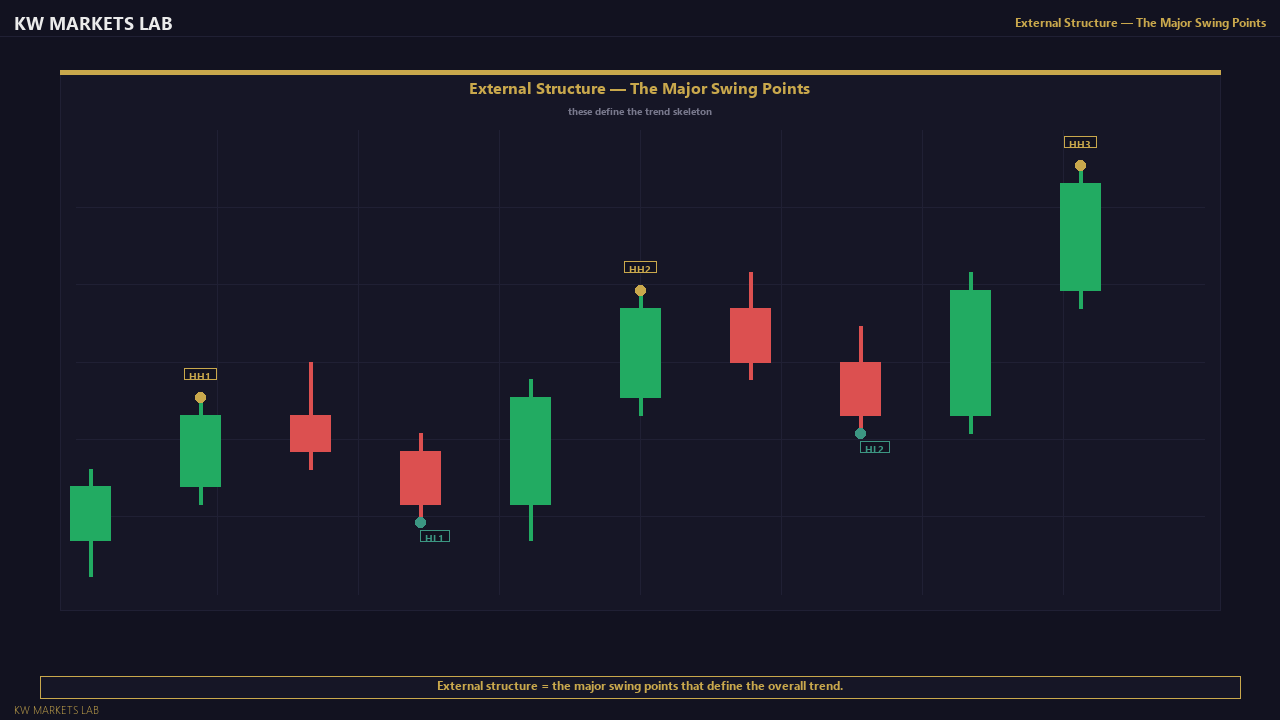
External Structure — Chart View
External Structure — Chart ViewExternal structure = the major swing points that define the overall trend.

External structure is what most traders mean when they talk about "key levels." These are the areas where large participants made decisions. Price tends to react at these levels not because of magic, but because other analysts mark the same points and position around them — creating self-reinforcing behaviour at predictable areas.

Continue Learning
L2.2 — Internal Structure: Swing Points Within a Trend Leg →
Stay Updated

Get notified when new lessons and content are published.