Intermediate Market Structure Mastery / Module 4: Context and Bias Filtering Lesson 12 of 16
Course Outline — Lesson 12 of 16
M1 Multi-Timeframe Structure Analysis
1 L1.1 — What Market Structure Actually Means 2 L1.2 — Swing Highs, Swing Lows, and How to Mark Them Consistently 3 L1.3 — The Multi-Timeframe Cascade 4 L1.4 — Reading Structure on Higher Timeframes to Filter Lower-Timeframe Noise
M2 Internal vs External Structure
1 L2.1 — External Structure: The Major Swing Points That Define the Trend 2 L2.2 — Internal Structure: Swing Points Within a Trend Leg 3 L2.3 — When Internal Structure Breaks Before External Structure Does
M3 Structure Traps and Liquidity
1 L3.1 — What Is Liquidity and Why Does Price Hunt It? 2 L3.2 — Recognising False Breaks and Stop Hunts at Structure 3 L3.3 — Range Edges and the Liquidity Trap at Equal Highs and Lows
M4 Context and Bias Filtering
1 L4.1 — Building a Daily Directional Bias 2 L4.2 — When to Stand Aside: Markets Not Worth Trading 3 L4.3 — Confluence: When Multiple Structural Factors Align
M5 Advanced BOS and CHOCH
1 L5.1 — Break of Structure vs Change of Character: The Critical Difference 2 L5.2 — Higher-Probability BOS: Quality Filters 3 L5.3 — Structural Analysis in Practice: A Full Worked Example
Lesson 12 of 16

L4.2 — When to Stand Aside: Markets Not Worth Trading

One of the most undervalued skills in trading is the ability to recognise when a market has no clear structure worth trading and to stand aside. Choppy, overlapping price action with no clear swing sequence is not a market in transition — it is a market telling you that conditions are unclear. Trading it anyway is treating randomness as edge.

The structural signs that a market is not worth trading: candles are overlapping heavily, swing highs and lows are ambiguous, the most recent BOS has immediately reversed, or the market is caught between two equal levels with no directional resolution. When these conditions are present, the correct action is to watch, not to find a reason to be in.
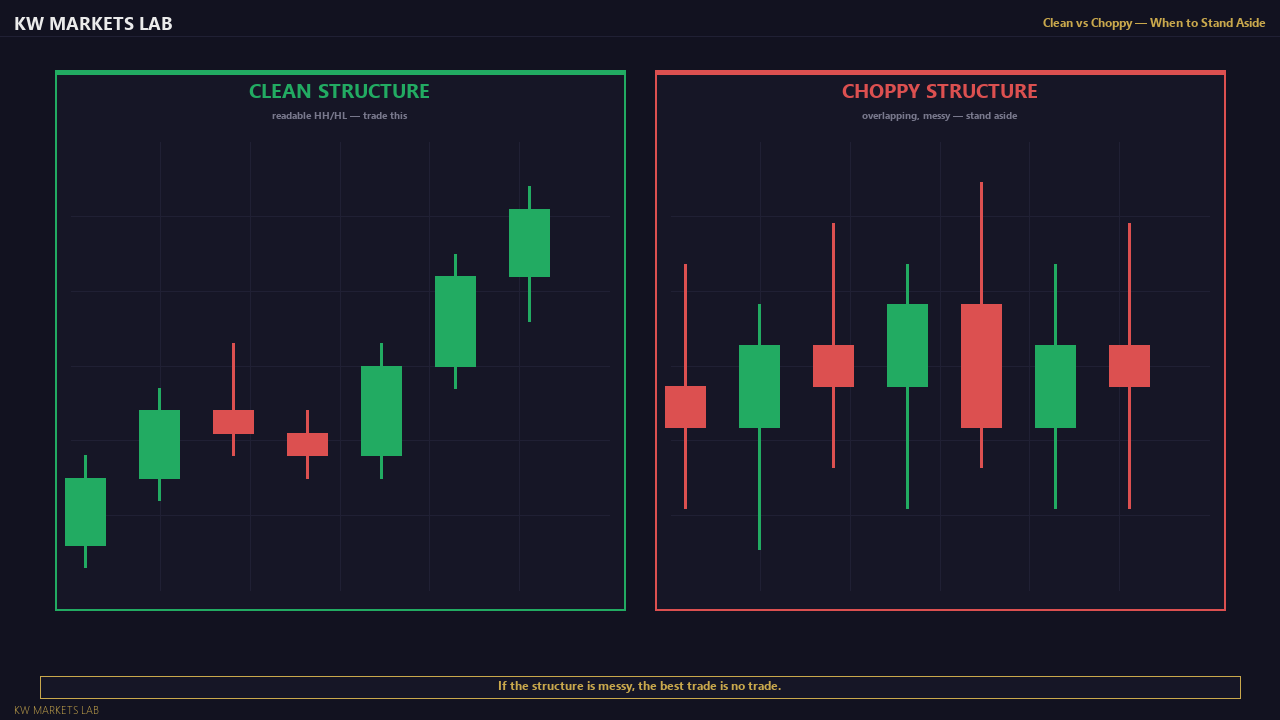
Clean vs Choppy Structure — Chart View
Clean vs Choppy Structure — Chart ViewIf the structure is messy, the best trade is no trade.

Standing aside is a position. It is not passivity — it is the active decision that the current environment does not meet your structural criteria. Traders who can make this decision consistently protect their capital during the periods that cause the most damage: directionless, choppy sessions where setups look valid but have no structural backing.

Continue Learning
L4.3 — Confluence: When Multiple Structural Factors Align →
Stay Updated

Get notified when new lessons and content are published.