Intermediate Market Structure Mastery / Module 2: Internal vs External Structure Lesson 7 of 16
Course Outline — Lesson 7 of 16
M1 Multi-Timeframe Structure Analysis
1 L1.1 — What Market Structure Actually Means 2 L1.2 — Swing Highs, Swing Lows, and How to Mark Them Consistently 3 L1.3 — The Multi-Timeframe Cascade 4 L1.4 — Reading Structure on Higher Timeframes to Filter Lower-Timeframe Noise
M2 Internal vs External Structure
1 L2.1 — External Structure: The Major Swing Points That Define the Trend 2 L2.2 — Internal Structure: Swing Points Within a Trend Leg 3 L2.3 — When Internal Structure Breaks Before External Structure Does
M3 Structure Traps and Liquidity
1 L3.1 — What Is Liquidity and Why Does Price Hunt It? 2 L3.2 — Recognising False Breaks and Stop Hunts at Structure 3 L3.3 — Range Edges and the Liquidity Trap at Equal Highs and Lows
M4 Context and Bias Filtering
1 L4.1 — Building a Daily Directional Bias 2 L4.2 — When to Stand Aside: Markets Not Worth Trading 3 L4.3 — Confluence: When Multiple Structural Factors Align
M5 Advanced BOS and CHOCH
1 L5.1 — Break of Structure vs Change of Character: The Critical Difference 2 L5.2 — Higher-Probability BOS: Quality Filters 3 L5.3 — Structural Analysis in Practice: A Full Worked Example
Lesson 7 of 16

L2.3 — When Internal Structure Breaks Before External Structure Does

One of the most valuable skills in structure analysis is the ability to spot early signs of trend weakness before the major swing points are breached. A break of internal structure in the opposite direction — while external structure is still intact — is a warning signal, not a full reversal confirmation.

For example: in a bullish external leg, if the internal higher highs stop being made and price instead prints a lower internal swing high, momentum has shifted. This is not yet a change of character on the higher timeframe, but it suggests the trend leg is weakening. An experienced analyst uses this as a reason to tighten management on existing longs, not as a signal to reverse.
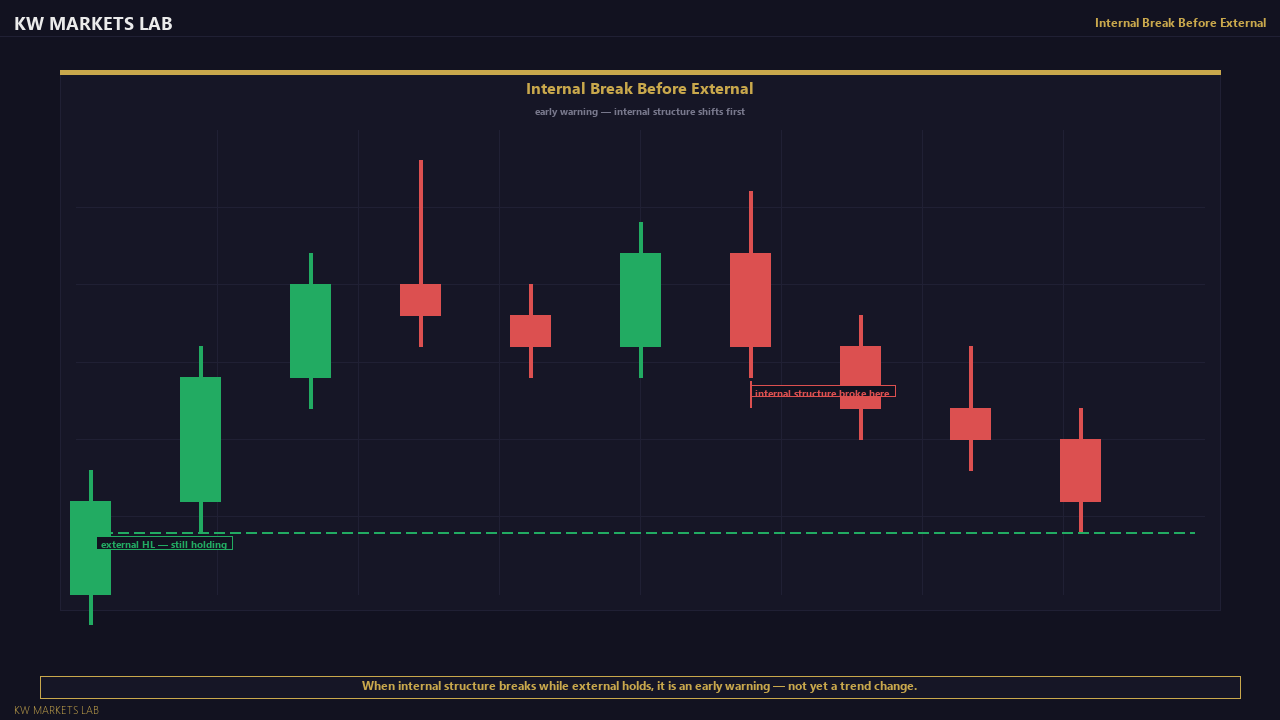
Internal Break Warning Signal — Chart View
Internal Break Warning Signal — Chart ViewWhen internal structure breaks while external holds, it is an early warning — not yet a trend change.

This skill separates reactive traders from anticipatory ones. Reactive traders wait for the external swing to break and then act. Anticipatory traders read the internal structure degradation early, manage accordingly, and are already positioned for the next move by the time the external break confirms.

Continue Learning
L3.1 — What Is Liquidity and Why Does Price Hunt It? →
Stay Updated

Get notified when new lessons and content are published.