Intermediate Market Structure Mastery / Module 4: Context and Bias Filtering Lesson 13 of 16
Course Outline — Lesson 13 of 16
M1 Multi-Timeframe Structure Analysis
1 L1.1 — What Market Structure Actually Means 2 L1.2 — Swing Highs, Swing Lows, and How to Mark Them Consistently 3 L1.3 — The Multi-Timeframe Cascade 4 L1.4 — Reading Structure on Higher Timeframes to Filter Lower-Timeframe Noise
M2 Internal vs External Structure
1 L2.1 — External Structure: The Major Swing Points That Define the Trend 2 L2.2 — Internal Structure: Swing Points Within a Trend Leg 3 L2.3 — When Internal Structure Breaks Before External Structure Does
M3 Structure Traps and Liquidity
1 L3.1 — What Is Liquidity and Why Does Price Hunt It? 2 L3.2 — Recognising False Breaks and Stop Hunts at Structure 3 L3.3 — Range Edges and the Liquidity Trap at Equal Highs and Lows
M4 Context and Bias Filtering
1 L4.1 — Building a Daily Directional Bias 2 L4.2 — When to Stand Aside: Markets Not Worth Trading 3 L4.3 — Confluence: When Multiple Structural Factors Align
M5 Advanced BOS and CHOCH
1 L5.1 — Break of Structure vs Change of Character: The Critical Difference 2 L5.2 — Higher-Probability BOS: Quality Filters 3 L5.3 — Structural Analysis in Practice: A Full Worked Example
Lesson 13 of 16

L4.3 — Confluence: When Multiple Structural Factors Align

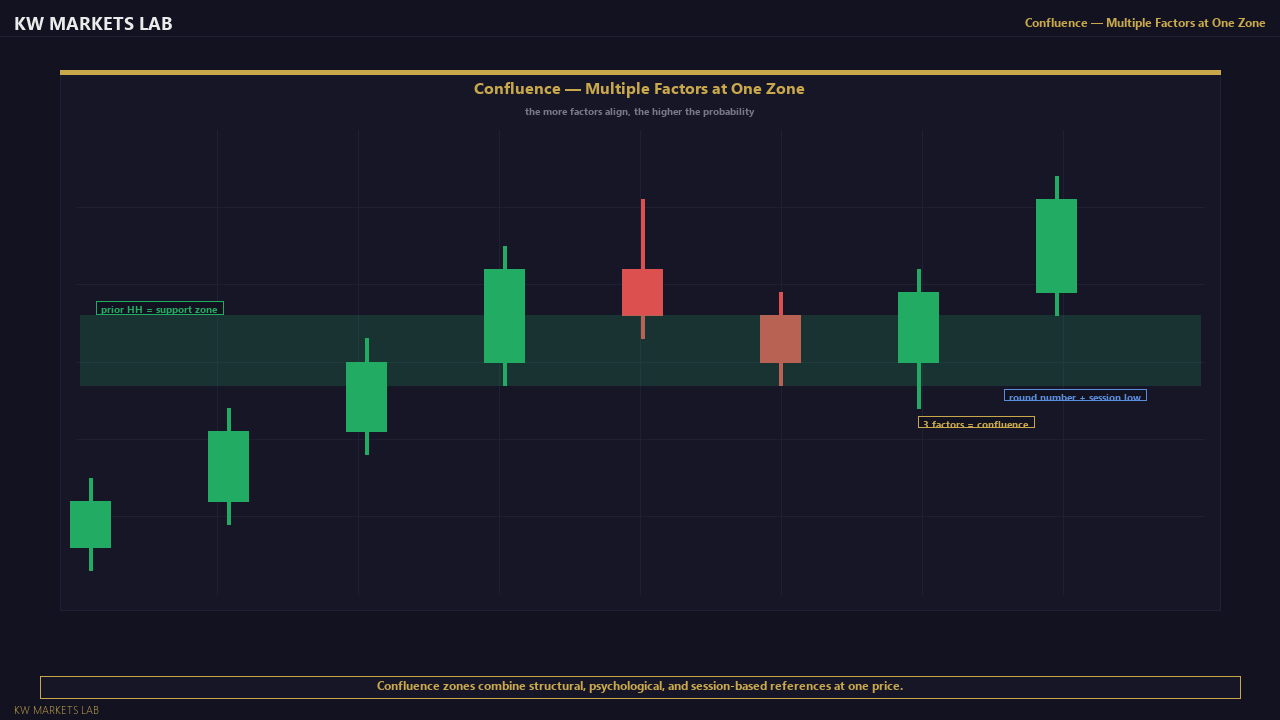
Confluence is the alignment of two or more independent structural factors at the same price area. A level that is both a previous major swing high and a 50% retracement of the last trend leg and is sitting at the daily structural support zone has higher confluence than a level that is only one of those things. Higher confluence does not guarantee a reaction — but it increases the probability that the level is significant enough to produce one.

Structural confluence factors worth tracking: previous swing highs/lows, broken structure levels that have flipped (resistance-turned-support), session highs and lows, weekly/monthly open levels, and round number psychological levels. The more of these that stack at the same zone, the stronger the case for watching that zone carefully.
Confluence Zone — Chart View
Confluence Zone — Chart ViewConfluence zones combine structural, psychological, and session-based references at one price.

The danger of the confluence concept is over-engineering: adding more and more factors until every level looks like a trade. The discipline is to identify two or three clean confluences and stop. A zone with three strong confluences is better than a zone with six weak ones.

Continue Learning
L5.1 — Break of Structure vs Change of Character: The Critical Difference →
Stay Updated

Get notified when new lessons and content are published.