Intermediate Risk Management and Capital Growth / Module 5: Capital Growth Without Overexposure Lesson 16 of 16
Course Outline — Lesson 16 of 16
M1 Position Sizing Mechanics
1 L1.1 — Risk Percentage: The Only Variable You Fully Control 2 L1.2 — Calculating Position Size from Stop Distance 3 L1.3 — Why Consistent Sizing Matters More Than Sizing Big on Good Trades 4 L1.4 — Lot Size Tools and Broker-Specific Calculations
M2 Drawdown Control
1 L2.1 — Understanding Drawdown: Peak-to-Trough Equity Decline 2 L2.2 — Defining Your Maximum Drawdown and Reset Protocol 3 L2.3 — Losing Streaks Are Normal: Surviving Them Without Damage
M3 Risk-to-Reward Reality
1 L3.1 — What Risk-to-Reward Actually Measures 2 L3.2 — Setting Realistic Targets Based on Structure 3 L3.3 — Partial Exits and Trail Stops Without Destroying Expectancy
M4 Expectancy and Survival
1 L4.1 — Expectancy: The Only Number That Predicts Long-Term Performance 2 L4.2 — Tracking Performance: Building a Minimal Expectancy Log 3 L4.3 — When to Stop Trading: Protecting Survival Capital
M5 Capital Growth Without Overexposure
1 L5.1 — Compounding: How Capital Grows With Consistent Edge 2 L5.2 — Scaling Up: When and How to Increase Risk Parameters 3 L5.3 — Building a Multi-Year Capital Plan
Lesson 16 of 16

L5.3 — Building a Multi-Year Capital Plan

A multi-year capital plan translates your measured expectancy and current account size into a realistic projection over 1, 2, and 3 years. It includes: starting equity, monthly trade volume, average R expectancy, risk percentage, maximum drawdown threshold, and projected equity at each milestone. It is not a guarantee — it is a planning tool that sets realistic timelines and prevents both impatience and overextension.

The plan should also include non-trading milestones: the number of live trades needed to prove the edge (50-100), the review cycle (monthly), the conditions for scaling up, and the conditions for stopping to review. A plan that only includes growth projections without these process milestones is optimistic fiction.
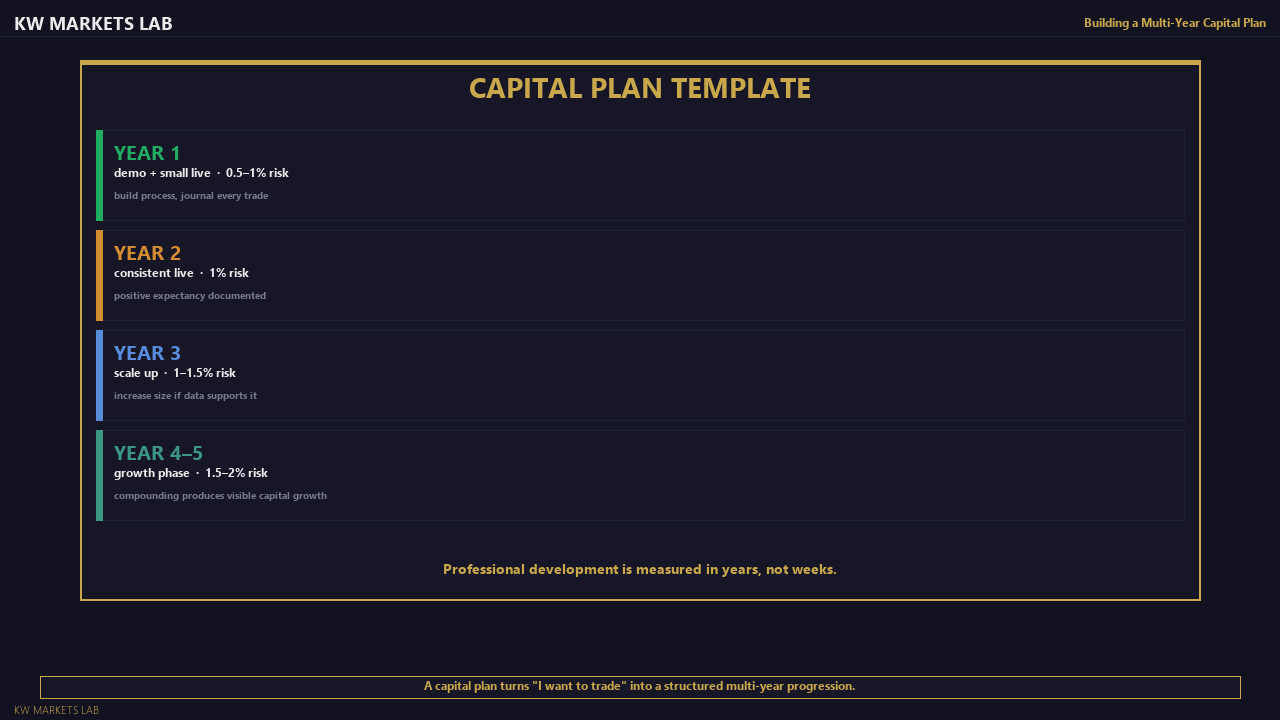
Multi-Year Capital Plan
Multi-Year Capital PlanA capital plan turns ambition into structured multi-year progression.

Review the plan quarterly. Compare actual performance against projection. If you are ahead of plan, resist the temptation to scale faster than the plan specifies. If you are behind plan, diagnose whether the gap is statistical variance or a genuine edge problem before adjusting the plan parameters.

Course Complete — Next in Path
Emotional traps, habit architecture, compliance tracking, an →
Stay Updated

Get notified when new lessons and content are published.