Intermediate Risk Management and Capital Growth / Module 4: Expectancy and Survival Lesson 13 of 16
Course Outline — Lesson 13 of 16
M1 Position Sizing Mechanics
1 L1.1 — Risk Percentage: The Only Variable You Fully Control 2 L1.2 — Calculating Position Size from Stop Distance 3 L1.3 — Why Consistent Sizing Matters More Than Sizing Big on Good Trades 4 L1.4 — Lot Size Tools and Broker-Specific Calculations
M2 Drawdown Control
1 L2.1 — Understanding Drawdown: Peak-to-Trough Equity Decline 2 L2.2 — Defining Your Maximum Drawdown and Reset Protocol 3 L2.3 — Losing Streaks Are Normal: Surviving Them Without Damage
M3 Risk-to-Reward Reality
1 L3.1 — What Risk-to-Reward Actually Measures 2 L3.2 — Setting Realistic Targets Based on Structure 3 L3.3 — Partial Exits and Trail Stops Without Destroying Expectancy
M4 Expectancy and Survival
1 L4.1 — Expectancy: The Only Number That Predicts Long-Term Performance 2 L4.2 — Tracking Performance: Building a Minimal Expectancy Log 3 L4.3 — When to Stop Trading: Protecting Survival Capital
M5 Capital Growth Without Overexposure
1 L5.1 — Compounding: How Capital Grows With Consistent Edge 2 L5.2 — Scaling Up: When and How to Increase Risk Parameters 3 L5.3 — Building a Multi-Year Capital Plan
Lesson 13 of 16

L4.3 — When to Stop Trading: Protecting Survival Capital

Survival capital is the minimum account balance required to continue trading at your standard risk parameters. If your account drops below a level where your standard 1% risk produces a position size smaller than the broker's minimum lot, you have lost the ability to trade your defined risk. At that point, continuing live trading is not developing your edge — it is gambling with degraded parameters.

Define your survival capital threshold in advance. If your account hits that level, the decision is automatic: stop live trading, return to demo or paper trading, rebuild the edge, and return only when the process is proven again. This rule protects the final reserves that make a return to live trading possible.
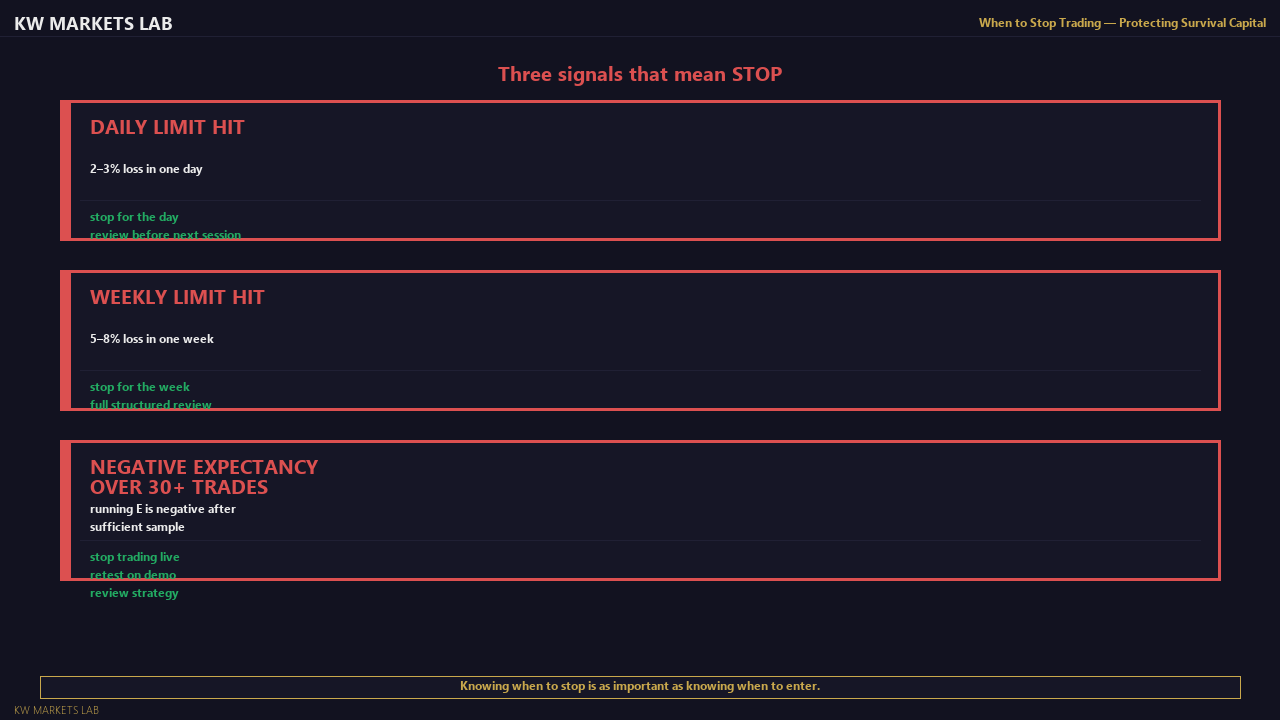
When to Stop Trading
When to Stop TradingKnowing when to stop is as important as knowing when to enter.

The hardest part of this rule is respecting it when your account is near the threshold and you "know" the next trade will recover it. That certainty is the feeling that has destroyed more accounts than any structural analysis error. The rule exists precisely for that moment. Respect it unconditionally.

Continue Learning
L5.1 — Compounding: How Capital Grows With Consistent Edge →
Stay Updated

Get notified when new lessons and content are published.