Intermediate Risk Management and Capital Growth / Module 2: Drawdown Control Lesson 5 of 16
Course Outline — Lesson 5 of 16
M1 Position Sizing Mechanics
1 L1.1 — Risk Percentage: The Only Variable You Fully Control 2 L1.2 — Calculating Position Size from Stop Distance 3 L1.3 — Why Consistent Sizing Matters More Than Sizing Big on Good Trades 4 L1.4 — Lot Size Tools and Broker-Specific Calculations
M2 Drawdown Control
1 L2.1 — Understanding Drawdown: Peak-to-Trough Equity Decline 2 L2.2 — Defining Your Maximum Drawdown and Reset Protocol 3 L2.3 — Losing Streaks Are Normal: Surviving Them Without Damage
M3 Risk-to-Reward Reality
1 L3.1 — What Risk-to-Reward Actually Measures 2 L3.2 — Setting Realistic Targets Based on Structure 3 L3.3 — Partial Exits and Trail Stops Without Destroying Expectancy
M4 Expectancy and Survival
1 L4.1 — Expectancy: The Only Number That Predicts Long-Term Performance 2 L4.2 — Tracking Performance: Building a Minimal Expectancy Log 3 L4.3 — When to Stop Trading: Protecting Survival Capital
M5 Capital Growth Without Overexposure
1 L5.1 — Compounding: How Capital Grows With Consistent Edge 2 L5.2 — Scaling Up: When and How to Increase Risk Parameters 3 L5.3 — Building a Multi-Year Capital Plan
Lesson 5 of 16

L2.1 — Understanding Drawdown: Peak-to-Trough Equity Decline

A drawdown is the percentage decline from the highest equity point to the current equity level. A 10% drawdown means your account is currently 10% below its peak. Drawdown is not just a performance metric — it is a psychological force. A 10% drawdown at consistent 1% risk took approximately 10 consecutive losses to produce. That is a losing streak within the normal statistical range for most strategies.

The mathematics of recovery make drawdown asymmetric and dangerous. A 10% drawdown requires an 11.1% gain to recover. A 20% drawdown requires a 25% gain. A 50% drawdown requires a 100% gain. This is why limiting drawdown is not conservative — it is mathematically essential to long-term capital preservation.
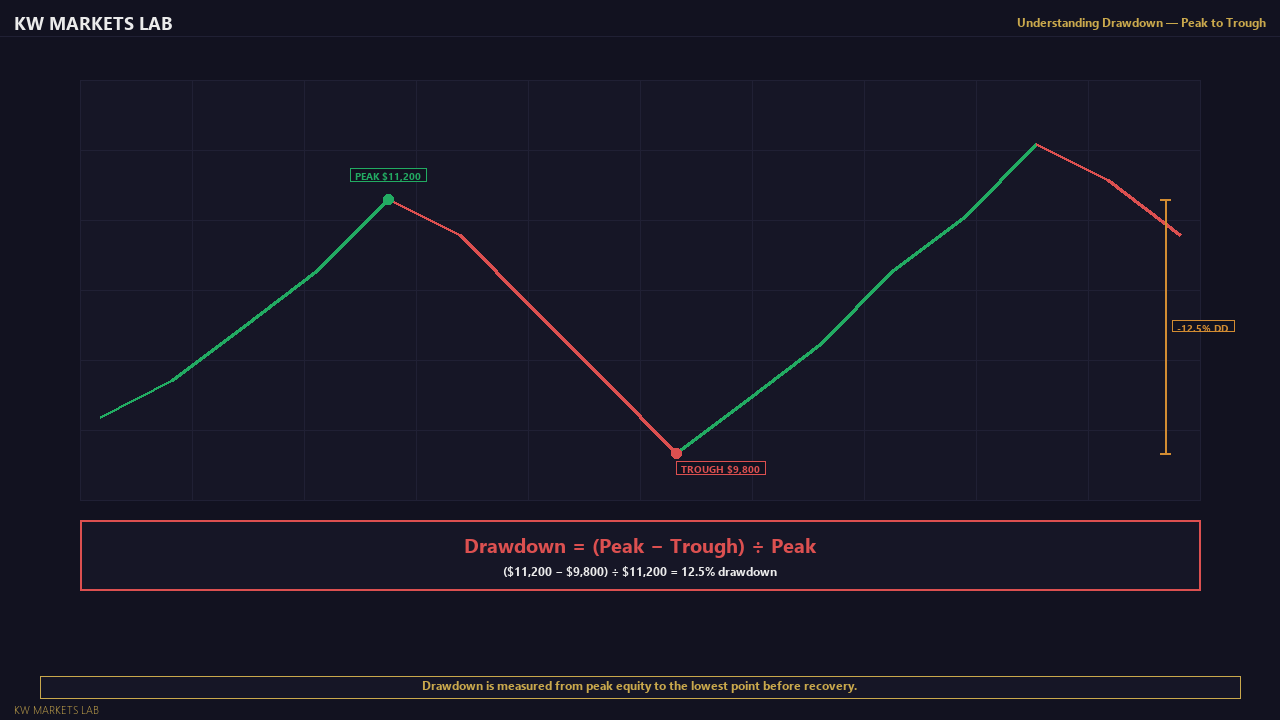
Understanding Drawdown
Understanding DrawdownDrawdown is measured from peak equity to the lowest point.

Every serious trader needs a maximum drawdown threshold: the level at which they stop trading, review everything, and do not return to live trading until the issues are identified. This threshold is not set reactively after a bad streak — it is defined in advance, in writing, before any losing streak occurs.

Continue Learning
L2.2 — Defining Your Maximum Drawdown and Reset Protocol →
Stay Updated

Get notified when new lessons and content are published.