Intermediate Risk Management and Capital Growth / Module 5: Capital Growth Without Overexposure Lesson 14 of 16
Course Outline — Lesson 14 of 16
M1 Position Sizing Mechanics
1 L1.1 — Risk Percentage: The Only Variable You Fully Control 2 L1.2 — Calculating Position Size from Stop Distance 3 L1.3 — Why Consistent Sizing Matters More Than Sizing Big on Good Trades 4 L1.4 — Lot Size Tools and Broker-Specific Calculations
M2 Drawdown Control
1 L2.1 — Understanding Drawdown: Peak-to-Trough Equity Decline 2 L2.2 — Defining Your Maximum Drawdown and Reset Protocol 3 L2.3 — Losing Streaks Are Normal: Surviving Them Without Damage
M3 Risk-to-Reward Reality
1 L3.1 — What Risk-to-Reward Actually Measures 2 L3.2 — Setting Realistic Targets Based on Structure 3 L3.3 — Partial Exits and Trail Stops Without Destroying Expectancy
M4 Expectancy and Survival
1 L4.1 — Expectancy: The Only Number That Predicts Long-Term Performance 2 L4.2 — Tracking Performance: Building a Minimal Expectancy Log 3 L4.3 — When to Stop Trading: Protecting Survival Capital
M5 Capital Growth Without Overexposure
1 L5.1 — Compounding: How Capital Grows With Consistent Edge 2 L5.2 — Scaling Up: When and How to Increase Risk Parameters 3 L5.3 — Building a Multi-Year Capital Plan
Lesson 14 of 16

L5.1 — Compounding: How Capital Grows With Consistent Edge

Compounding is the process by which profits are reinvested, producing growth on a growing base. At 1% fixed-percentage risk with a positive expectancy of 0.5R per trade, across 100 trades, the account grows non-linearly because each win is calculated on a slightly larger equity base. This is the legitimate mechanism for capital growth in trading — not leverage, not large individual bets.

The requirement for compounding to work: the edge must be real and consistent across a sufficiently large sample. Compounding a strategy with no proven edge compounds the losses just as efficiently as it would compound gains. This is why the foundation — consistent sizing, drawdown control, expectancy measurement — must be established before compounding becomes the focus.
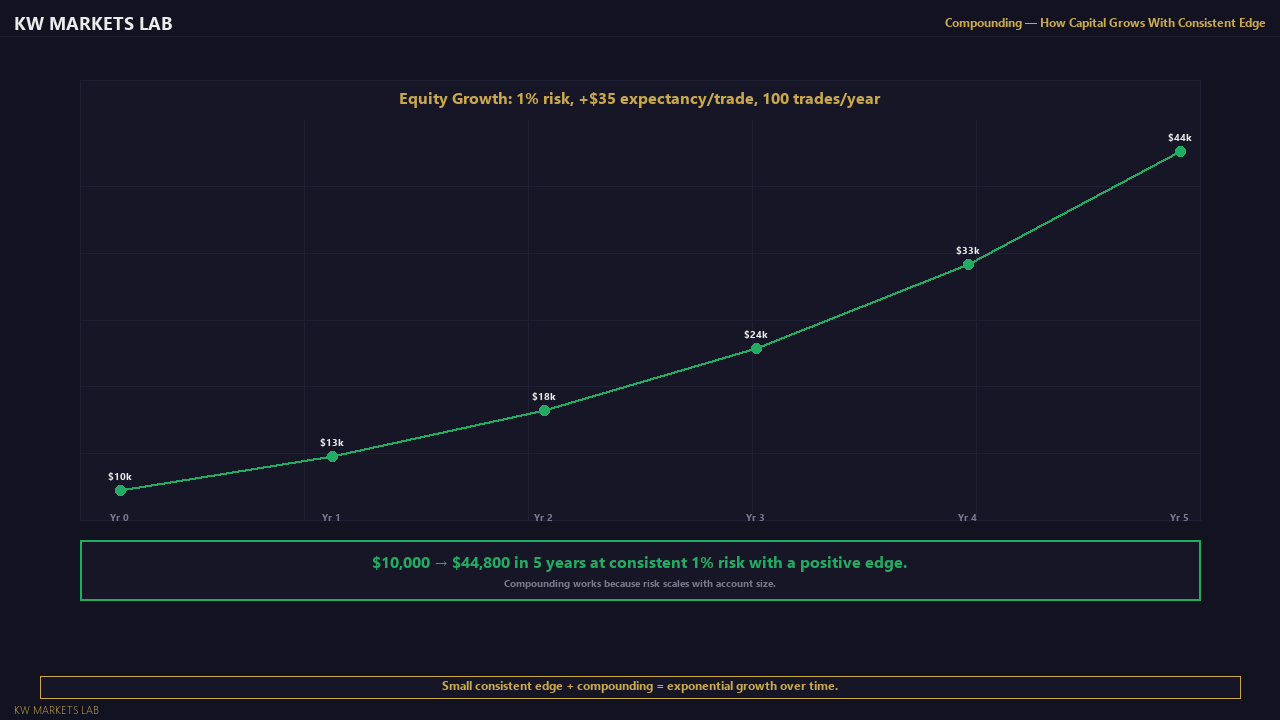
Compounding Growth Curve
Compounding Growth CurveSmall consistent edge + compounding = exponential growth.

Use a compounding calculator to model realistic growth scenarios based on your actual (not hoped-for) expectancy. A 50% win rate, 1:2 R:R strategy at 1% risk over 200 trades produces approximately 65% growth. That is compelling without being unbelievable. Set realistic expectations based on real numbers, not best-case projections.

Continue Learning
L5.2 — Scaling Up: When and How to Increase Risk Parameters →
Stay Updated

Get notified when new lessons and content are published.