Intermediate Risk Management and Capital Growth / Module 2: Drawdown Control Lesson 7 of 16
Course Outline — Lesson 7 of 16
M1 Position Sizing Mechanics
1 L1.1 — Risk Percentage: The Only Variable You Fully Control 2 L1.2 — Calculating Position Size from Stop Distance 3 L1.3 — Why Consistent Sizing Matters More Than Sizing Big on Good Trades 4 L1.4 — Lot Size Tools and Broker-Specific Calculations
M2 Drawdown Control
1 L2.1 — Understanding Drawdown: Peak-to-Trough Equity Decline 2 L2.2 — Defining Your Maximum Drawdown and Reset Protocol 3 L2.3 — Losing Streaks Are Normal: Surviving Them Without Damage
M3 Risk-to-Reward Reality
1 L3.1 — What Risk-to-Reward Actually Measures 2 L3.2 — Setting Realistic Targets Based on Structure 3 L3.3 — Partial Exits and Trail Stops Without Destroying Expectancy
M4 Expectancy and Survival
1 L4.1 — Expectancy: The Only Number That Predicts Long-Term Performance 2 L4.2 — Tracking Performance: Building a Minimal Expectancy Log 3 L4.3 — When to Stop Trading: Protecting Survival Capital
M5 Capital Growth Without Overexposure
1 L5.1 — Compounding: How Capital Grows With Consistent Edge 2 L5.2 — Scaling Up: When and How to Increase Risk Parameters 3 L5.3 — Building a Multi-Year Capital Plan
Lesson 7 of 16

L2.3 — Losing Streaks Are Normal: Surviving Them Without Damage

A trader with a 50% win rate trading 1:2 risk-to-reward will, over a large sample, have periods of 6-8 consecutive losses. This is not a sign that the edge is broken — it is a statistical certainty. The question is not whether losing streaks happen, but whether you are capitalised and psychologically prepared to survive them.

The worst response to a losing streak is to increase position size to recover losses faster. This approach, sometimes called "revenge trading," compounds the drawdown by betting more at the exact moment when your edge may be temporarily underperforming. A losing streak requires the opposite response: maintain or reduce sizing, increase selectivity, and let the statistical variance work itself out.
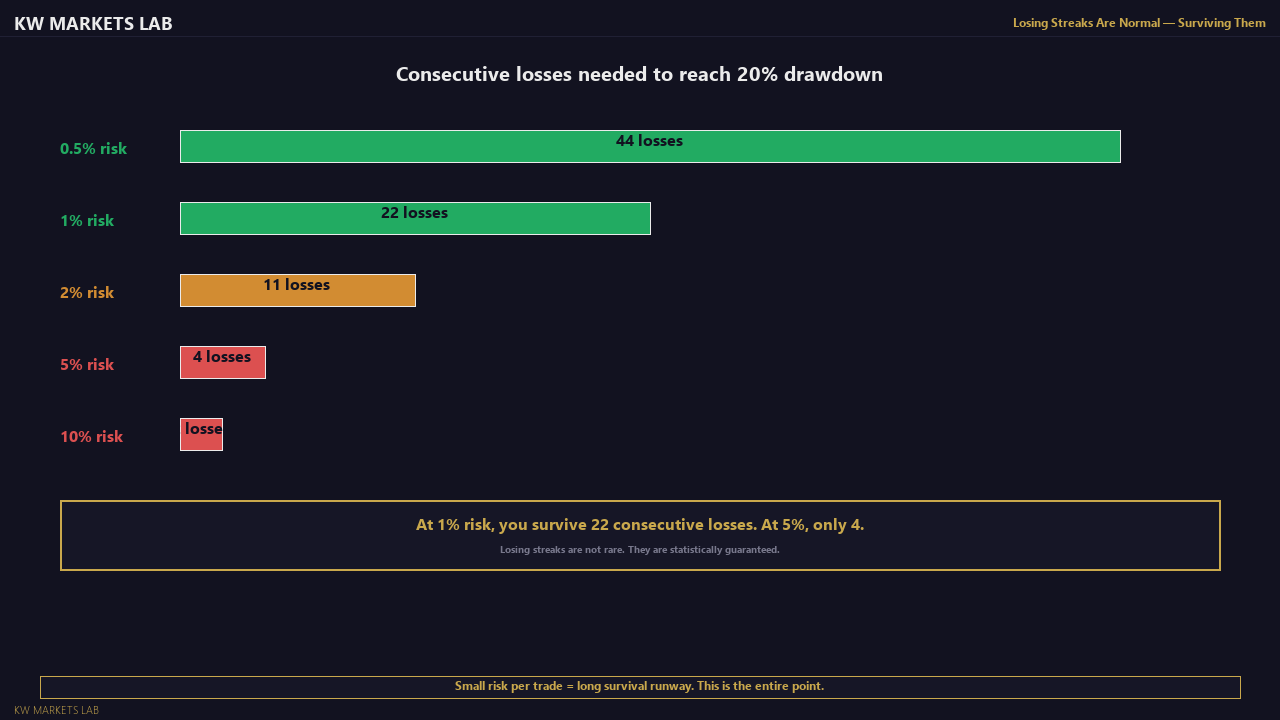
Losing Streaks: Survival Runway
Losing Streaks: Survival RunwaySmall risk per trade = long survival runway.

Simulate losing streaks on paper before you encounter them live. Take your current strategy, assume an 8-trade losing streak, and calculate the equity impact at your current risk percentage. If the number is painful but survivable, you are sized correctly. If the number is devastating, you are oversized regardless of what your confidence level in the strategy is.

Continue Learning
L3.1 — What Risk-to-Reward Actually Measures →
Stay Updated

Get notified when new lessons and content are published.