Intermediate Risk Management and Capital Growth / Module 3: Risk-to-Reward Reality Lesson 8 of 16
Course Outline — Lesson 8 of 16
M1 Position Sizing Mechanics
1 L1.1 — Risk Percentage: The Only Variable You Fully Control 2 L1.2 — Calculating Position Size from Stop Distance 3 L1.3 — Why Consistent Sizing Matters More Than Sizing Big on Good Trades 4 L1.4 — Lot Size Tools and Broker-Specific Calculations
M2 Drawdown Control
1 L2.1 — Understanding Drawdown: Peak-to-Trough Equity Decline 2 L2.2 — Defining Your Maximum Drawdown and Reset Protocol 3 L2.3 — Losing Streaks Are Normal: Surviving Them Without Damage
M3 Risk-to-Reward Reality
1 L3.1 — What Risk-to-Reward Actually Measures 2 L3.2 — Setting Realistic Targets Based on Structure 3 L3.3 — Partial Exits and Trail Stops Without Destroying Expectancy
M4 Expectancy and Survival
1 L4.1 — Expectancy: The Only Number That Predicts Long-Term Performance 2 L4.2 — Tracking Performance: Building a Minimal Expectancy Log 3 L4.3 — When to Stop Trading: Protecting Survival Capital
M5 Capital Growth Without Overexposure
1 L5.1 — Compounding: How Capital Grows With Consistent Edge 2 L5.2 — Scaling Up: When and How to Increase Risk Parameters 3 L5.3 — Building a Multi-Year Capital Plan
Lesson 8 of 16

L3.1 — What Risk-to-Reward Actually Measures

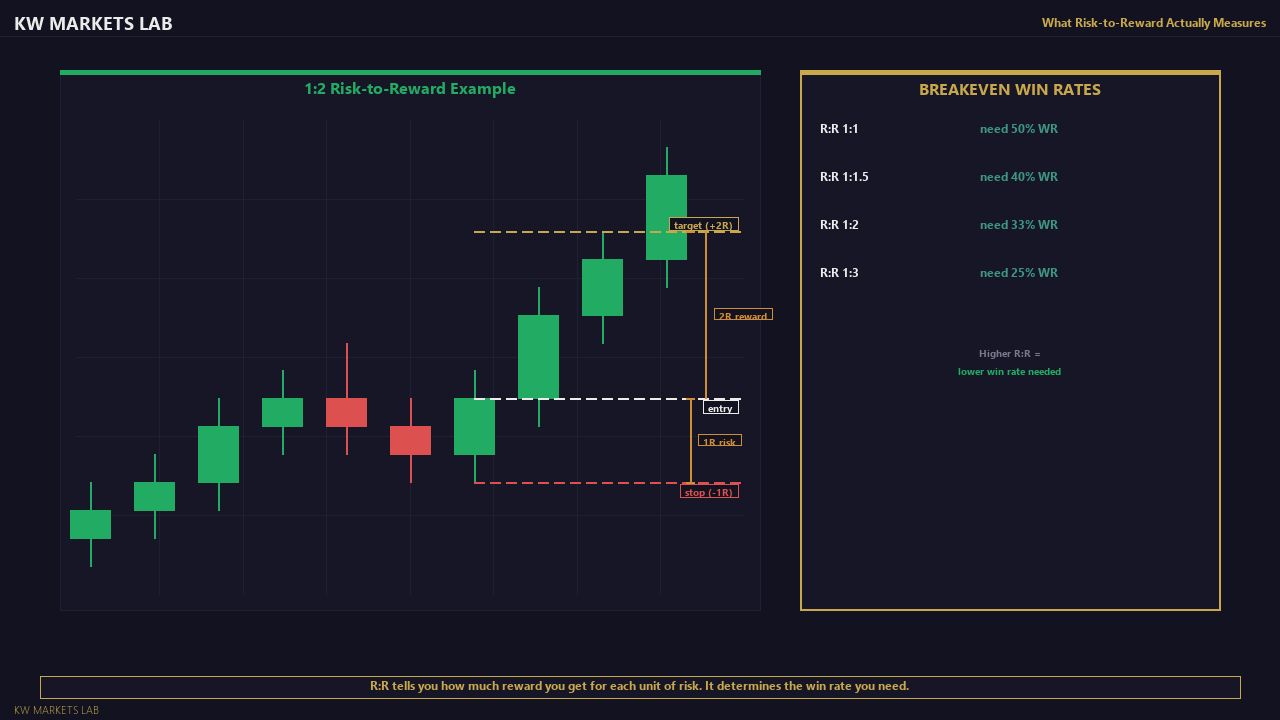
Risk-to-reward (R:R) is the ratio of the potential loss on a trade (risk) to the potential gain (reward). A trade with a 20-pip stop and a 40-pip target is 1:2 R:R. A trade with a 20-pip stop and a 20-pip target is 1:1. The R:R ratio determines how often you need to win to be profitable at breakeven — and how much profitability you generate above breakeven per winning trade.

At 1:1 R:R, you need a >50% win rate to be profitable. At 1:2, you need only >33%. At 1:3, you need only >25%. The higher the R:R, the lower the win rate required to be profitable. This is why traders who consistently achieve 1:2 or better can be profitable with win rates that feel psychologically discouraging.
What R:R Actually Measures
What R:R Actually MeasuresR:R determines the win rate you need to break even.

The error is treating R:R as the only metric. A 1:3 target that is never hit because it sits beyond a major structural resistance zone is not a 1:3 trade — it is a trade where the realistic exit is 1:1 and the 1:3 number is wishful thinking. R:R must be measured against realistic, structurally supported targets.

Continue Learning
L3.2 — Setting Realistic Targets Based on Structure →
Stay Updated

Get notified when new lessons and content are published.