Intermediate Risk Management and Capital Growth / Module 1: Position Sizing Mechanics Lesson 4 of 16
Course Outline — Lesson 4 of 16
M1 Position Sizing Mechanics
1 L1.1 — Risk Percentage: The Only Variable You Fully Control 2 L1.2 — Calculating Position Size from Stop Distance 3 L1.3 — Why Consistent Sizing Matters More Than Sizing Big on Good Trades 4 L1.4 — Lot Size Tools and Broker-Specific Calculations
M2 Drawdown Control
1 L2.1 — Understanding Drawdown: Peak-to-Trough Equity Decline 2 L2.2 — Defining Your Maximum Drawdown and Reset Protocol 3 L2.3 — Losing Streaks Are Normal: Surviving Them Without Damage
M3 Risk-to-Reward Reality
1 L3.1 — What Risk-to-Reward Actually Measures 2 L3.2 — Setting Realistic Targets Based on Structure 3 L3.3 — Partial Exits and Trail Stops Without Destroying Expectancy
M4 Expectancy and Survival
1 L4.1 — Expectancy: The Only Number That Predicts Long-Term Performance 2 L4.2 — Tracking Performance: Building a Minimal Expectancy Log 3 L4.3 — When to Stop Trading: Protecting Survival Capital
M5 Capital Growth Without Overexposure
1 L5.1 — Compounding: How Capital Grows With Consistent Edge 2 L5.2 — Scaling Up: When and How to Increase Risk Parameters 3 L5.3 — Building a Multi-Year Capital Plan
Lesson 4 of 16

L1.4 — Lot Size Tools and Broker-Specific Calculations

Pip value varies by instrument, lot size, and account currency. On EURUSD with a USD account, one standard lot = $10 per pip. On XAUUSD, one standard lot = $100 per dollar move ($1 per pip if pips are the smallest increment). On GBPJPY with a USD account, the pip value depends on the current USDJPY rate. Calculating this manually every trade is error-prone. Use a position sizing calculator or build the formula into your pre-trade process.

Most trading platforms include a position size calculator or have a formula available. MetaTrader 4 and 5 display the pip value per lot in the contract specification. Verify the pip value for each instrument you trade at least once per quarter — it can shift as exchange rates change.
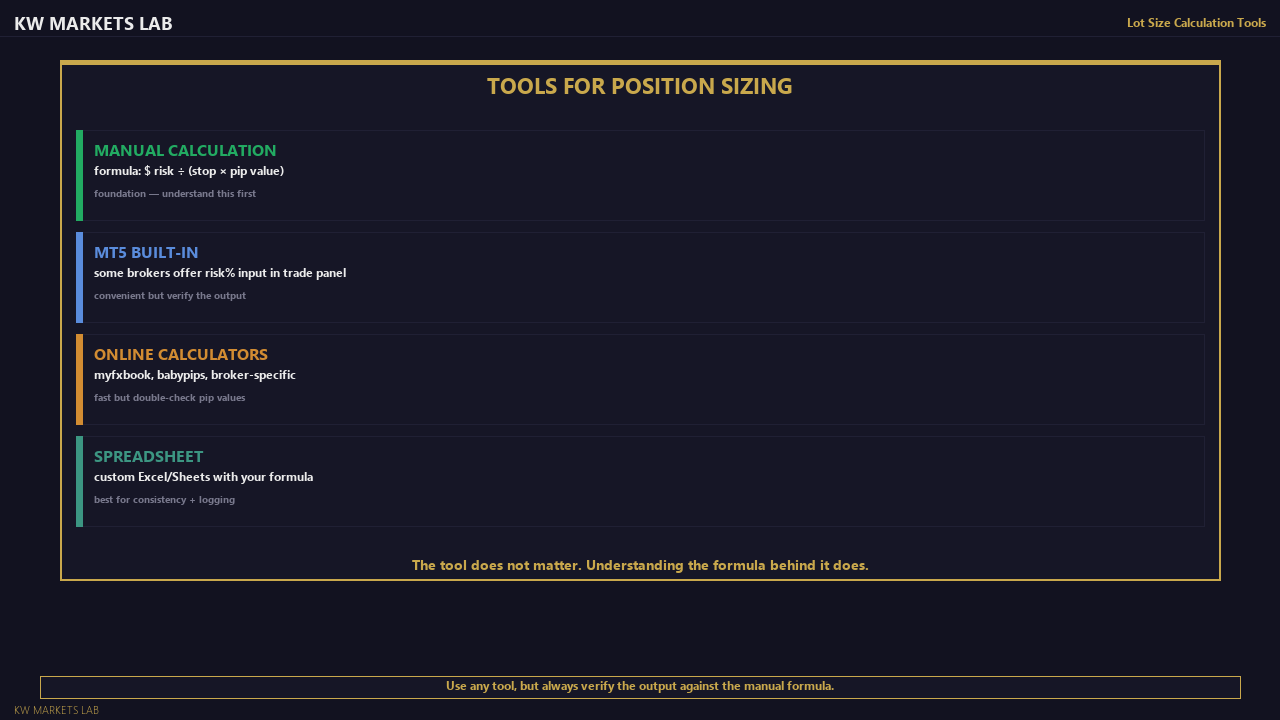
Lot Size Calculation Tools
Lot Size Calculation ToolsUse any tool, but understand the formula behind it.

The goal is to remove calculation friction from the execution process. If calculating position size takes more than 30 seconds, you will skip it under pressure. Automate or template the calculation so it is a mechanical 10-second step, not a cognitive burden that gets skipped when you are eager to enter.

Continue Learning
L2.1 — Understanding Drawdown: Peak-to-Trough Equity Decline →
Stay Updated

Get notified when new lessons and content are published.