Intermediate Risk Management and Capital Growth / Module 4: Expectancy and Survival Lesson 11 of 16
Course Outline — Lesson 11 of 16
M1 Position Sizing Mechanics
1 L1.1 — Risk Percentage: The Only Variable You Fully Control 2 L1.2 — Calculating Position Size from Stop Distance 3 L1.3 — Why Consistent Sizing Matters More Than Sizing Big on Good Trades 4 L1.4 — Lot Size Tools and Broker-Specific Calculations
M2 Drawdown Control
1 L2.1 — Understanding Drawdown: Peak-to-Trough Equity Decline 2 L2.2 — Defining Your Maximum Drawdown and Reset Protocol 3 L2.3 — Losing Streaks Are Normal: Surviving Them Without Damage
M3 Risk-to-Reward Reality
1 L3.1 — What Risk-to-Reward Actually Measures 2 L3.2 — Setting Realistic Targets Based on Structure 3 L3.3 — Partial Exits and Trail Stops Without Destroying Expectancy
M4 Expectancy and Survival
1 L4.1 — Expectancy: The Only Number That Predicts Long-Term Performance 2 L4.2 — Tracking Performance: Building a Minimal Expectancy Log 3 L4.3 — When to Stop Trading: Protecting Survival Capital
M5 Capital Growth Without Overexposure
1 L5.1 — Compounding: How Capital Grows With Consistent Edge 2 L5.2 — Scaling Up: When and How to Increase Risk Parameters 3 L5.3 — Building a Multi-Year Capital Plan
Lesson 11 of 16

L4.1 — Expectancy: The Only Number That Predicts Long-Term Performance

Expectancy is the average amount you expect to win or lose per unit risked across a large sample of trades. The formula: (Win Rate x Average Win Size) - (Loss Rate x Average Loss Size). A positive expectancy means the strategy produces profit over time. A negative expectancy means it loses over time, regardless of individual winning trades.

Example: 50% win rate, average win 2R, average loss 1R. Expectancy = (0.5 x 2) - (0.5 x 1) = 0.5R per trade. Over 100 trades risking 1% each, this produces approximately 50% cumulative return assuming no compounding. This is the number you are building toward — not the individual trade result.
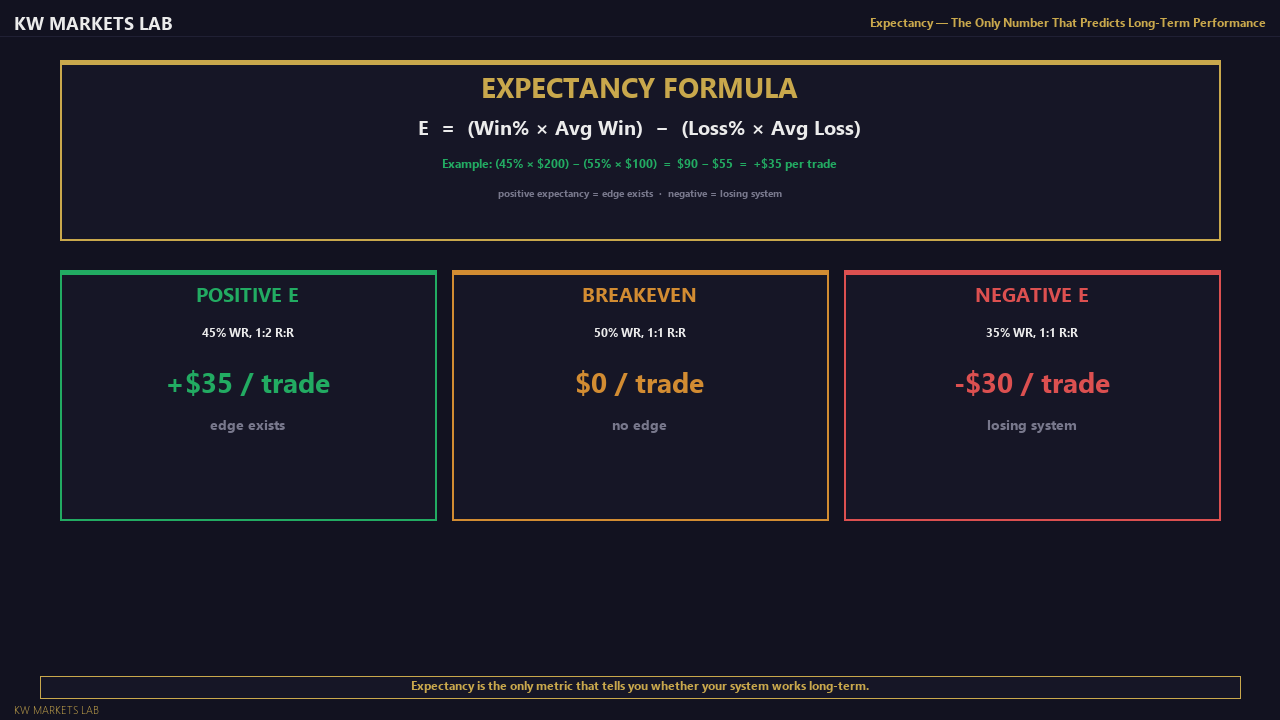
Expectancy Formula
Expectancy FormulaExpectancy is the only metric that predicts long-term performance.

You cannot know your expectancy from 10 trades. You need a minimum of 50, and 100 is more reliable. Until you have that sample, you do not know whether you have a positive expectancy strategy. This is why capital preservation during the learning phase is essential — you need to survive long enough to accumulate the sample that tells you whether your edge is real.

Continue Learning
L4.2 — Tracking Performance: Building a Minimal Expectancy Log →
Stay Updated

Get notified when new lessons and content are published.