Intermediate Risk Management and Capital Growth / Module 1: Position Sizing Mechanics Lesson 3 of 16
Course Outline — Lesson 3 of 16
M1 Position Sizing Mechanics
1 L1.1 — Risk Percentage: The Only Variable You Fully Control 2 L1.2 — Calculating Position Size from Stop Distance 3 L1.3 — Why Consistent Sizing Matters More Than Sizing Big on Good Trades 4 L1.4 — Lot Size Tools and Broker-Specific Calculations
M2 Drawdown Control
1 L2.1 — Understanding Drawdown: Peak-to-Trough Equity Decline 2 L2.2 — Defining Your Maximum Drawdown and Reset Protocol 3 L2.3 — Losing Streaks Are Normal: Surviving Them Without Damage
M3 Risk-to-Reward Reality
1 L3.1 — What Risk-to-Reward Actually Measures 2 L3.2 — Setting Realistic Targets Based on Structure 3 L3.3 — Partial Exits and Trail Stops Without Destroying Expectancy
M4 Expectancy and Survival
1 L4.1 — Expectancy: The Only Number That Predicts Long-Term Performance 2 L4.2 — Tracking Performance: Building a Minimal Expectancy Log 3 L4.3 — When to Stop Trading: Protecting Survival Capital
M5 Capital Growth Without Overexposure
1 L5.1 — Compounding: How Capital Grows With Consistent Edge 2 L5.2 — Scaling Up: When and How to Increase Risk Parameters 3 L5.3 — Building a Multi-Year Capital Plan
Lesson 3 of 16

L1.3 — Why Consistent Sizing Matters More Than Sizing Big on Good Trades

The intuition that "bigger risk on better setups" makes sense is correct in theory but unworkable in practice. The problem is that your pre-trade quality assessment is based on incomplete information. The setup you grade as A+ and risk 5% on may lose. The setup you grade as B and risk 1% on may produce a 4R return. Over a large sample, variable sizing based on perceived quality produces high variance in outcomes — not consistently better performance.

Consistent fixed-percentage sizing produces a different result: your account equity curve reflects your edge — your actual win rate and risk-to-reward ratio — rather than your sizing decisions. If your performance is inconsistent with consistent sizing, the problem is your edge, not your sizing. If you add variable sizing to an inconsistent edge, you amplify the inconsistency.
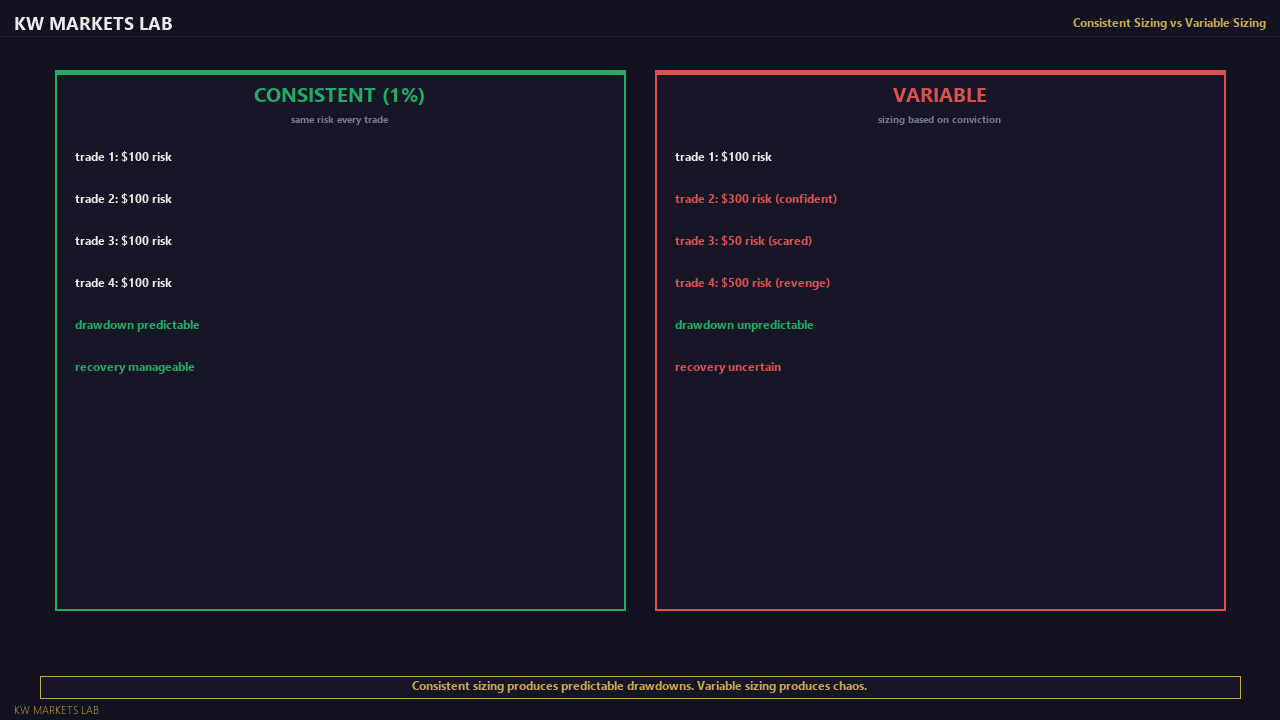
Consistent vs Variable Sizing
Consistent vs Variable SizingConsistent sizing produces predictable drawdowns.

Build the sizing discipline first. Once your fixed-percentage edge is proven across 100+ trades with detailed records, you can explore modest variation — for example 0.75% on B-grade setups and 1.25% on A-grade. But the baseline of consistent sizing must be established first.

Continue Learning
L1.4 — Lot Size Tools and Broker-Specific Calculations →
Stay Updated

Get notified when new lessons and content are published.